DeepSeek Harness: Taking AI Testing from Standalone Tools to a Team Platform

DeepSeek Harness drives AI testing from a personal assistant toward a team platform via server-side operation and a plugin mechanism.
Based on a Bilibili livestream, this article discusses AI testing tools evolving from a "personal assistant" to a "team platform." Tools like Codex and Claude Code are installed locally, causing inconsistent AI capabilities and output quality during team rollouts. DeepSeek Harness runs as a web service with a shared instance and customizes interfaces through plugins, embedding modules like test case management and device centers. The instructor recommends a decoupled architecture and notes that platformization lowers the barrier but may widen capability stratification among testing roles.
AI testing tools are everywhere, but results tend to vary widely when teams collaborate. In a Bilibili livestream, the instructor used DeepSeek Harness as an example to explore the trend of AI testing evolving from a "personal assistant" to a "team platform," and pointed out that its plugin mechanism and server-side operation model could bring structural changes to test development.
From Standalone Tools to Shared Services: The Collaboration Dilemma of AI Testing
The vast majority of AI coding tools—whether Codex, Claude Code, or WorkBuddyAd—are installed by default on personal computers, with chat histories, rule files, and skill configurations stored locally. This has a direct consequence: switch to another computer, and the AI "loses its memory"; when rolling out across a team, everyone ends up with different AI capabilities.
The livestream gave a typical scenario: a company uniformly promotes AI-generated test cases, but some people's skill versions on their computers aren't updated, others have configuration problems, and the final output quality varies. According to Bilibili creator "华策教育三方老师," such tools are essentially "oriented toward personal assistants," while enterprise testing work is precisely a team-collaboration format—the two are naturally misaligned.

"Skills" in AI coding tools usually refer to reusable capability units that encapsulate task-specific instructions, prompt templates, and accompanying scripts—for example, "generate test cases that comply with company standards" or "output defect reports in a fixed format." Such skills are generally stored as Markdown or configuration files in local directories and loaded by the tool during conversation. Due to the lack of unified distribution and version management mechanisms, team members each maintain their own copies; once someone fails to sync updates, the AI's output standards drift from the team's conventions—this is precisely the technical root of the "varying output quality" mentioned in the article.
The Core Differences of DeepSeek Harness: Server-Side + Pluginization
The key design of DeepSeekAd Harness (also called DeepSync Harness in the livestream) lies in two points: running as a web service, and a plugin-based extension mechanism. The former means everyone shares a single service instance, with models, skills, and memory uniformly maintained on the server; the latter means the interface, features, and integration capabilities can all be customized as needed.
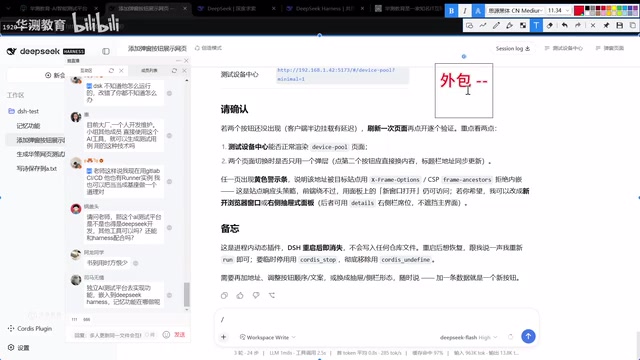
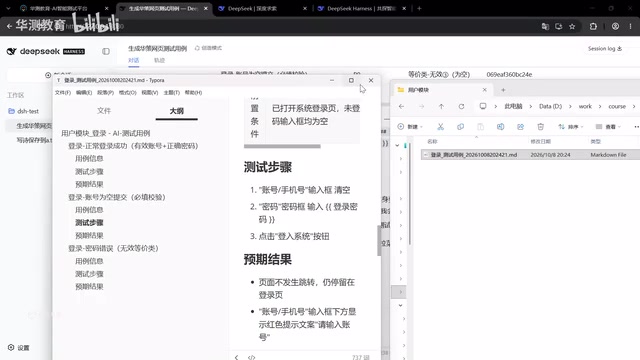
This stands in sharp contrast to traditional AI tools. In the livestream, the instructor demonstrated integrating modules such as a test case management interface and a device center into Harness through the plugin mechanism—after generating test cases, you can view and edit them in a structured way directly in the customized interface, rather than facing a pile of Markdown or Excel files.
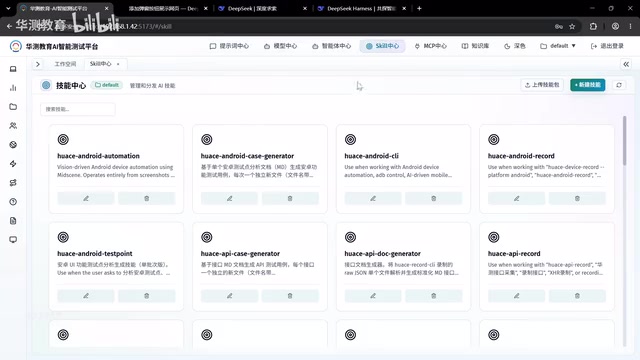
The livestream also showed the official documentation's positioning of "everything is a plugin," and had the AI implement a simple memory mechanism on the spot, writing rules into the engine.md file. Such extensions cannot be done by default on tools like Codex, because the latter do not provide the same level of interface and architectural extension points.
A plugin architecture means the host program dynamically loads external modules at startup or runtime; the host exposes a registration interface through which plugins mount new interface routes, commands, data sources, or tool functions. Unlike "configuration-based extension," plugins can introduce entirely new code and pages, so independent systems such as test case management and device centers can be embedded as native interfaces. The cost is that plugins depend on the APIs exposed by the host; if a major host upgrade changes the interface contract, plugins must be adapted accordingly.
From a Test Development Perspective: Platform Thinking Matters More Than the Tool Itself
The livestream repeatedly emphasized one point: a stronger tool does not mean your work gets stronger; the key is whether you can identify inefficient steps in the testing process and solve them with engineering means. AI-generated test case documents have poor readability and low review efficiency—this is the source of demand for test development: build visual interfaces, mind-map views, and device management panels, then integrate them into Harness.
The instructor recommended a "decoupled" architecture: test features become an independent system that connects to Harness through a server-side workspace, rather than stacking complex features directly inside Harness. The reason is practical—Harness is still iterating rapidly, and deep coupling may cause plugins to fail during upgrades.
This approach also explains the logic of big-tech testing platforms: a small number of people maintain the platform and skills, while most people only need to know how to operate a browser. The livestream mentioned that this model lowers the barrier to using AI testing, but may at the same time widen the capability stratification among testing roles—the value gap between platform maintainers and platform users will become more obvious.
"Decoupling" in software architecture refers to reducing direct dependencies between modules so that a change in one does not cascade to another. Here it means test features form their own independent service and communicate with Harness only through a server-side workspace (predefined interfaces and data formats), rather than writing business logic into Harness's plugin code. In this way, when Harness is upgraded, as long as the interface conventions remain unchanged, the independent system needs no changes; conversely, if features are deeply coupled into the host's internals, a host refactor could render the plugins entirely unusable.
A Calm View: Benchmark Significance Outweighs Being the Only Answer
The instructor also acknowledged in the livestream that DeepSeek Harness is not the only choice, and its significance lies in "setting a feasibility benchmark" for the industry. Bases such as GitLab Runner, due to limited extension capabilities, are not suitable for directly taking on this role. For testing teams, a more pragmatic approach is to understand its design ideas around server-side operation and plugin extension, then decide—based on their own tech stack—whether to build their own platform or integrate on top of Harness.
A note: this livestream had a course-promotion nature, and some comparative conclusions came from a single-source demo environment; actual enterprise implementation results still need to be comprehensively evaluated in light of team size, operations capabilities, and security requirements.
One-line Summary
DeepSeek Harness, with its server-side operation and plugin mechanism, drives AI testing from a personal assistant toward a team platform.
Paragraph Summary
Based on a Bilibili livestream, the article discusses the trend of AI testing tools evolving from a "personal assistant" to a "team platform." Tools like Codex and Claude Code are installed by default on personal computers, with configurations and skills stored locally, leading to inconsistent AI capabilities and varying output quality during team rollouts. The key difference of DeepSeek Harness is that it runs as a web service, with everyone sharing an instance, and customizes interfaces and feature integration through a plugin mechanism, allowing modules such as test case management and device centers to be embedded. The instructor emphasizes that the value of test development lies in identifying inefficient process points and solving them with engineering means, and recommends a decoupled architecture where test features form an independent system connected through a server-side workspace to avoid deep coupling. Platformization lowers the usage barrier but may also widen the capability stratification among testing roles.
Related articles
Salesforce Acquires Rune for $375M: AI Logistics Tech Bolsters Defense Business
Salesforce reportedly acquires defense tech startup Rune for $375M. Rune's AI logistics tech will strengthen Salesforce's Missionforce defense platform, continuing its M&A spree.

Why Fair Use Benefits Everyone in the AI Era
Starting from a Hacker News discussion, this article analyzes the legal logic and controversies of the fair use principle in AI training and content creation, and its dual impact on creators and the tech ecosystem.

Mistral Large 4 Open-Sources a Trillion Parameters, Microsoft Offers Voluntary Severance to 60,000 Employees
Mistral Large 4 open-sources a trillion-parameter multimodal model with a coding agent score of 48; SanDisk earnings show AI inference reshaping NAND demand; Google Gemini adds in-app file editing, OpenAI raises Codex quotas, and Microsoft offers voluntary severance to 60,000 employees.