DeepSeek Open-Sources SuperAgent: AI Watches Your Repo and Replies with PRs
DeepSeek SuperAgent hits 19,000 stars in two days, focusing on repo automation with PR delivery.
The article introduces GitHub trending project DeepSeek SuperAgent, which gained 19,000 new stars just two days after launch. Rather than a general-purpose conversational assistant, it focuses on a single code repository: when a developer assigns it a task, it automatically creates an independent workspace to execute it and delivers the result as a Pull Request, making changes reviewable, rollback-able, and non-polluting to the main branch. Its core design principle is "occupy as little of people's attention as possible," avoiding frequent confirmation pop-ups and only notifying when a PR is produced. Positioned as a research prototype and open-sourced under the MIT license, it is not an official DeepSeek product. The article sees this as reflecting a trend of AI coding agents evolving from "conversational assistance" to "task-based agents," and worth developers' attention.
An AI Agent That Focuses on Just One Repository
A recently open-sourced project called DeepSeekAd SuperAgent has appeared on GitHub's trending list, gaining 19,000 new stars in just two days. Unlike general-purpose coding assistants, its positioning is highly focused: it watches a single code repository, opens a workspace and gets to work whenever someone assigns it a task, then returns a PR when done.
The project's design philosophy is strikingly clear—occupy as little of people's attention as possible and create as much value as possible. It doesn't aim to be an all-purpose conversational assistant; instead, it confines itself to the role of "repository caretaker," freeing developers from repetitive code maintenance chores.
Workflow: Assign a Task, Open a Workspace, Return a PR
According to an analysis by Bilibili creator Banmo Dengxin, SuperAgent's operating logic is lightweight. You simply assign it a task, and it automatically creates an independent workspace to execute it. When the task is complete, it hands the result back to you as a Pull Request.
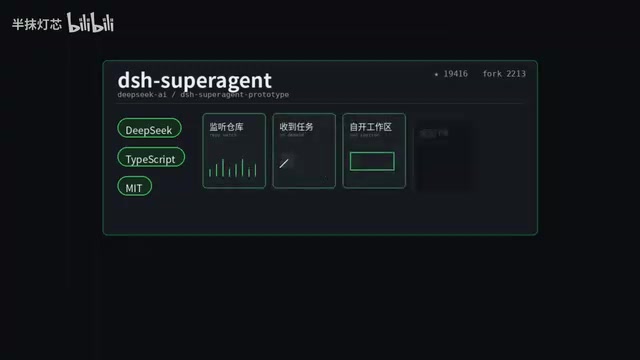
This "PR as delivery" model has several advantages: all changes are reviewable and rollback-able, and the main branch isn't directly polluted; workspace isolation prevents multiple tasks from interfering with each other. For repositories that frequently need to handle issues, fix minor bugs, or update dependencies, this automation can significantly reduce the number of times a person has to switch context.
Pull Request (PR) is the core collaboration mechanism on code hosting platforms like GitHub: a developer pulls an independent branch from the main branch (e.g., main) to make changes, then submits a merge request to the main repository. A PR doesn't directly modify the main branch; instead, it first presents the changes as a diff for others to review line by line, comment on, and request changes, and only merges after approval. Because every PR carries the full branch history, it can be rolled back as a whole if problems arise. Using PRs as the delivery method for an AI agent is clever—it reuses the team's existing code review process, putting the bot's output through the same quality gate as human colleagues' commits without needing to build an extra trust mechanism.
A Design Principle of Minimal Disturbance
The most noteworthy aspect of the project is its value orientation. At a time when most AI tools are desperately competing for user time, SuperAgent goes the opposite direction, making "reducing attention occupation" a core principle.

This means it won't pop up frequent prompts or ask you to confirm step by step. Instead, it completes work in the background as much as possible and only notifies you when a PR is produced. This design approach is developer-friendly, and it also hints at a new criterion for evaluating AI tools: not how long you used it, but how much work it saved you.
A Research Prototype, MIT License, Not an Official Product
It should be made clear that SuperAgent is positioned as a research prototype, open-sourced under the MIT license, and is not an official DeepSeek product. This positioning means it's better suited for developers with an exploratory spirit to try out, rather than for direct use in production environments.

At the end of the video, the creator also mentioned that if you want to try it, you can have a coding agent help you configure it. This actually lowers the barrier to entry—using AI to configure AI is quite in keeping with the character of this project itself.
The MIT license is one of the most permissive open-source licenses, with only one core obligation: retain the original author's copyright notice and license notice. It allows users to freely copy, modify, merge, publish, sublicense, and even use the software commercially, and modified derivative works do not have to be open-sourced under the same license (unlike GPL's "copyleft" nature). As a result, projects under the MIT license have a very low barrier to entry and are suitable for being quickly borrowed, embedded in other tools, or further developed. Note, however, that a permissive license also means the author provides no warranty of any kind—which echoes the "research prototype" positioning: the code is usable, but stability and production-grade support are not promised, and users bear the risk themselves.
A Signal Worth Watching
The emergence of SuperAgent reflects a trend: AI coding agents are moving from "conversational assistance" to "task-based agents." The former requires full human involvement, while the latter compresses the human role to assigning tasks and accepting results. Although it is currently only a research prototype, this "less disturbance, more output" approach may influence the design direction of future repository automation tools. For developers interested in the evolution of AI coding tools, this project is worth adding to the watchlist.
Related articles
 Tech Frontiers
MuJoCo: An Analysis of DeepMind's Open-Source General-Purpose Physics Simulator
An in-depth analysis of Google DeepMind's open-source physics simulator MuJoCo: high-performance C++ kernel, MJCF modeling format, contact solving principles, MJX GPU acceleration, and robot reinforcement learning use cases.
 Tech Frontiers
Claude API Quick Start: The Official Quickstarts Project Collection
Anthropic's official claude-quickstarts project collection helps developers quickly build deployable apps with the Claude API. Nearly 20k stars, Python-based, great for beginners and prototyping.
 Tech Frontiers
AI Agents Connecting Directly to APIs: Which Calls Can Be Safely Allowed?
AI agents can call any API, but the real challenge is deciding which calls can be safely allowed. This article analyzes allowance decisions from three dimensions—intent matching, least privilege, and controllable impact—and argues that the control layer should sit outside the agent, combined with audit traceability to build a trustworthy API call governance mechanism.