DeepSeek SuperAgent Open-Source Deep Dive: An Engineering Exploration of Multi-Agent Collaboration

DeepSeek proposes Super Agent, using a Router+Worker architecture to solve the attention bottleneck in multi-Agent parallelism.
DeepSeek released the Super Agent concept and open-sourced a prototype; the core idea isn't a stronger model but a redesign of the multi-Agent system layer. It uses a two-tier Router and Worker architecture: the Router handles scheduling and continuity, while Workers execute tasks in independent contexts. Subscription mechanisms and event-driven design reduce Router load and let the Agent be proactively triggered by external events, with noise detection and allowlists curbing accidental triggers. Interaction is asynchronous, and the architecture separates compute and storage — elastic compute containers, state in a database, the execution environment kept local — with a Watchdog enabling self-recovery. The article also reviews same-week projects like Agent Desktop, Claude SEO, Awesome DSH Plugin, and See-Through.
When one person runs three to five Agents at once, switching between windows to check progress, the bottleneck is often no longer model capability — it's human attention. DeepSeek's newly proposed Super Agent concept is a redesign of the entire working system around exactly this pain point. This article, combined with this week's GitHub trends, breaks down the architectural thinking behind SuperAgent and reviews several practical projects from the same period.
SuperAgent: From "a Smarter Model" to "a More Sensible System"
DeepSeekAd released the Super Agent concept last week and open-sourced the concept repository alongside it. Its starting point is simple: the task ceiling of a single Agent depends on model capability, but when multiple tasks run in parallel, the bottleneck quickly shifts to human attention — a person can only follow a limited number of active sessions at once. Anyone who has frequently run multiple Agents simultaneously knows this feeling well.
So SuperAgent's goal isn't to swap in a stronger model, but to give users an agent that keeps working continuously: how many sessions are open underneath, which tasks are running in parallel, and who messages should be forwarded to — all managed by the system. The "super" here refers to a system-level redesign.
Two-Tier Architecture: Router and Worker
The core design has two layers: Router and Worker. The Router acts as a front-desk dispatcher, responsible for receiving messages, determining task relationships, scheduling tasks, and maintaining overall continuity. Workers each handle specific work — fixing bugs, running tests — using independent contexts to make progress.
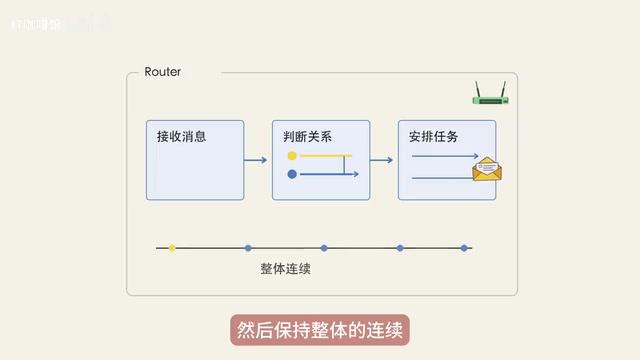
The most direct change: users can add requirements in an existing discussion without having to find the corresponding background session window. This scheduling mindset isn't unique to DeepSeek; its value lies in applying a familiar scheduling pattern to a long-running Agent system.
Context Isolation is a key concept in multi-Agent system design. Each Worker has its own independent context window, meaning each maintains its own conversation history, tool-call records, and intermediate results without polluting one another. The benefits: a single Worker's context length stays manageable and won't balloon from irrelevant information from other tasks; different tasks can use different system prompts and tool sets; and when one Worker fails, it won't cascade to the others. The cost is that Workers can't directly share implicit knowledge — coordination must go through the Router or explicit message passing, which is exactly why the Router needs to judge task relationships and maintain overall continuity.
Subscription Mechanism and Event-Driven Design
If every message required the Router to read it from scratch before deciding routing, it would quickly hit a bottleneck. To address this, DeepSeek added a subscription mechanism: for example, a discussion on GitHub may have a fixed owning Worker, and once that Worker subscribes to the discussion, subsequent replies are pushed directly to it — only when ownership is unclear does the Router need to step in.
This also lets SuperAgent be driven by external events: chat messages, code review results, automated test output, and Feishu content can all become events that the Agent proactively handles. But the flip side of proactivity is noise and accidental actions — if every message in a group chat triggers an AI action, the result would be a disaster. So the prototype includes noise detection, allowlists, and policy judgment.
Event-Driven Architecture is a system design paradigm centered on "events": rather than actively polling, the system has an event source emit a notification when some state change occurs (e.g., a new message arrives, a code review completes, a test fails), and subscribers passively receive and handle it. Compared with timed polling, event-driven design enables near-real-time response and saves resources. In Agent scenarios, event-driven design shifts the agent from "act only when the user asks" to "act when something happens," but it also introduces the risk of event storms and accidental triggers, so it usually needs to be paired with event filtering, priority queues, and idempotent handling.
Asynchronous Interaction and Compute-Storage Separation
At the interaction layer, time-consuming commands are executed asynchronously: first return "started," then push back the result when ready — foreground interaction and background work no longer block each other. Different channels also get targeted optimizations — IM needs low interruption, sending only decisions and conclusions; emails and documents get the full content.
Architecturally, compute and state are separated: compute runs in stateless containers that can be placed in the cloud and restarted or scaled at any time; state lives in a database; and the execution environment stays on the user's computer, with only a lightweight Daemon installed to execute commands or wait for results to be sent back. This lets the Agent stay persistently online and even switch between multiple devices.
There is also an independent Watchdog that stays online permanently, waking on a timer to handle API errors and let the model judge whether each Worker is making substantive progress, intervening to fix problems when found.
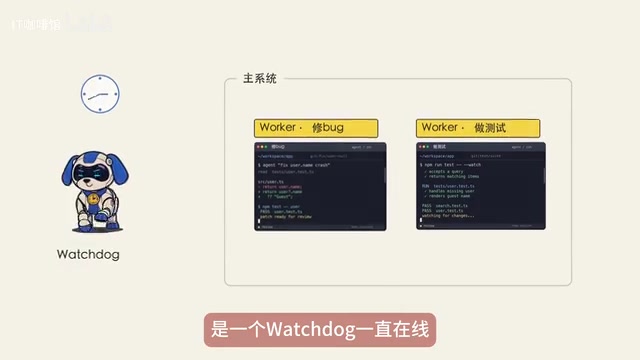
Compute-Storage Separation originates from mature cloud computing architecture practice: decoupling the stateless compute layer (e.g., containers, functions) from the stateful storage layer (e.g., databases, object storage). The compute layer can scale horizontally on demand and restart at any time without losing data; the storage layer handles persistence and consistency. Adopting this pattern in an Agent system means the Agent's "memory" and "task state" aren't bound to a particular machine or process, enabling persistent online operation, fault recovery, and multi-device switching. Keeping the execution environment local is a hybrid architecture: sensitive operations and local resource access still happen on the user's device, while computation and coordination are placed in the cloud.
Relationship with DeepSeek Harness
The relationship between SuperAgent and DeepSeek Harness is worth clarifying: Harness provides foundational runtime capabilities such as model access, tools, sessions, and plugins, while SuperAgent explores, on top of that foundation, how to organize a persistently online, cross-task collaborative system. The open-source project itself is a prototype targeting a single GitHub repository and a DeepSeek Harness plugin, capable of connecting to GitHub and optionally Feishu, including event handling, tickets, execution sessions, and a management panel — a partial validation of the ideas above.
Other Projects Worth Noting from the Same Period
Agent Desktop: Letting Agents Operate Desktop Software
Many tools have previously let Agents operate browsers; Agent Desktop's goal shifts to desktop software. It provides a command line and a C library, reading the application interface structure through the operating system's accessibility interfaces — what buttons, input fields, and menus are in a window — and then lets the Agent click, type, or check results based on elements. Think of it as giving the Agent a catalog of interface elements instead of judging every step from screenshots.
The official docs list support requirements for macOS, Windows, and Linux — for example, macOS requires enabling accessibility permissions. Which controls can be read depends on whether the application properly exposes accessibility information; complex canvases or permission restrictions will prevent it from working.
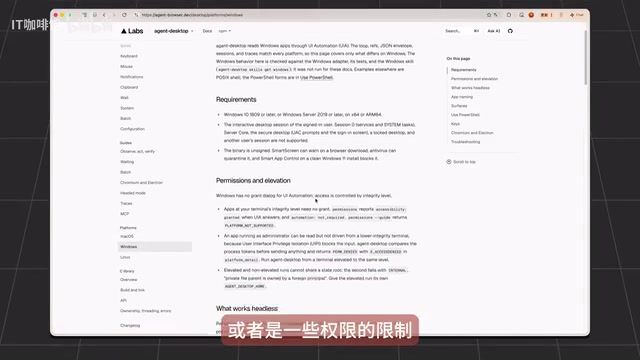
Accessibility API is a programming interface that operating systems provide for assistive technologies (such as screen readers); it exposes the roles, names, states, and hierarchy of controls in an application's interface. macOS's Accessibility API, Windows's UI Automation, and Linux's AT-SPI all fall into this category. By reading this structured information, an Agent can know what buttons, input fields, and menus are in a window, and then click or type precisely, without relying on screenshots plus vision models to judge frame by frame. The advantages of this approach are accuracy, lightness, and interpretability; the drawback is complete dependence on whether the application properly exposes accessibility information — custom-drawn interfaces, game canvases, or unadapted applications often can't be read.
Claude SEO: Turning SEO Checks into a Plugin
Suited for those building websites, indie products, and content operations. After a site goes live, whether search engines can properly index pages, whether page structure is clear, and how fast pages load are all SEO concerns. This project turns SEO checks into a Claude Code plugin, covering technical SEO, content quality, structured data, and AI search-related checks. After installation, run SEO setup, then use SEO Audit to load the site for auditing; checks are distributed to different specialized Agents and finally compiled into a prioritized list. For indie developers who have just launched, running through it to check for issues with crawling, titles, structured data, and page structure is quite helpful.
Awesome DSH Plugin: A Plugin Directory
The biggest design highlight of DeepSeek Harness is that everything is a plugin, and plugin extensions are also where it's most fun. This project is a community-curated plugin directory, categorized by model access, memory, browser, voice interface, code review, etc. — add whatever you're missing. The latest Harness desktop version supports plugin marketplace integration; you can copy the marketplace index provided by the project to the discovery page next to plugins to add it.
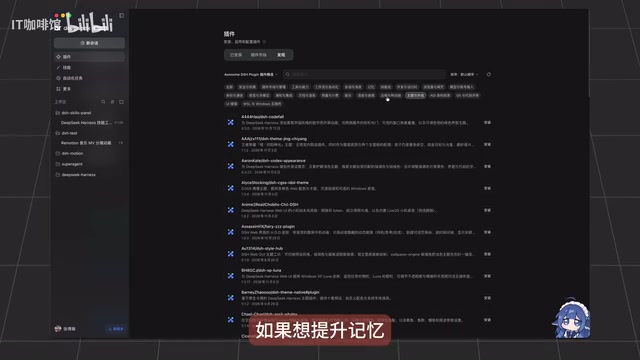
One reminder: being listed doesn't mean passing a security audit. Plugins run third-party code, which carries certain security risks — be sure to exercise caution.
See-Through: Automatic Layering of Anime Characters
Very useful for animation and game characters. If you have a finished anime character illustration and want the hair, face, and clothes to move separately, the first step is often splitting it into individual element layers. See-Through's approach is to start from a single image, determine the character's parts and their front-back relationships, extract independent layers, and generate completions for occluded regions — up to 23 layers can be split out and exported as a layered PSD. The project offers an online environment; local deployment requires Python, PyTorch, and models, with the documentation stating roughly 12 to 16 GB of VRAM needed at the default 1280 resolution, and it also provides options to reduce VRAM usage. Complex occlusion and hand details still require manual checking and repair — which is normal.
Two Reports Worth Reading
At the end of the video, two reports are shared: first, the "China AIGC Development Research Report 2026," which surveys production tools for AI writing, image design, audio, and video content, and also covers office, marketing, and coding Agents and workflows — suited for those working in content and AI applications; second, the "2026 to 2027 China Consumer AI Hardware Trend Report," which divides consumer AI hardware into six categories — wearables, health, sports, desktop, pets, and toys — for those interested in AI hardware.
SuperAgent is still at the experimental stage, but its thinking around multi-Agent and long-running scenarios is worth watching.
One-line Summary
DeepSeek proposes Super Agent, using a Router+Worker architecture to solve the human attention bottleneck when multiple Agents run in parallel.
Paragraph Summary
DeepSeek released the Super Agent concept and open-sourced a prototype; the core idea isn't pursuing a stronger model but redesigning the system layer for multi-Agent collaboration. It uses a two-tier Router and Worker architecture, with the Router handling scheduling and continuity and Workers executing specific tasks in independent contexts; subscription mechanisms and event-driven design reduce Router load and let the Agent be proactively triggered by external events, while noise detection and allowlists control accidental triggers. Interaction is asynchronous, and the architecture achieves compute-storage separation — elastic compute containers, state in a database, execution environment kept local — with a Watchdog for self-recovery. The article also reviews same-week projects including Agent Desktop, Claude SEO, Awesome DSH Plugin, and See-Through.
Related articles
 Tech Frontiers
MuJoCo: An Analysis of DeepMind's Open-Source General-Purpose Physics Simulator
An in-depth analysis of Google DeepMind's open-source physics simulator MuJoCo: high-performance C++ kernel, MJCF modeling format, contact solving principles, MJX GPU acceleration, and robot reinforcement learning use cases.
 Tech Frontiers
Claude API Quick Start: The Official Quickstarts Project Collection
Anthropic's official claude-quickstarts project collection helps developers quickly build deployable apps with the Claude API. Nearly 20k stars, Python-based, great for beginners and prototyping.
 Tech Frontiers
AI Agents Connecting Directly to APIs: Which Calls Can Be Safely Allowed?
AI agents can call any API, but the real challenge is deciding which calls can be safely allowed. This article analyzes allowance decisions from three dimensions—intent matching, least privilege, and controllable impact—and argues that the control layer should sit outside the agent, combined with audit traceability to build a trustworthy API call governance mechanism.