Delta 2.0 Update: iPhone Duo Turns Into a Foldable Handheld, Adds Sega Genesis Games

Delta 2.0 optimizes for iPhone Duo and adds Sega Genesis support plus dynamic skins.
Delta emulator released a major 2.0 update featuring dedicated optimization for Apple's foldable iPhone Duo, leveraging the large unfolded screen for immersive gaming. The new version officially adds Sega Genesis (Mega Drive) game support, further expanding its retro platform lineup. It also introduces dynamic controller skins and a custom Pokémon DLC experience for enhanced feedback and personalization. The interface is rebuilt around Apple's Liquid Glass design language for better visual integration with iOS. The article suggests Delta is evolving along three axes—device adaptation, content expansion, and experience personalization—gradually becoming a comprehensive retro gaming platform, while reminding users about ROM legality and compatibility changes.
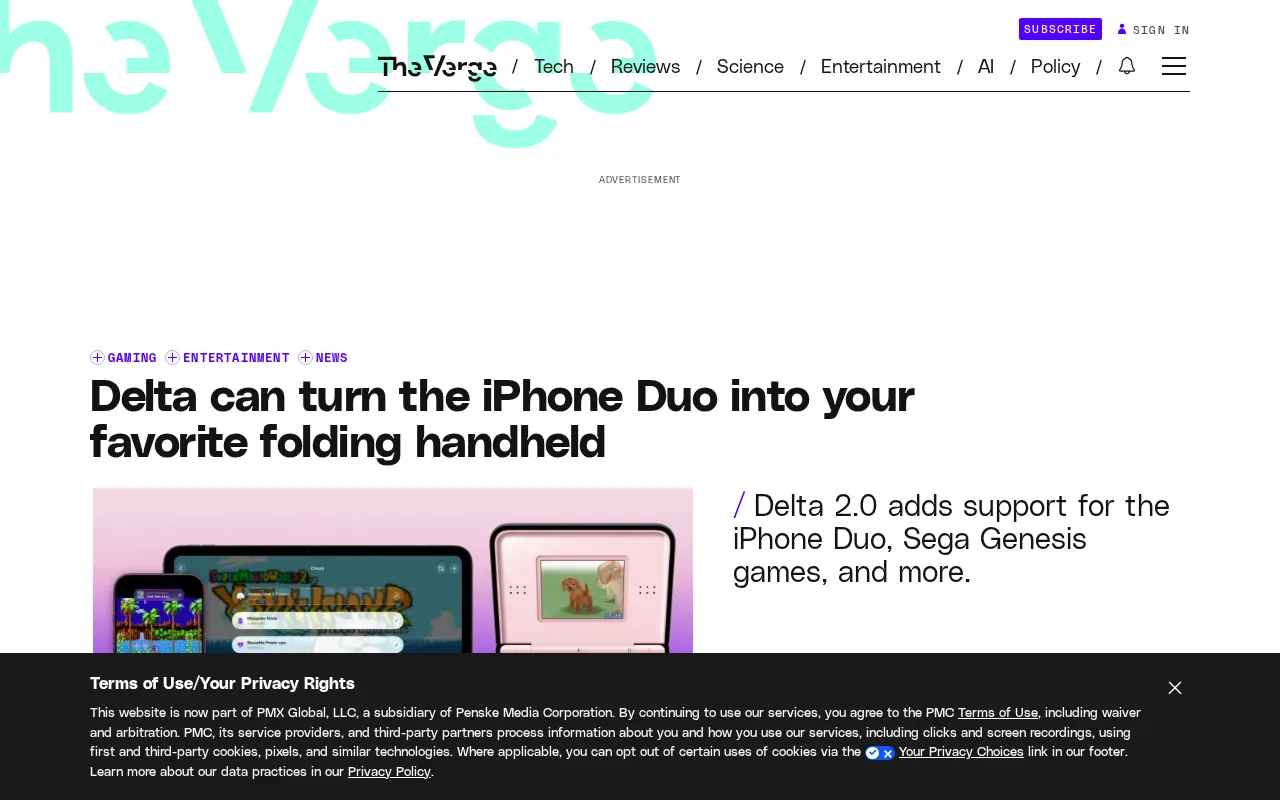
Delta emulator has received a major 2.0 update. This upgrade not only brings dedicated optimizations for Apple's iPhone Duo but also introduces a series of new features that will excite retro gaming fans. From Sega Genesis game support to dynamic controller skins, and a new interface built around the Liquid Glass design, Delta is redefining what's possible for phones as handheld gaming devices.
iPhone Duo Optimization: The Gaming Potential of Foldable Screens
According to the RSS source, Delta 2.0's most notable improvement is optimization for Apple's iPhone Duo. This foldable device has a unique screen form factor, and Delta clearly sees its potential in gaming. Although the original article doesn't detail the specific technical aspects of the optimization, it's reasonable to infer that it involves leveraging the large screen when the foldable is unfolded, as well as possible controller layout adjustments tailored to the folded form factor.
For iPhone Duo users, this means their device can more naturally transform into a "favorite foldable handheld gaming console." The advantage of foldable phones in gaming scenarios lies in the immersive visual experience provided by the large unfolded screen, while the portability when folded aligns with handheld gaming habits. Delta's adaptation may encourage more developers to pay attention to game interaction design for foldable devices.
iPhone Duo is Apple's first foldable iPhone, with an inner screen size close to a tablet when unfolded while maintaining a regular phone form factor when folded. The key challenge in game adaptation for foldable devices is the dynamic switching of screen ratios and resolutions: apps need to transition smoothly between unfolded and folded states and re-layout controls for different aspect ratios. For emulators, this means virtual controllers, game screens, and menu areas need adaptive arrangement to avoid stretching or black bars. Delta's dedicated optimization likely includes using the large unfolded screen to display a more complete game image and designing a more compact touch controller layout for the folded form.
Sega Genesis Games Join, Expanding the Retro Lineup
Delta 2.0 officially introduces support for Sega Genesis (also known as Mega Drive) games. This means players can now run classic Sega titles like Sonic the Hedgehog and Streets of Rage on Delta. Previously, Delta already supported platforms like Nintendo and Super Nintendo, and the addition of Sega Genesis further enriches its retro gaming ecosystem.
For emulator users, platform compatibility is always a core concern. By continuously updating to support more gaming platforms, Delta is solidifying its position as an all-in-one emulator on iOS. The addition of Sega Genesis also fills the gap in the Sega camp from the 16-bit era, allowing players to more completely revisit that golden age.
Sega Genesis (known as Mega Drive outside North America) is a 16-bit home console released by Sega in 1988, belonging to the same era as Nintendo's SFC/SNES. It uses a Motorola 68000 as the main CPU, paired with a Zilog Z80 coprocessor for audio. Its hardware architecture differs significantly from Nintendo's platform, so emulators need to separately implement its CPU, video display, and sound chips. Genesis is known for titles like Sonic the Hedgehog, Streets of Rage, and Phantasy Star, and was particularly successful in the North American market. For emulators, supporting Genesis means handling its unique YM2612 FM sound source and VDP graphics chip. Delta's addition of this platform indicates that its core emulation framework already possesses multi-architecture expansion capabilities.
Dynamic Controller Skins and Custom Pokémon DLC Experience
Beyond platform expansion, Delta 2.0 also brings a visual personalization upgrade—dynamic controller skins. Although the original article doesn't describe the specific animation effects, it can be understood that controller skins will no longer be static but will feature dynamic feedback, enhancing immersion during operation.
More uniquely, the update introduces a "custom Pokémon DLC experience." This phrasing is somewhat vague—it may mean players can import custom Pokémon-related content, or that Delta provides some kind of extended gameplay centered around Pokémon. Given the complex relationship between emulators and ROMs, the specific implementation of this feature is worth following up on. Regardless, it shows that the Delta team is attempting to provide more personalized experiences beyond standardized emulation features.
New UI Built Around Liquid Glass
Delta 2.0 adopts a brand-new user interface, explicitly built "around support for Liquid Glass." Liquid Glass is the design language introduced by Apple in its latest operating system, emphasizing semi-transparent, fluid visual effects. Delta's new UI follows this design trend, making the emulator visually more integrated with the iOS system.
The new UI isn't just a cosmetic change—it typically also means adjustments to interaction logic. For emulator apps that require frequent game switching and settings adjustments, interface efficiency is crucial. Delta's choice to rebuild its UI in version 2.0 may be laying the groundwork for future feature expansion.
Liquid Glass is the design language Apple announced at WWDC 2025, introduced with iOS 26 and other next-generation systems. Its core features include semi-transparent materials, real-time refraction, and flowing highlight effects, with interface elements dynamically changing in response to content and lighting. Developers invoke this effect through new material APIs in SwiftUI and UIKit, keeping app controls visually consistent with the system interface. For emulators, adopting Liquid Glass is not just about aesthetics—it also involves performance overhead. Real-time blur and refraction have certain GPU requirements, and overlaying such effects while a game is running requires reasonable optimization. Delta's UI reconstruction around it indicates the team wants the app to achieve a native-like look at the system level.
Conclusion: Delta's Evolution Direction
Looking at Delta 2.0's update content, this emulator is evolving in three directions: device adaptation (iPhone Duo optimization), content expansion (Sega Genesis support), and experience personalization (dynamic skins, custom DLC, new UI). For iOS gamers, Delta is no longer just a simple emulator but is gradually becoming a comprehensive retro gaming platform.
With the proliferation of foldable devices and Apple's loosening policies on emulators, the value of apps like Delta may become even more prominent. However, users should also be mindful of the legality of ROM sources and potential compatibility changes that emulator feature updates may bring. Delta 2.0 has been released, and iPhone Duo owners should give it a try to see what the foldable handheld gaming experience is really like.
Related articles

DeepSeek Open-Sources DeepInfer: What Is an Inference Framework Actually For?
DeepSeek open-sources its inference framework DeepInfer under Apache 2.0, supporting DeepSeek V4.1 Flash offline inference. This article explains its request scheduling, FlashMLA/DeepGEMM compute optimization, DSPark speculative verification acceleration, and what it means for developers and ordinary users.

Open-Source AI Learning Agent: A Full Workflow Experience from Topology Graphs to Exam Generation
Explore an open-source AI learning agent: built on DeepSeek API, it constructs knowledge systems via topology graphs, with automatic document generation, notes, super documents, and exams. Learn about its Agent workflow and design highlights.

DeepSeek Whale Girl Open-Source MV Meme: AI Industry Coded Slang About Pivoting to Closed Source
Bilibili's DeepSeek Whale Girl rap MV uses fictional memes to tease the AI open-source vs. closed-source debate, with lyrics full of industry slang. This article explains the meme culture, the Whale Girl symbol, and the open/closed tension.