Desktop Nightly Build Update: UX Validation Report Rendering Integrated into Existing Artifact Access Pipeline

Nightly build commit shows UX validation report rendering will reuse Desktop's existing artifact access capability.
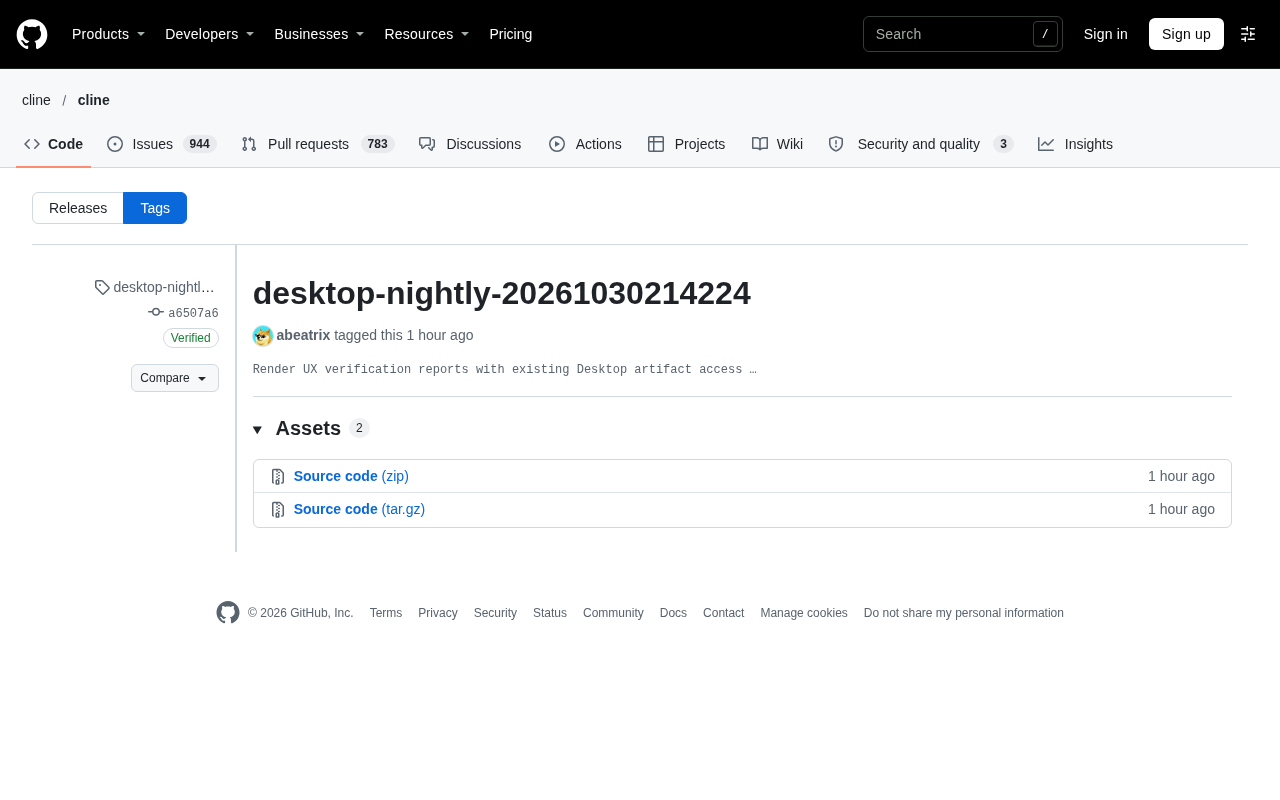
The article analyzes a GitHub nightly build desktop-nightly-20261030214224 (commit a6507a6). The commit summary states the core change is "rendering UX validation reports using the existing Desktop artifact access capability." The author infers this is capability reuse rather than a new feature: integrating report rendering into existing desktop artifact access infrastructure can converge responsibility boundaries, unify behaviors like permissions and caching, and reduce long-term maintenance costs. The commit has a GitHub verified signature, was tagged by abeatrix with 2 assets, and is traceable. However, disclosed information is limited—report format and UI entry point are unspecified—so it should be seen as a directional adjustment, not an immediately usable feature.
A Nightly Build Commit Reveals the Direction
On GitHub, a nightly build tagged desktop-nightly-20261030214224 was labeled, corresponding to commit a6507a6. The commit summary shows that the core of this change is "rendering UX validation reports using the existing Desktop artifact access capability." The commit is verified by GitHub signature (GPG key ID: B5690EEEBB952194), the tag was applied by abeatrix at 21:21 that day, and it comes with 2 assets.
This is a typical nightly build entry: the item name itself is the version identifier, and the content consists mainly of the commit description and build assets. It does not expand on feature details, but the commit summary already points out the direction of the change—integrating UX validation report rendering into Desktop's existing artifact access mechanism.
What "Reusing Existing Artifact Access" Means
From an engineering perspective, the key word in this sentence is "existing." UX validation reports are typically produced by testing or review processes, and in the past often required an additional set of reading, transmission, and display pipelines. If the change is to reuse Desktop's existing artifact access capability, there are at least three implications.
First, responsibility boundaries converge. Artifact access is existing desktop infrastructure, and report rendering is built directly on top of it, which can reduce duplicated download, authentication, and state management logic. Second, behavioral consistency improves. Users opening a report and opening other artifacts go through the same path, so permissions, caching, and error handling behave more uniformly. Third, maintenance costs decrease. When the artifact access pipeline is upgraded in the future, report rendering can benefit naturally without separate adaptation.
This also explains why the change appears in the desktop nightly build rather than in some standalone tool—it is essentially a capability reuse rather than a new feature.
Artifact in software engineering generally refers to files produced by build, test, or review processes, such as compiled outputs, test reports, screenshots, and logs. Artifact access capability refers to a unified mechanism responsible for locating, authenticating, downloading, and caching these files. Building UX validation report rendering on top of this mechanism makes reports "just another kind of artifact," thereby directly inheriting the existing permission model and caching strategy without starting from scratch.
The Engineering Significance of Nightly Builds and Signature Verification
The value of nightly builds lies in exposing changes at a high-frequency, small-step pace. This commit carries a GitHub verified signature, indicating that the provenance of the build artifacts is traceable; the tag was manually applied by a maintainer and comes with 2 assets, meaning this nightly version is obtainable and verifiable.
For users of nightly versions, such commits are better placed on a "watch list": they do not represent a commitment to a stable release, but they can reflect in advance the engineering direction the team is converging on. The integration of UX validation reports with artifact access is a signal worth noting—the team is bringing internal validation processes closer to the desktop product experience.
Nightly build is a release cadence in continuous integration practice: automatically building once from the main branch every night (or more frequently), with artifacts named by date-time stamp, as in this example's 20261030214224. It targets developers and early adopters and does not promise stability; its purpose is to expose changes to real usage scenarios with minimal delay, thereby catching regression issues as early as possible. It contrasts with more mature release tiers such as alpha, beta, and stable.
GitHub verified signature refers to GitHub automatically attaching cryptographic signatures to commits or tags made through its platform. When viewing a commit, a "Verified" badge is displayed along with the GPG key ID used by the signer (in this case B5690EEEBB952194). Its significance lies in proving that the commit was indeed issued by the account holding the corresponding private key and that the content has not been tampered with since signing, providing a foundation for supply chain security and release traceability.
Caution to Maintain
The amount of information disclosed in this change is limited. The commit summary does not explain the specific format of the reports, where the rendering entry point is located in the interface, or the extent of changes to the existing artifact access pipeline. Therefore, a more reasonable judgment is: this is a directional engineering adjustment rather than a complete feature that can be experienced immediately. Nightly build artifacts are suitable for follow-up verification; whether it enters a stable version and how it performs still need to be confirmed by subsequent commits and release notes.
For developers, what is worth noting is this approach of "reusing existing infrastructure to carry new scenarios." It often means a lower onboarding cost and a smaller long-term maintenance burden, and it is often a sign of a product maturing.
One-line Summary
Nightly build commit shows UX validation report rendering will reuse Desktop's existing artifact access capability.
Paragraph Summary
The article analyzes a GitHub nightly build desktop-nightly-20261030214224 (commit a6507a6). The commit summary states that the core of the change is "rendering UX validation reports using the existing Desktop artifact access capability." The author infers that this is a capability reuse rather than a new feature: by integrating report rendering into the desktop's existing artifact access infrastructure, it can converge responsibility boundaries, unify behaviors such as permissions and caching, and reduce long-term maintenance costs. The commit carries a GitHub verified signature, was tagged by abeatrix, and comes with 2 assets, making its provenance traceable. However, the disclosed information is limited—neither the report format nor the interface entry point is explained—so it should be regarded as a directional adjustment rather than a complete feature that can be experienced immediately.
Related articles

Anthropic IPO Explained: Fuel for the AI Boom or the Spark for a Bubble?
Anthropic files for an IPO under ticker ANT. Breaking down the prospectus: 80% of revenue from usage-based pricing, $72B of an $80.7B net loss being non-cash charges, 900% net revenue retention, and how past IPOs like SpaceX performed on day one and over three years — answering the AI bubble question.

Will AI Kill the Research Paper? Mathematicians Offer a New Answer
Mathematicians on the Lex Fridman podcast discuss whether AI will kill research papers—from journal review pressure to Lean formal verification, GitHub open source fatigue to Mathlib's crowdsourcing model, exploring the evolution of academic contributions and the future of mathematical knowledge verification.

Enterprise LLM Development: From RAG to Multi-Agent in Practice
A course breakdown of enterprise LLM application development: from prompt engineering and RAG to multi-agent engineering practice and FDE project delivery, helping developers understand why Agent technology is a key focus for enterprise deployment and learn systematically to avoid detours.