Did the US Midterms Vote No to AI Data Centers? A Map Reveals the Truth
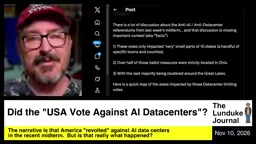
Anti-data-center votes in the US midterms are concentrated in a few Ohio townships, not a national referendum.
The article rebuts the popular narrative that the US midterms were a national referendum on AI data centers. Using a self-made map, YouTube channel Lunduke Journal points out that ballot measures restricting, delaying, or banning new data centers are almost entirely concentrated in Ohio and the Great Lakes region, mostly at the township level, involving only 10 states and covering less than one percent of all US towns. The author further finds that more than half of the votes were driven by a single Ohio-focused PAC, not a spontaneous wave across localities. The article criticizes some media for emphasizing the "40-plus measures passed" figure without showing the map, amplifying the misunderstanding. The author acknowledges that local community trade-offs over data centers are a normal democratic process and that more votes will come, but elevating them into a nationwide anti-AI wave is neither accurate nor helpful for rational discussion.
Introduction: An Exaggerated "Data Center Referendum"
During the US midterm elections, several localities held ballot measures on AI data center construction. After the election, outlets like CNBC, BBC, and PBS ran headlines such as "Voters Reject Data Centers" and "Data Center Backlash Shapes Election Results." On social media, a narrative spread even further: that this midterm was a large-scale referendum on AI and data centers.
But is that really true? The YouTube channel Lunduke Journal offers a different answer with a self-made map: the so-called "nationwide anti-data-center wave" is in fact concentrated in a handful of townships in Ohio and the Great Lakes region, covering less than one percent of all towns in the United States.
Ballot measure is a common direct-democracy tool at the US state and local level, referring to a policy issue placed on the ballot as a bill or constitutional amendment for voters to decide on election day. It usually comes in two forms: one initiated by citizen petition signatures (initiative), and the other submitted by a legislative body for voter confirmation (referendum). At the township and county level, the threshold for a ballot measure is often far lower than for a statewide referendum—fewer signatures are needed and organizing costs are low—so a single organization can focus on just a few jurisdictions to push multiple measures. This is the institutional reason why the "40-plus measures" in this article sound impressive but cover an extremely small geographic area: a high count does not equal broad coverage.
The Truth on the Map: Black Dots Concentrated Around the Great Lakes
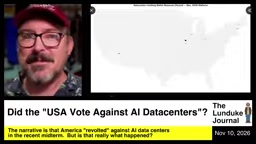
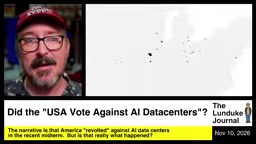
The video's author presents a map where small black dots represent areas that passed ballot measures restricting, delaying, or banning new data center construction. These black dots are almost entirely concentrated around the Great Lakes, especially Ohio. There is not a single statewide ban on the map; the vast majority are township-level votes, with only a few counties participating.
"You see those little black dots, mostly clustered near the Great Lakes. These are the places that passed some form of ballot measure restricting new data center construction," the author says in the video.
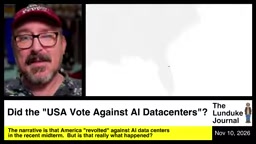
More importantly, these votes are spread across only 10 states, and more than half of the ballot measures are strictly speaking only in Ohio. If you remove Ohio and the Great Lakes region, the rest of the country has only a scattering of votes—one town in Florida, one dot in California, one dot in Nevada. States like Texas, Louisiana, Arkansas, Mississippi, Alabama, and Georgia have no related votes at all.
A Single Political Action Committee Drove Most of the Votes
The author further points out that the concentration of these votes is no coincidence. Most can be traced back to the same political action committee (PAC) focused on Ohio. The organization concentrated its efforts on pushing measures to restrict data centers onto ballots in townships across Ohio, and spread to parts of neighboring states.
"Take away that one organization with a single clear goal, and the so-called 'data center backlash' narrative completely disappears," the author says.
This also explains why the black dots on the map are so concentrated: it is not that voters across America spontaneously oppose data centers, but that one organization ran a highly focused operation in a specific region. Township-level ballot measures are far easier to push than statewide referendums, which is what made Ohio the main battleground.
A political action committee (PAC) is an organizational form within the US system of political funding and election mobilization, legally allowed to raise funds to support or oppose specific issues, candidates, or policy positions. In the context of local ballot measures, PACs play a particularly key role: they can pool funds, concentrate signature-gathering efforts, run local ads, and coordinate volunteers, turning scattered individual discontent into an actionable ballot issue. That is precisely why a single goal-oriented PAC can push multiple township-level measures simultaneously within a specific region, creating the highly clustered "black dots" on the map. When observing local votes, tracking the PAC behind them and its funding flows often reveals the true scale and intent of a movement better than counting the number of measures.
The Gap Between Media Narrative and the Data
The author criticizes some media for emphasizing only the figure "more than 40 measures passed" without showing the map. The number sounds large, but the actual reach is extremely small.
"They show you the number. They say more than 40 measures passed nationwide. Nationwide? Strictly speaking, most are just in Ohio," the author says. "But if they showed you the map, it would look like someone sneezed and left a few tiny spots. That story wouldn't sound as good."
The author argues that this style of reporting is misleading: it packages local, township-level land-use decisions as a nationwide anti-AI wave. In reality, most of these measures are not "bans" on data centers but rather impose additional conditions on construction or delay approvals.
Local Choice and the Real Trade-offs of Data Centers
The author also makes clear that townships have the right to decide whether to welcome data centers. Data centers bring tax revenue and jobs, but also land use, power consumption, and visual impact. It is similar to bringing in a car factory—there are pros and cons.
He uses a hypothetical to illustrate: building a data center on Malibu Beach in California would probably be inappropriate; building one on the vast open land outside Dallas, Texas, might be perfectly reasonable. Different places have different preferences, and that is entirely normal.
"A town in Florida says 'we don't want a data center in our town'—is that a referendum on AI? Obviously not. It is just a small town making a choice for itself," the author says.
The local impact of data centers usually centers on several dimensions: land and water use, power load, noise (cooling systems and backup generators), visual changes, and tax revenue and jobs. A single large AI training cluster can draw tens of megawatts or more, requiring local grid expansion, which increasingly makes site selection depend on cheap power, ample land, and a permissive approval environment. At the same time, data centers are highly automated and create limited long-term direct jobs, so local governments tend to value property tax revenue and the spillover effects of infrastructure development more. Understanding these trade-offs is essential to explaining why communities differ: sparsely populated areas with cheap land tend to welcome them, while areas with sensitive landscapes or strained grids tend to restrict them.
Future Trends: More Local Votes, But Not a National Wave
The author predicts that more localities will vote on data centers in future election cycles—some restricting, some welcoming. Data center investment is large in scale and far-reaching in impact, so local-level bargaining will continue. But that does not mean a nationwide anti-AI wave has arrived.
"It is almost certain there will be more votes in the future," the author says. "Some places are suitable for construction, some are not, and that is completely fine. But calling it a wave, calling it a referendum on AI, only shows people haven't looked carefully—or are deliberately misleading."
Based on the current map, the United States has not voted against AI data centers. A handful of townships said "no," and that is all.
Conclusion
"America voted against AI data centers" is an amplified narrative. The reality is: a PAC focused on Ohio drove most of the township-level ballot measures, covering less than one percent of all US towns. Media highlighting the number while avoiding the map has worsened the misunderstanding. Local trade-offs over data centers are a normal democratic process, but elevating them into a nationwide referendum is neither factual nor helpful for a rational discussion about the future of AI infrastructure.
Related articles

Skykea Showdown: A Hilarious Variety Show Experience of a Minecraft Airship Building Competition
Skykea Showdown is a Minecraft airship building racing variety show. This article analyzes its two-phase build + hole race format, airship mod lift physics, secret mission design, and team confrontation dynamics—ideal for game content creators.
ApexW Optimizer Benchmark: Matches 8-bit AdamW in Unsloth with Lower Memory Usage
Developer shares benchmark of ApexW optimizer in Unsloth: ApexW 8bit has lower optimizer state memory (47.101 MB) and slightly better final loss than 8-bit AdamW, but similar speed. Needs independent reproduction.

US Computer Science Enrollment Drops 12.4% — Is CS Still Worth Studying?
CS enrollment fell 12.4% while health majors grew 6.2%. A CS master's grad explains why the degree's real value isn't coding but systems thinking.