Dify in Practice: How This Open-Source LLM Platform Builds AI Apps with Zero Code

A Dify hands-on tutorial, compared with Codes, offering AI app platform selection guidance.
The article summarizes a Bilibili creator's hands-on tutorial centered on Dify, an open-source LLM application development platform. It supports collaboration between technical and non-technical users, covers chat assistants, Agent building, text generation, and workflow orchestration, and enables zero-code AI Agent building with enterprise tools and data. The tutorial stresses case-driven hands-on learning. It also compares Codes: friendly to non-programmers with convenient one-click generation, but primarily cloud-hosted with third-party data management; Dify supports private deployment with fully local data retention, better for compliance-sensitive industries like finance and healthcare. Selection should hinge on data boundaries and team composition, tested with a real small project.
As the barrier to AI application development keeps dropping, many teams face a practical question: how do you pick a platform that gives technical teams deep customization while letting non-technical users get up to speed quickly? In a recent hands-on tutorial on Bilibili, the creator centers on Dify, walking through the full path from understanding the platform to building an app, and compares it with another currently popular tool, Codes, offering clear selection guidance for learners from different backgrounds.
What Is Dify: An Open-Source, Privately Deployable LLM Application Platform
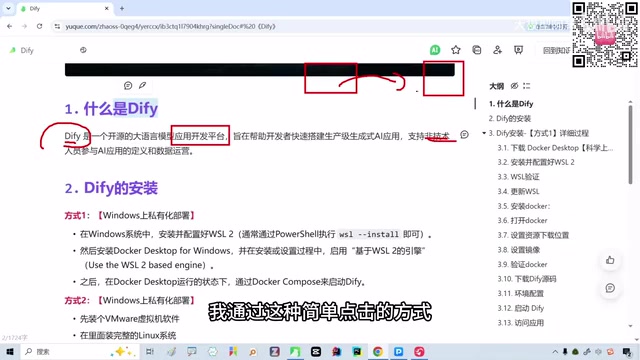
The video opens by helping viewers build an intuitive picture. According to the creator, Dify is an open-source large model application development platform whose core positioning is to help developers quickly build production-grade AI applications, while also enabling non-technical users to participate in defining AI applications and operating their data. This means everyone from technical developers to business operations staff can collaborate on the same platform.
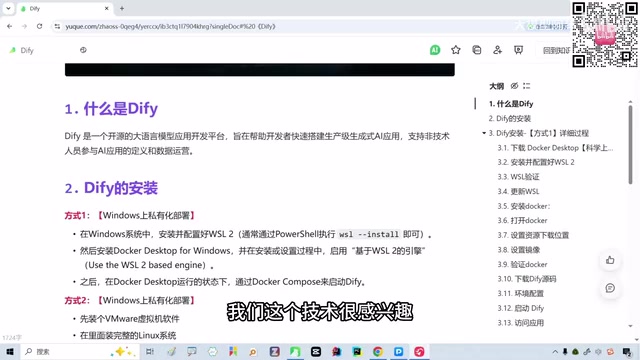
Functionally, Dify covers scenarios including creating chat assistants, building Agents, text generation applications, and orchestrating complex workflows. The creator emphasizes that the platform supports building AI Agents with zero code through simple clicking, and can call enterprise tools and enterprise data to address more complex needs. For learners who want to bring AI capabilities into real projects, this closed loop from definition to deployment is Dify's core value.
LLMOps is the key background for understanding Dify's positioning. LLMOps (Large Language Model Operations) refers to the full set of engineering practices around developing, orchestrating, monitoring, and operating LLM applications — essentially an extension of MLOps into the large model era. It focuses not just on the model itself, but also on prompt management, context and knowledge base retrieval, Agent tool calling, logging and performance evaluation, and version iteration. Dify's emphasis on "production-grade" and a "closed loop from definition to deployment" stems precisely from LLMOps requiring the platform to connect experimental prototypes with applications running in production, letting business staff participate in data operations while developers manage releases and monitoring. Without an LLMOps perspective, zero-code building is easily mistaken for a toy demo, when in fact it addresses the ongoing maintenance of an application after it goes live.
Building an Agent with Zero Code: Even Non-Technical Users Can Complete a Full Case
The hands-on portion of the tutorial centers on Agent building, with the creator demonstrating how to assemble an AI Agent through click-based operations. This process requires no coding, lowering the barrier to entry.
The creator notes that if viewers can run through that day's case from start to finish, it will be reusable whether for a graduation thesis or for later small projects. This hands-on, learning-by-doing approach is more efficient than simply reading documentation or grinding through books. For beginners, a case-driven path helps quickly build an overall understanding of the AI application development process rather than staying at the conceptual level.
AI Agent differs from an ordinary chat assistant in that it has goal-oriented autonomous decision-making capability. An Agent typically uses a large model as its reasoning core, combined with callable tools (such as search, database queries, and internal enterprise APIs), memory mechanisms, and task planning, so it can adjust its next action based on intermediate results across multiple steps rather than just single-turn Q&A. The click-based building Dify demonstrates essentially productizes elements like "role setting, tool mounting, and process branching," letting non-technical users define an Agent's behavioral boundaries through configuration rather than coding. Understanding this helps judge applicable scenarios: tasks with clear processes and standardized tool interfaces are better suited to zero-code Agents, while scenarios involving complex exception handling or high-performance requirements still need developers to step in for deep customization.
Comparison with Codes: The Trade-off Between Cloud Hosting and Private Deployment
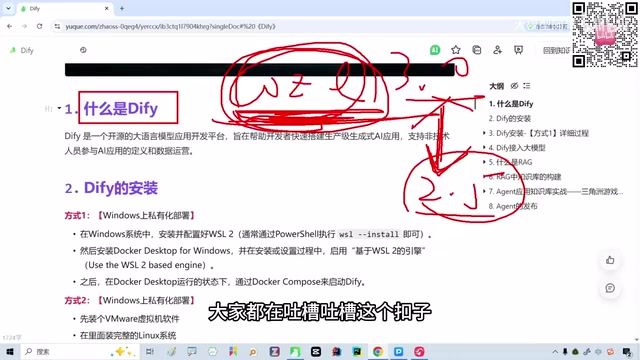
In the video, the creator compares Dify with another popular tool, Codes. By their observation, Codes has been updated frequently of late; the creator is also updating a course on Codes 3.0 and points out that 3.0 differs greatly from 2.5 and earlier versions, with some users reporting they don't quite understand its design approach and plenty of complaints on online platforms.
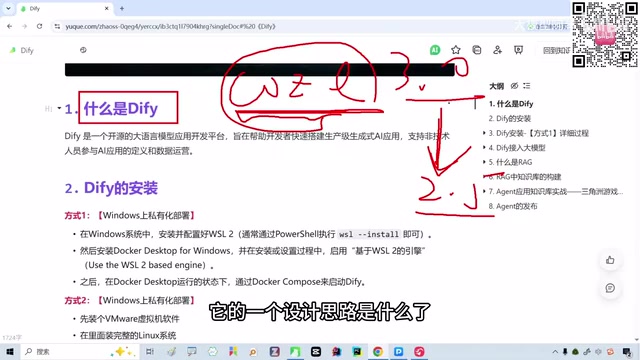
In terms of target users, the creator believes Codes is actually friendlier to non-programmers — if you want to generate mini-programs, web apps, or Android clients from text, Codes' one-click generation works well. But users accustomed to version 2.5 will notice a clear difference.
The more critical difference lies in deployment mode. Codes is primarily cloud-hosted, meaning enterprise data must be managed by a third-party platform. The creator says plainly in the video that for industries with high compliance requirements such as finance and healthcare, whether it's appropriate to hand enterprise data to an external platform is a question that must be carefully considered.
This is precisely where Dify's advantage lies. According to the creator, Dify supports private deployment, so data can stay 100% on-premises; for enterprises and projects with compliance needs, Dify is the safer choice. This comparison also explains why, even as Codes' reputation fluctuates, it's still worth systematically learning Dify.
Private deployment means installing and running a software system in an enterprise's own servers or private cloud environment rather than using a vendor's multi-tenant SaaS service. For AI applications, private deployment matters not only for where data is stored but also for whether the model invocation chain, log retention, and access auditing are controllable. LLM applications often take sensitive information such as business documents and customer conversations as context input; once this data passes through an external platform, it may touch on data cross-border transfer, industry regulation, or contractual confidentiality clauses. Industries like finance and healthcare typically have explicit data localization and auditing requirements, so platforms supporting private deployment are more likely to pass compliance review. The cost is that enterprises must bear server resources, operations staffing, and version upgrades themselves — which is also why cloud-hosted solutions remain attractive for lightweight scenarios.
Selection Advice: Decide Based on Data Boundaries and Team Composition
Taken together, Dify and Codes are not simple substitutes but tools for different scenarios. If a team is mostly non-programmers seeking to quickly generate lightweight applications and has no strict restrictions on data hosting, Codes' convenience is worth considering; if a project involves sensitive data, requires private deployment, or wants technical and non-technical staff to collaborate on defining applications on the same platform, Dify's open-source nature and localization capabilities are more appealing.
The creator repeatedly stresses the importance of running cases hands-on in the tutorial, and this approach applies equally to tool selection: rather than agonizing over spec comparisons, run a real small project on each, observe data flows, collaboration workflows, and deployment costs, and then decide. For readers looking for an entry path into AI application development, this hands-on tutorial centered on Dify offers an actionable starting point.
One-line Summary
Using a Dify hands-on tutorial as the thread, compares it with Codes to offer AI application platform selection guidance.
Paragraph Summary
The article summarizes a Bilibili creator's hands-on tutorial centered on Dify. Dify is an open-source LLM application development platform supporting collaboration between technical and non-technical users, covering chat assistants, Agent building, text generation, and workflow orchestration, and enabling zero-code click-based AI Agent building with access to enterprise tools and data. The tutorial emphasizes case-driven, hands-on learning, with cases reusable for theses or small projects. The article also compares Codes: it's friendly to non-programmers with convenient one-click app generation, but is primarily cloud-hosted, requiring data to be managed by a third party; Dify supports private deployment with fully local data retention, better suited to compliance-sensitive industries like finance and healthcare. The final selection advice is to decide based on data boundaries and team composition, and to run a real small project on each before judging.
Related articles

T3 Code: The Open-Source AI Coding Assistant's Comeback Story
T3 Code is an open-source AI coding assistant that unifies subscriptions like Codex and Claude, with powerful remote control and parallel task management.

Never Elected, Yet Ruled New York for 30 Years: The Ultimate Case Study in the Mechanics of Power
Robert Caro's biographies reveal how unelected Robert Moses ruled New York for 30 years through legal drafting and public authorities, and how Lyndon Johnson built leverage as a "powerless" Senate Majority Leader. Unpacking the underlying logic of accumulating and sustaining power.

The CPython 3.10 Recursion Trap and Synthetic Recovery in TokenGuard, an LLM Circuit Breaker
TokenGuard's author recounts a recursion crash caused by OrderedDict.pop in CPython 3.10 and introduces v0.3.0's Loop Nudge synthetic recovery, inline DLP scanning, and other new LLM agent circuit-breaker capabilities.