Digitally Restoring the Buddha Head from Merv: A New Breakthrough in Tech-Archaeology

Digital technology restores the Merv Buddha head, connecting fragmented history with complete understanding.
This article introduces the project "Making the Buddha Head from Merv Whole Again," which uses 3D scanning and algorithmic fragment assembly to digitally restore fragments of a Buddha head from Merv, an important city on the ancient Silk Road. It covers the historical background of Merv's Buddhist art, the technical workflow from point cloud data acquisition and geometric feature matching to virtual restoration, and emphasizes the need to carefully mark speculative areas for academic rigor. Digital restoration reduces physical intervention in fragile artifacts and reveals ancient craftsmanship and artistic transmission, but also faces challenges such as missing fragments, algorithmic errors, and subjective stylistic inference. The project highlights the promise of interdisciplinary collaboration between archaeology and computer science.
Introduction
At the intersection of archaeology and digital technology, a project called "Making the Buddha Head from Merv Whole Again" has drawn attention from the Hacker News community. The project is dedicated to restoring a Buddha head statue from Merv, using digital means to make broken historical remains whole again. As an important city on the ancient Silk Road, Merv's Buddhist art blended diverse cultural features, and restoring the Buddha head is not only a matter of artifact repair but also a re-interpretation of a lost civilization.
The Buddha Head and Merv: Historical Background
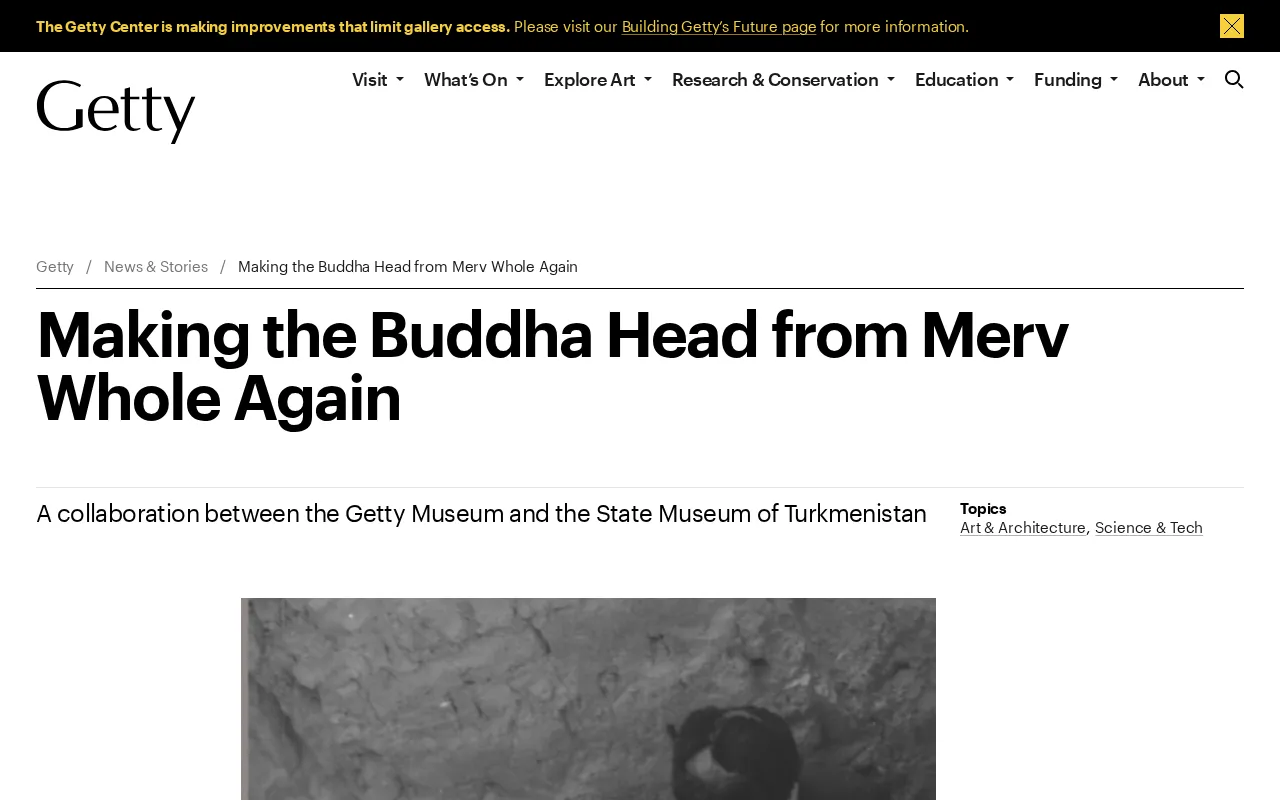
The ancient city of Merv is located in present-day Turkmenistan and was once an important hub for the eastward spread of Buddhism. The Buddha head statues here were usually made of stucco or plaster, with styles showing a fusion of Hellenistic, Persian, and Indian elements. Due to age and human destruction, many statues survive only as head fragments, often broken into pieces. The Buddha head being restored here is one such case; its fragments may be scattered across different collecting institutions, and digital technology becomes the key to reassembling them.
How Is Digital Restoration Achieved?
3D Scanning and Fragment Assembly
The project team first conducts high-precision 3D scanning of the Buddha head fragments to generate point cloud data. Then, through algorithms, they compare the geometric features and textures of fragment edges to automatically find the best assembly positions. This process is similar to solving a jigsaw puzzle, but it relies on shape matching and material analysis rather than visual judgment. According to the project description, the restoration focuses not only on appearance but also considers the symmetry and proportions of the Buddha statue to ensure that the restored head conforms to the aesthetic logic of the original sculpture.
Point cloud data is the basic output form of 3D scanning technology. Scanning devices (such as laser scanners or photogrammetry systems) emit light beams onto an object's surface or take multi-angle photographs, recording the three-dimensional coordinates (X, Y, Z) of countless points on the surface to form a dense set of points, i.e., a point cloud. Each point may also contain color or reflectance intensity information. Point clouds can accurately depict an object's geometry, but they are inherently discrete and lack topological structure. In digital restoration, point cloud data provides the raw data foundation for subsequent mesh reconstruction, feature extraction, and fragment matching. High-precision point clouds can capture tiny undulations along fragment edges, thereby helping algorithms determine whether two fragments were originally connected.
Geometric feature matching is the core algorithmic step in automatic fragment assembly. The basic idea is to extract geometric descriptors of fragment fracture edges (such as curvature, normal vectors, Fourier descriptors of edge contours, etc.), and then use optimization algorithms (such as iterative closest point, ICP, or its variants) to find the rigid transformation (rotation and translation) that aligns the edges of two fragments. In practice, the algorithm calculates alignment errors for all possible pairings and selects the combination with the smallest error. Because fragments may be worn or missing, matching usually needs to combine texture information (such as pigment residues and surface texture continuity) for multimodal verification. This process is highly related to the 3D registration problem in computer vision, but archaeological fragments often have irregular shapes and lack complete references, so prior constraints such as symmetry and proportion need to be introduced to improve reliability.
Virtual Restoration and Presentation
In the digital environment, missing parts are carefully filled in. The team may infer based on the style of Buddha statues from the same period and region, but speculative areas are marked in semi-transparent or different colors to distinguish original from restored parts. The final result may be presented through 3D printing or virtual reality, allowing the public to glimpse the solemnity of the Buddha head when complete.
Marking speculative areas with semi-transparency or different colors is a common practice in digital restoration that follows the principles of "reversibility" and "distinguishability." In the field of cultural heritage conservation, restored parts should be clearly distinguished from original parts to avoid misleading viewers or researchers. In digital environments, original fragments are usually rendered in solid color, while filled-in missing parts are presented in semi-transparent, gray, or bright colors, and display can be toggled in the interface. This practice stems from the concept of "distinguishable restoration" in archaeological drawing and physical restoration, namely that any intervention should be identifiable and reversible. In virtual presentations, viewers can intuitively see which parts are confirmed original material and which are reasonable inference, thereby maintaining a critical understanding of the restoration result.
The Archaeological Significance Behind the Technology
Digital restoration is not merely a technical demonstration; it also has academic value. First, it allows researchers to repeatedly test assembly schemes without touching the physical objects, reducing damage to fragile artifacts. Second, the restoration process itself can reveal ancient craftsmen's techniques and material choices, such as the thickness of plaster layers or pigment residues. In addition, the complete form of the Buddha head helps understand the evolution of Merv's Buddhist art and its transmission path along the Silk Road.
Challenges and Limitations
Despite advanced technology, digital restoration still faces challenges. Missing fragments may lead to excessive speculation, and different scholars may dispute restoration schemes. In addition, scanning precision, algorithmic errors, and the subjectivity of stylistic inference may all affect the credibility of the results. The project team needs to clearly mark uncertainties in reports to avoid misleading the public through "over-restoration."
Over-restoration refers to adding too much speculative content during restoration, causing the restored result to deviate from historical truth and even mislead public perception. In digital restoration, over-restoration may manifest as: filling missing parts too smoothly and completely without clearly marking speculative areas; or forcibly assembling mismatched fragments based on a single stylistic assumption. The risk is that digital models are often regarded as "objective" results, and the public easily overlooks the assumptions and uncertainties within them. Therefore, the project team needs to clearly mark uncertainties in reports, provide multiple restoration schemes for comparison, and retain original data for review. The academic consensus is that restoration should be as conservative as possible, prioritizing confirmed evidence, and keeping speculative parts to a minimum while explaining them.
Conclusion
"Making the Buddha Head from Merv Whole Again" represents a new direction in cultural heritage preservation: using digital technology as a bridge to connect a fragmented past with complete understanding. As more similar projects are carried out, we may gain a more comprehensive understanding of ancient civilizations while promoting deeper collaboration between archaeology and computer science.
(Note: This article is based on the Hacker News entry and publicly available archaeological background knowledge. Specific technical details of the project are subject to official releases.)
One-line Summary
Digital technology restores the Buddha head from Merv, connecting fragmented history with complete understanding.
Paragraph Summary
This article introduces the project "Making the Buddha Head from Merv Whole Again," which uses 3D scanning and algorithmic fragment assembly technology to digitally restore fragments of a Buddha head from Merv, an important city on the ancient Silk Road. The article reviews the historical background of Merv's Buddhist art, explains in detail the technical workflow from point cloud data acquisition and geometric feature matching to virtual restoration and presentation, and emphasizes the need to carefully mark speculative areas during restoration to maintain academic rigor. Digital restoration not only reduces physical intervention in fragile artifacts but also reveals ancient craftsmen's techniques and artistic transmission paths, while also facing challenges such as missing fragments, algorithmic errors, and the subjectivity of stylistic inference. The project demonstrates the prospects for interdisciplinary collaboration between archaeology and computer science.
Related articles

14 Core Concepts of Reasoning Models: From Chain of Thought to GRPO Explained
A systematic breakdown of 14 core concepts of reasoning models: chain of thought, test-time compute, verifiers, RLVR and GRPO, distillation, and reward hacking, plus rules for controlling thinking-token costs to help you decide when reasoning is worth paying for.
OpenAI's Claimed Refutation of ETH Sparks Debate, Meta Bets Big on AI Infrastructure
OpenAI claims an AI-assisted discovery that challenges the Exponential Time Hypothesis (ETH) and launches the mid-tier GPT-6.1 Tera. Cloudflare discloses a cross-customer data leak postmortem, and Meta plans $95B in AI infrastructure financing.

Data Scraping, AI Proofs, and Open Source Contracts: This Week's Deep Dive into the Tech World
From the 3D model crawler controversy and OpenAI's Lean formal proofs to AI agents challenging Brooks' Law and Debian rejecting LLM review, this week's tech discussions center on openness and verifiability.