Director of 'Obsession' Drops New Horror Short 'Mama Bear' on YouTube

Director Curry Barker of 'Obsession' releases nearly five-minute horror short 'Mama Bear' on YouTube, with an explicit-content warning.
Curry Barker, the director who drew genre attention with horror feature 'Obsession,' has released a new horror short 'Mama Bear' on YouTube, running under five minutes. It continues his precise command of suspense, is described as 'disturbing,' and carries a warning for some explicit imagery. The piece reads this return to shorts as a deliberate choice to experiment with more direct, sensory horror in low-budget short form—not a step back from features. As a key channel for horror shorts, YouTube lets the work skip traditional distribution and reach global audiences directly, while gathering feedback for his next project.
Curry Barker, the director who broke into the horror scene with Obsession, has just released a brand-new horror short on YouTube. Titled Mama Bear, the film runs under five minutes, continuing his precise command of suspenseful pacing while pushing further into bold visual territory.
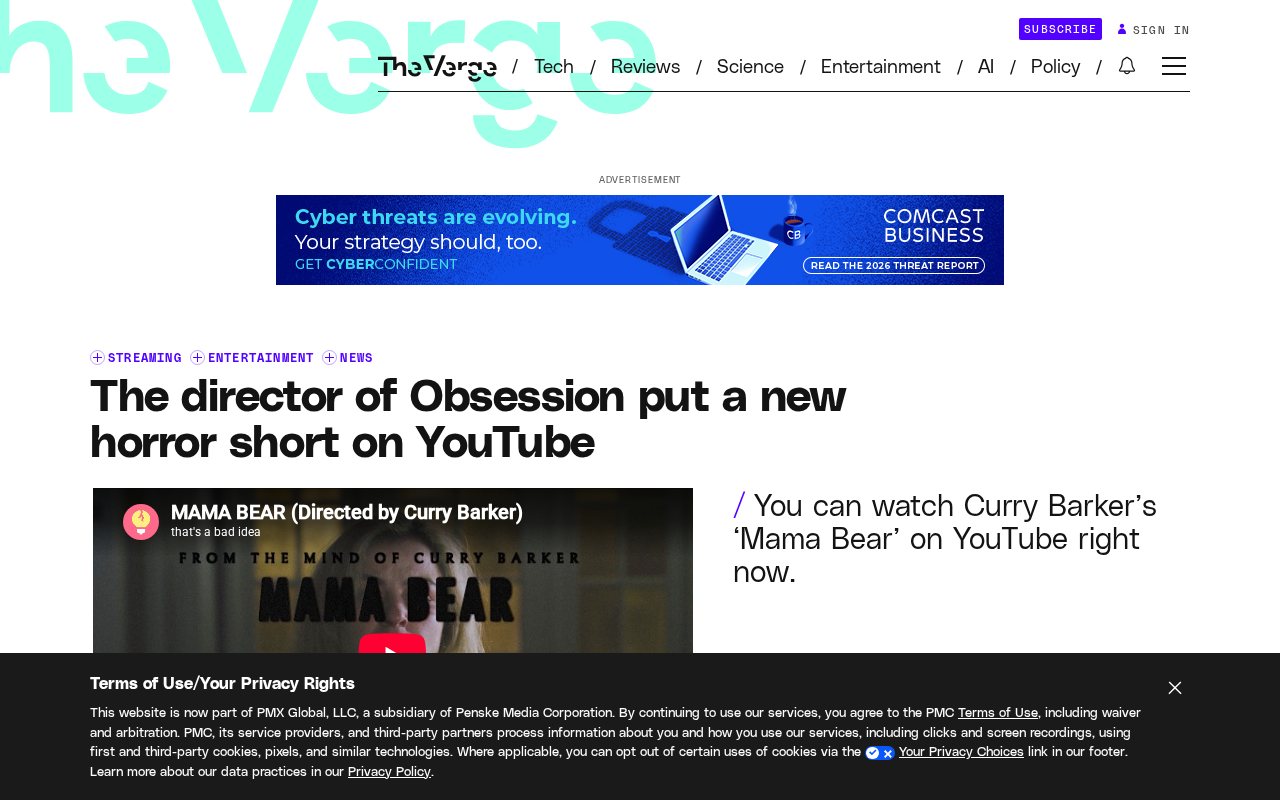
Director Background and the Short's Positioning
Curry Barker previously gained significant attention with the horror feature Obsession, which cemented his standing in the genre. This time, rather than continuing down the feature route, he's circled back to shorts, sending a clear creative signal: experimenting with more direct, more sensory horror within low-budget, short-form constraints. Mama Bear is not a family-friendly crowd-pleaser—it's more of a rapid authorial exercise, compressing the oppressive tension he excels at into just a few minutes.
Obsession is an independent horror feature co-directed by and starring Curry Barker and Cooper Tomlinson, which drew genre-circle attention after its 2024 festival premiere. Made on an extremely low budget, the film generates fear through confined-space staging and psychological pressure, and is regarded as one of the recent indie horror standouts that achieves much with little. Understanding the feature's production context helps situate Mama Bear: it isn't a casual diversion after success, but a continuation of the same low-cost, high-control creative path—and the visual experiments in the short could well feed back into future feature projects.
Content and Viewing Experience
According to the original description, Mama Bear can be summed up as "disturbing," and it contains some explicit imagery, for which the official release provides a warning. The short doesn't rely on complex setups or lengthy buildup; instead, it rapidly establishes tension within its limited runtime, dragging viewers into unease at the very moment they let their guard down. For audiences accustomed to seeking thrills on YouTube, this kind of quick, punchy horror experience fits perfectly with fragmented viewing habits—which also explains why it quickly gained traction on the platform.
Why Horror Fans Should Take Note
The short form has always held a special place in horror: it's both a calling card for emerging directors and a sandbox for established ones to test new ideas. Barker's choice to release a piece like this after Obsession signals at least two things. First, he's committed to maintaining a high creative output, using short-cycle projects to stay sharp. Second, he hasn't shied away from sharper, more marginal expression despite his feature success. The explicit-content warning on Mama Bear is itself a signal—this isn't a short made to please everyone, but a genre exercise with clear authorial intent.
From an industry perspective, YouTube has become a major channel for horror shorts. Compared to festival screenings, platform releases let works reach global audiences instantly and generate buzz on social media. By putting his new work directly on YouTube, Barker bypasses traditional distribution—lowering the barrier for viewers and accumulating more direct feedback data for his next project.
The YouTube ecosystem for horror shorts deserves separate mention. Unlike narrative features that depend on theatrical windows and streaming rights, shorts can be published on the platform with virtually zero barrier, and algorithmic recommendations plus word-of-mouth sharing within horror communities can bring in hundreds of thousands or even millions of views within days. David F. Sandberg was discovered by Hollywood after his short Lights Out went viral on YouTube, going on to direct the feature adaptation; Andy Muschietti's Mamá likewise traveled the path from short to feature. Such cases have made YouTube a de facto showcase for horror talent, and they let directors directly observe viewers' immediate reactions in the comments as reference for their next work.
Viewing Advice and What to Watch Next
Mama Bear runs close to five minutes, making it easy to take in entirely in one sitting. Because it contains some explicit imagery, viewers sensitive to gore should take note. For horror fans, the short offers a window into the director's stylistic evolution: from Obsession to Mama Bear, Curry Barker is experimenting with tighter structures and more direct means of generating fear. If the short generates enough response, it's entirely possible its creative direction will influence his future feature projects.
If you're interested in the director's next work, it's worth watching this short first, then going back to compare the narrative techniques in Obsession. Seen side by side, the two make it clearer how he adjusts horror pacing across different formats.
Related articles
The Touchscreen MacBook and Apple's Delightful Mess: A Deliberate Gamble
The Vergecast unpacks the touchscreen MacBook Pro's launch logic, the ProLed naming controversy, the iPad squeezed between iPhone and Mac, and how Apple stays competitive with premium hardware in the AI era.

Fifty Years Studying Power: Robert Caro's Writing and Insights on Power
Robert Caro reflects on 50 years studying power: Lyndon Johnson's persuasion and leverage, Robert Moses's transformation from idealist to ruthless builder, the dilemmas of large-scale construction, and his methods of compressing themes and solitary focus in biography writing.

Can a $20,000 Robot Do Your Chores? The Test Results Are Surprising
A YouTube test video shows how a $20,000 robot responds to commands like washing dishes, turning off lights, taking out trash, and feeding the dog. This article analyzes its real capability boundaries, the state of voice interaction technology, and how far household robots are from mainstream adoption.