Doc-foundry: AI Automatically Writes and Validates Security Detection Rules
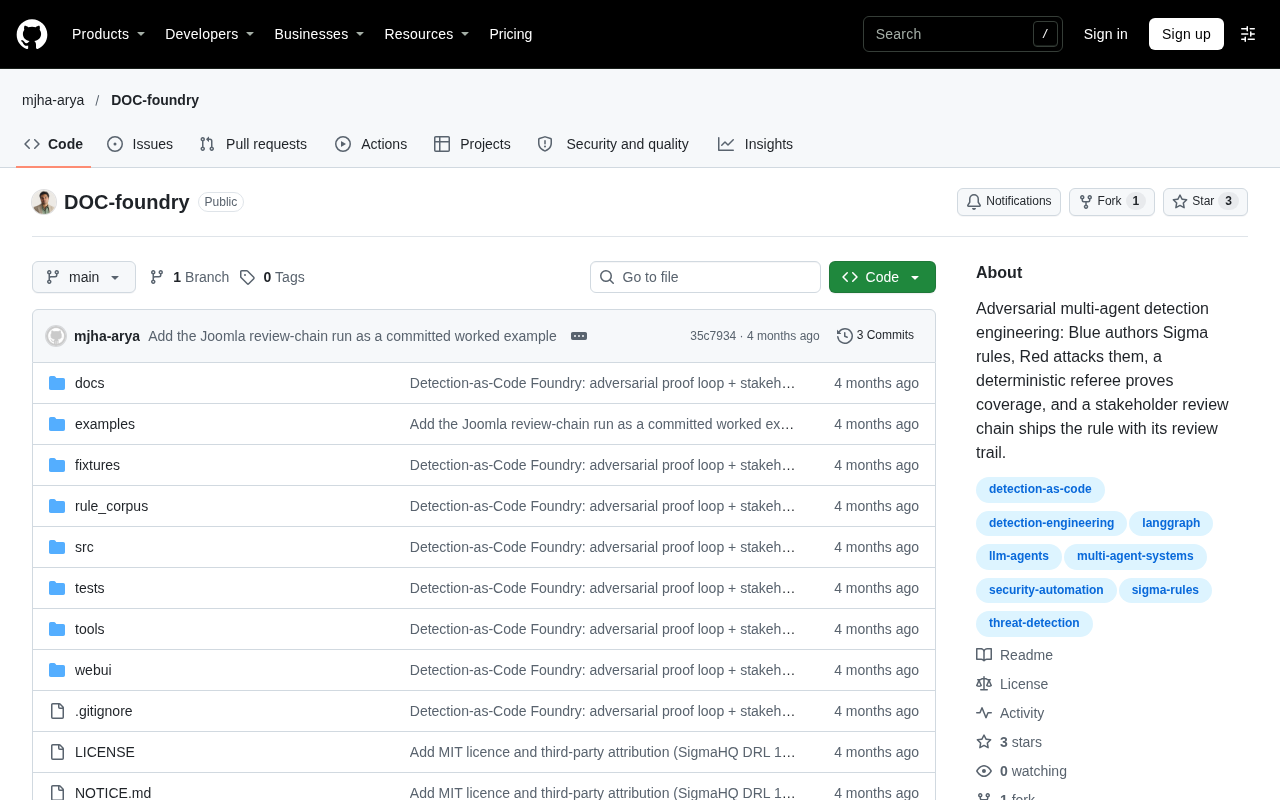
Doc-foundry advocates using AI to generate security detection rules and self-prove their effectiveness, hitting the pain point of rule trustworthiness, but validation details are still lacking.
Doc-foundry is a project introduced on Hacker News, whose core proposition is to let AI not only automatically generate security detection rules but also prove before delivery that the rules are actually effective. The article points out that traditional rule development relies on experts hand-writing rules and validating them in test environments, a loop that is slow and difficult to scale; AI generation can speed things up, but rules without validation may merely "look reasonable." In security scenarios, the hallucination risk of large models is amplified, and incorrect rules can lead to missed detections or false-positive fatigue. Therefore, the combination of "generation + self-proof" amounts to adding an engineering constraint to generative systems. The industry is shifting from piling up rules to managing rule quality, and such tools would be clearly valuable to small and medium-sized teams lacking dedicated detection staff. However, the project discloses limited information, with key details such as validation methods, covered scenarios, and false positive rate measurement missing, and there is no substantive feedback from the HN community; evaluation should focus on whether the validation mechanism is transparent and whether it can be reproduced in one's own log environment.
Security operations teams have long faced an awkward reality: writing detection rules relies heavily on expert experience, and the validation step after a rule is written is often even more time-consuming—whether a rule can actually catch the target attack behavior and whether it will produce a flood of false positives usually requires repeated debugging and testing against real traffic. Doc-foundry attempts to connect these two steps with AI: not only automatically generating security detection rules, but also proving that these rules are actually effective.
From "Able to Write" to "Proving Effectiveness"
According to the project introduction on Hacker News, Doc-foundry's core proposition is to let AI take on the work of writing detection rules and complete effectiveness validation before delivery. This positioning hits a key pain point in detection engineering: the number of rules has never been a scarce resource—trustworthy rules are.
The traditional rule development process is usually: security analysts hand-write rules based on threat intelligence or attack-defense experience, then run them against logs in a test environment for validation. This loop is slow, depends on individual skill levels, and is difficult to scale. Bringing AI into the generation step can significantly speed things up, but without validation, the resulting rules may merely "look reasonable"—syntactically correct and logically consistent, yet unable to catch attacks in practice, or so noisy that they are unusable. By making validation part of its product proposition, Doc-foundry means to solve the problem of rule trustworthiness, not just generation efficiency.
Detection Rules and False Positive Rates
Security detection rules (such as Sigma, YARA, and Snort rules) essentially formalize attack behavior characteristics into matchable conditional expressions. The quality of a rule is usually measured along two dimensions: recall (whether it can catch the target attack) and precision (whether it produces a large number of false positives). An excessively high false positive rate leads to "alert fatigue"—analysts are overwhelmed by noise and consequently ignore real threats, which is one of the most common operational pain points for SOC teams. Therefore, rule validation must not only test whether a rule can hit malicious samples, but also assess its false positive level on normal business traffic—both are indispensable.
Why This Direction Is Worth Watching
Automatic generation of detection rules is not a new idea, but the combination of "generation + self-proof" has special significance at the current stage. Content generated by large models carries hallucination risk, and in security scenarios this risk is amplified: an incorrect detection rule may cause real attacks to be missed, or may consume analysts' time. Requiring AI to provide verifiable evidence of effectiveness for its own output is essentially adding an engineering constraint to generative systems.
From an industry trend perspective, security operations is shifting from "piling up rules" to "managing rule quality." The maintenance costs and false-positive fatigue brought by rule base expansion are already common troubles for SOC teams. A tool system that can automatically generate and filter out highly trustworthy rules—if its validation step is solid enough—would be quite valuable to small and medium-sized security teams, which often lack dedicated detection engineering staff.
The Amplified Effect of LLM Hallucinations in Security Scenarios
When large language models generate content, "hallucinations" may occur—output that is grammatically fluent and logically consistent but factually incorrect. In the context of security detection rules, this risk is especially fatal: a rule that seems reasonable but is actually ineffective may lead a team to believe that a certain type of attack is already covered, thereby relaxing other protective measures and causing missed detections; or a rule with overly broad conditions may trigger massive false positives in production environments, consuming analysts' energy. Therefore, when introducing AI generation into security operations, verifiable evidence of effectiveness must accompany it, and the "surface reasonableness" of generated results must not be accepted on its own.
What Deserves Cautious Scrutiny
The original information is quite limited, and the details disclosed by the project remain at the level of claims: what method is used to validate rules, which attack scenarios the validation covers, and how false positive rates are measured—none of these key questions currently have public data to support them. The discussion热度 of the post on Hacker News is also not high, and the community has not yet provided substantive technical feedback or test results.
The trustworthiness of AI-generated detection rules ultimately depends on the rigor of the validation method itself. If validation only passes on synthetic data or limited samples, the real-world value of the rules remains questionable. For security teams considering trying such tools, it is advisable to examine whether their validation mechanisms are transparent and whether they support reproducible testing in their own log environments.
Common Methods of Rule Validation and Their Limitations
Validation of detection rules usually relies on three types of approaches: first, replay testing with known attack samples (such as Atomic Red Team and CALDERA simulations) to check whether rules trigger; second, evaluating false positive rates using normal business logs; third, adversarial testing in real or simulated environments. Validation on synthetic data or limited samples tends to overestimate rule effectiveness, because real attackers will mutate and obfuscate, and normal traffic is far more complex than test sets. Therefore, when evaluating a rule generation tool, attention should be paid to the source, scale, and diversity of its validation datasets, as well as whether it supports reproducible testing in users' own log environments—only validation results that can be stably reproduced in real environments have practical reference value.
Conclusion
Doc-foundry's "generation-as-validation" idea points to a pragmatic direction for AI implementation in security operations: not replacing analysts' judgment, but automating the repetitive labor of rule development and validation, and attaching testable evidence of effectiveness to the output. This direction is worth continued observation, but the currently available information is not sufficient to evaluate its actual effectiveness.
One-line Summary
Doc-foundry advocates using AI to generate security detection rules and self-prove their effectiveness, hitting the pain point of rule trustworthiness, but validation details are still lacking.
Paragraph Summary
Doc-foundry is a project introduced on Hacker News, whose core proposition is to let AI not only automatically generate security detection rules but also prove before delivery that the rules are actually effective. The article points out that traditional rule development relies on experts hand-writing rules and validating them in test environments, a loop that is slow and difficult to scale; AI generation can speed things up, but rules without validation may merely "look reasonable." In security scenarios, the hallucination risk of large models is amplified, and incorrect rules can lead to missed detections or false-positive fatigue. Therefore, the combination of "generation + self-proof" amounts to adding an engineering constraint to generative systems. The industry is shifting from piling up rules to managing rule quality, and such tools would be clearly valuable to small and medium-sized teams lacking dedicated detection staff. However, the project discloses limited information, with key details such as validation methods, covered scenarios, and false positive rate measurement missing, and there is no substantive feedback from the HN community; evaluation should focus on whether the validation mechanism is transparent and whether it can be reproduced in one's own log environment.
Related articles

AI Writes Your Code—Do You Still Need to Learn Git? Five Reasons
AI coding agents handle Git operations automatically—is it still necessary to learn Git? Five reasons: team communication, reviewing agent PRs, monitoring code changes, fallback when AI goes down, and the joy of learning—plus how the focus of learning Git is shifting in the agent era.

Anthropic Reportedly Prices IPO at $83 Per Share, Valuing Company at $1.5 Trillion
Anthropic reportedly prices IPO at $83 per share, above the expected range, with a fully diluted valuation of $1.5 trillion. This article analyzes the signal significance of the pricing and its impact on the AI industry's financing environment.
Open-Source Code Hosting Platform Codeberg Suffers Outage, Sparking Debate in Developer Community
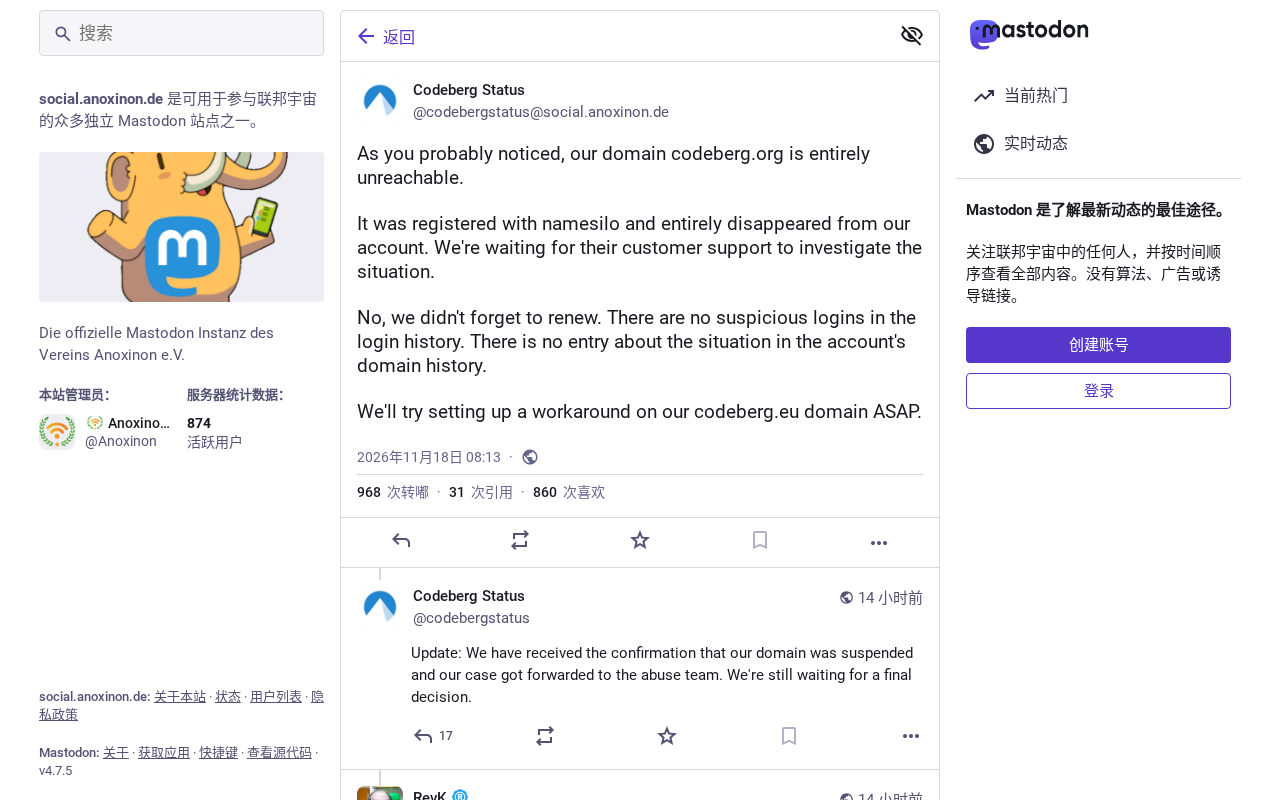
Open-source code hosting platform Codeberg.org suffered an outage, sparking Hacker News debate over nonprofit platform stability and open-source infrastructure dependency risks.