Don't Let Permission Pop-ups Scare Users Away: On-Demand Requests Are the Right Approach for AI Plugins

Requesting all permissions at once when installing AI plugins creates a permission wall; on-demand requests can reduce user fear and churn.
Based on a technical sharing video, the article analyzes the "permission wall" problem caused by AI plugins and skills requesting all permissions at once during installation. This model shifts all security decision pressure onto users who lack context, causing them to fear that they cannot judge whether the permissions are safe and to abandon use. The video proposes "on-demand requests": a skill initiates a permission request only when the user enters a specific space and data truly needs to be read, binding authorization to specific scenarios. The article argues that on-demand requests split permission decisions into contextual small steps, significantly reducing users' psychological burden, but require developers to design finer-grained permission trigger mechanisms. Although quantitative data is lacking, from the logic of interaction it can be judged that reducing the permission wall at install time is an effective direction for improving AI tool adoption.
AI plugins and skills present users with a long list of permissions at install time, and when faced with the question "are all these permissions safe?", users often simply give up. Based on a technical sharing video, this article explores why the "request-everything-at-install" model creates friction and fear, and how "on-demand requests" can improve the experience. The demo screenshots in the video show a comparison of the two interactions.
The Problem: The Permission Wall at Install Time Deters Users
Many AI plugins or skills require users to approve all permissions at once during installation, forming a "permission wall." The video describes this design as "more friction" and "a bit scary," because it directly confronts users with a pile of unknown authorization items. Users instinctively wonder: Are all these permissions safe? Should I agree to all of them? Without context, users find it hard to judge, and may ultimately abandon the product due to distrust.
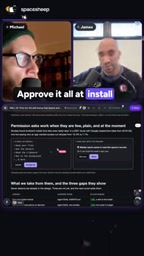
This upfront permission request model essentially shifts all the pressure of security decisions onto the user, who at that moment does not have enough information to make a judgment.
Why Users Feel Uneasy
The video further points out that when users face a list of permissions, the core confusion is "are they safe? You don't know." This uncertainty stems from the disconnect between permission requests and specific usage scenarios. At install time, users don't know which features the plugin will be used for in the future, so they can only decide whether to trust it based on intuition.

When permission requests lack scenario explanations, the cost of user decision-making is high, and fear rises accordingly. This explains why many users are cautious about installing new plugins.
Permission Fatigue is a recognized phenomenon in the security and privacy field: when users are repeatedly asked to make authorization decisions over a period of time, the quality of their decisions drops significantly, and they tend to mechanically click "agree" or simply give up using the product. Research shows that the more permissions a mobile app requests on average per installation, the higher the probability that users will uninstall it or abandon installation; and if permission requests lack explanations tied to the current task, users' trust is further reduced.
This concept explains why the "permission wall" in the article is harmful: it not only creates pressure for a single decision, but also accumulates into overall distrust of the product. Common strategies for alleviating permission fatigue include: postponing the request until the feature trigger point, providing a one-sentence scenario-based explanation (such as "used to read data in your current space to generate a summary"), and allowing users to continue using other features without granting a certain permission. These strategies align with the design direction of on-demand requests and can serve as a reference framework for product teams evaluating permission interactions.
The Solution: Request Permissions Only When Truly Needed
The core idea proposed in the video is: let skills initiate a request only when a certain permission is truly needed. For example, when the user is in a certain "space" and the skill needs to read the data behind that space, then pop up a request asking the user "can I do this?"

This on-demand request approach binds permissions to specific scenarios, so users can clearly understand why the permission is needed and make more informed decisions. At the same time, it avoids the oppressive feeling caused by asking for too many permissions all at once during installation.

From a product design perspective, on-demand requests split permission decisions into multiple small steps, each with clear context, making them easier for users to accept. For developers, this means designing finer-grained permission trigger mechanisms rather than packaging all permissions at the installation stage.
Incremental Authorization in OAuth 2.0 is the corresponding practice of the "on-demand request" model at the technical standard level. Traditional OAuth flows usually request all required scopes at once during the first authorization, whereas incremental authorization allows an app, after initial authorization, to request additional scopes when the user triggers a specific feature. Platforms such as Google already support this extension, which requires the authorization server to obtain user consent again each time a new scope is requested, and can return all currently granted scopes in the response. For AI plugin developers, this means scope sets can be split by functional module and authorization requests can be initiated dynamically at runtime, rather than packaging permission requests at the installation stage.
The key points for implementing incremental authorization include: the client needs to record granted scopes to avoid duplicate requests; the authorization server needs to support the include_granted_scopes parameter to merge old and new authorizations; and when the user refuses a new scope, the app should degrade gracefully rather than crash directly. These mechanisms closely match the product idea in the article of "splitting permission decisions into multiple small steps," and also provide developers with an actionable protocol-layer reference.
Implications for the AI Plugin Ecosystem
Although this sharing is brief, it points out a key contradiction in the permission design of AI tools: how to balance security and ease of use. Requesting permissions at install time may seem like "explaining everything at once," but in fact it increases the user's psychological burden; on-demand requests require more interaction design, but can significantly lower the barrier to use.
For product teams building AI plugins or skills, it is advisable to re-examine the timing and granularity of permission requests. Embedding permission requests into specific task flows and letting users make decisions with context can both enhance trust and reduce churn caused by permission fear.
The video does not provide specific performance data or user statistics, but from the logic of interaction it can be judged that reducing the upfront permission wall is an effective direction for improving the adoption rate of AI tools.
One-line Summary
Requesting all permissions at once when installing AI plugins creates a permission wall; on-demand requests can reduce user fear and churn.
Paragraph Summary
Based on a technical sharing video, the article analyzes the "permission wall" problem caused by AI plugins and skills requesting all permissions at once during installation. This model shifts all security decision pressure onto users who lack context, causing them to fear that they cannot judge whether the permissions are safe and to abandon use. The video proposes an alternative: "on-demand requests," where a skill initiates a permission request only when the user enters a specific space and data truly needs to be read, binding authorization to specific scenarios. The article argues that on-demand requests split permission decisions into contextual small steps, significantly reducing users' psychological burden, but require developers to design finer-grained permission trigger mechanisms. Although quantitative data is lacking, from the logic of interaction it can be judged that reducing the permission wall at install time is an effective direction for improving AI tool adoption.
Related articles

Lewis's Scoring Completely Out of Control: An Absurd Observation of Gaming Entertainment
Lewis's scoring rules completely out of control in gameplay, switching from rewards to penalties at will, even offsetting deductions and additions to zero. This article analyzes the entertainment logic and rule transparency issues behind such absurd scoring.

The Democrats' Leftward Path for 2028: Blurry Labels and Backroom Games
Using Florida candidate Angie Nixon's case, this analysis examines the Democrats' leftward path for 2028: the mismatch between national media label wars and local voter perception, and how elite donations, polls, and endorsements will decide candidates' fates before the 2027 primary.

One Glass of Orange Juice Contains a Shocking Amount of Sugar: How Continuous Glucose Monitoring Changes Dietary Perception
A glass of orange juice contains up to eight teaspoons of sugar. Continuous glucose monitoring reveals individualized dietary responses. This article explores the link between blood sugar and brain health and how CGM helps ordinary people make smarter dietary choices.