DoorDash Acquires Instacart for $17 Billion, Shaking Up the Grocery Delivery Market
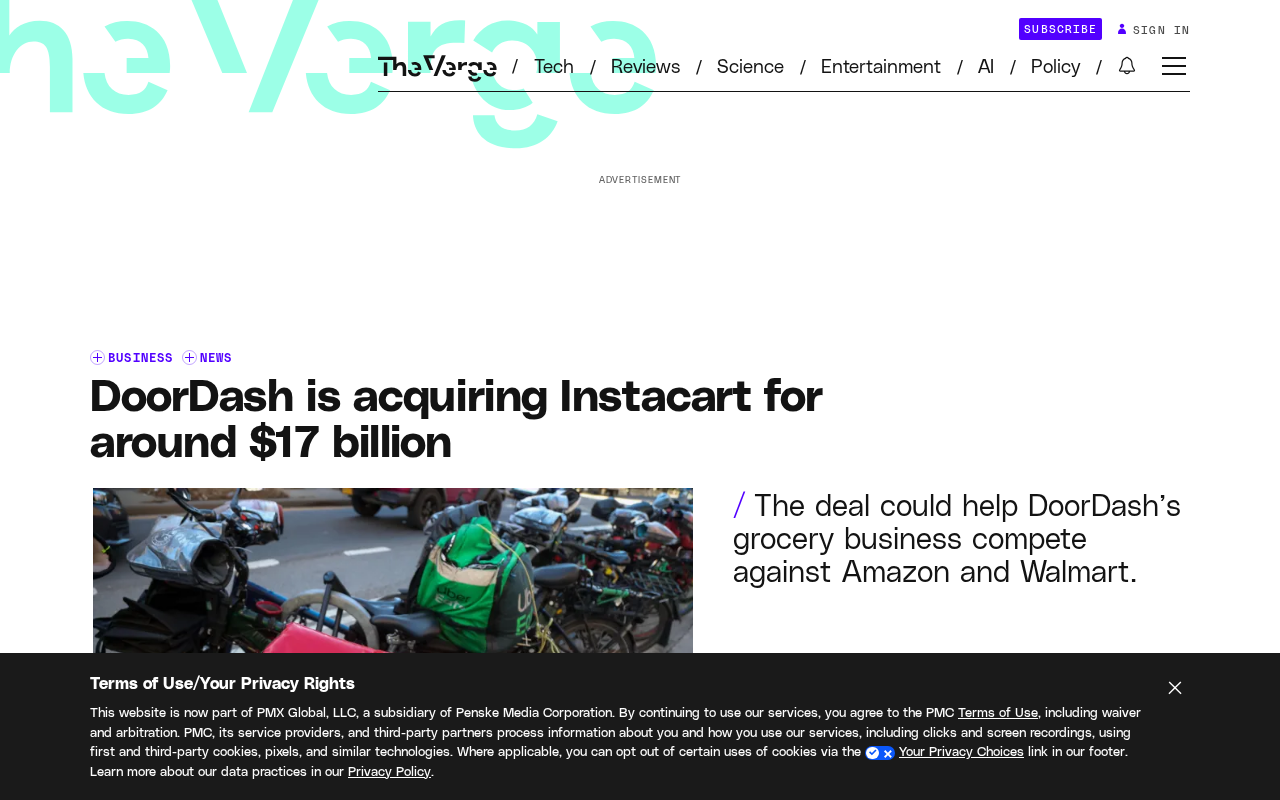
DoorDash acquires Instacart for $17 billion to shore up grocery delivery and reshape the industry.
DoorDash announced it will acquire grocery delivery platform Instacart for about $17 billion to address its competitive weakness in groceries. Instacart's mature retailer network and grocery marketplace are the deal's core assets. The merger will significantly increase U.S. grocery delivery market concentration and let DoorDash form a local life closed loop combining restaurant and grocery delivery, but may raise delivery fees long term. The deal faces antitrust review and integration challenges across culture and technology stacks. The article notes this reflects local delivery platforms' expansion into all categories and will test whether scale can bring sustainable profitability to low-margin grocery delivery.
Deal Overview: The Strategic Intent Behind $17 Billion
According to an RSS source, U.S. food delivery platform DoorDash announced it will acquire grocery delivery platform Instacart for approximately $17 billion. This is another major move following its expansion from restaurant delivery into multi-category delivery. Once the deal closes, DoorDash will gain Instacart's mature grocery marketplace platform and retailer partner network, significantly strengthening its competitiveness in the online grocery delivery space.
From a strategic perspective, this acquisition directly targets DoorDash's weakness. Although DoorDash has built its own grocery delivery business, in the face of intense competition from players such as Uber Eats and Amazon Fresh, its grocery category has never established a sufficient moat. Instacart, as a pioneer in the grocery delivery space, has established deep partnerships with numerous supermarket chains across the United States—exactly what can fill DoorDash's gaps in supply chain and retailer relationships.
Instacart's business model differs fundamentally from DoorDash's. Instacart is not a retailer with its own warehouses; instead, it operates on a "platform + crowdsourced shopper" model: after users place an order, independent contractors (Shoppers) go to partner supermarkets to purchase items on their behalf and deliver them. Its revenue mainly comes from commissions charged to retailers, service fees charged to users, and its advertising business. This asset-light model enables Instacart to quickly cover thousands of stores across the U.S., but it also relies heavily on relationships with retailers. Understanding this is key to seeing why the article emphasizes that "retailer partnerships" are the core asset of the deal—once retailers switch to another platform, Instacart's supply network would be weakened.
Potential Impact on the Industry Landscape
If this acquisition is successfully completed, the U.S. grocery delivery market will shift from a multi-player free-for-all to a more concentrated competitive landscape. DoorDash will simultaneously own two high-frequency scenarios—restaurant delivery and grocery delivery—forming a more complete closed loop of local life services. For consumers, more bundled services and subsidy campaigns may appear in the short term, but in the long run, increased market concentration could also put upward pressure on delivery fees.
Interestingly, Instacart's retailer partnerships are the core asset of this deal. These partnerships involve not only delivery fulfillment but also deep system integration such as inventory synchronization and product data interconnection. Whether DoorDash can keep these relationships stable after the acquisition will directly determine the actual value of the deal.
Antitrust and Integration Challenges
Despite the enormous deal size, a horizontal merger of this kind is likely to face strict scrutiny from U.S. regulators. Although competition in the grocery delivery market is intense, the combined DoorDash and Instacart would hold a significant market share, which could raise antitrust concerns. In addition, the differences between the two companies in corporate culture, technology stacks, and operating models cannot be ignored—DoorDash started with restaurant delivery and emphasizes delivery speed, while Instacart focuses more on planned purchasing and retailer services. Friction during integration could affect service quality.
A horizontal merger refers to a merger between direct competitors within the same relevant market, as opposed to a vertical merger (a merger between upstream and downstream companies). U.S. antitrust review is mainly based on Section 7 of the Clayton Act, focusing on whether a transaction may "substantially lessen competition" or "tend to create a monopoly." Review agencies (the Department of Justice or the Federal Trade Commission) define the relevant market, calculate market share and concentration (the HHI index), and assess the merger's impact on prices, innovation, and consumer welfare. In recent years, U.S. regulators have become stricter about acquisitions involving technology platforms and have filed lawsuits against several large transactions. If DoorDash and Instacart are found to compete directly in the same geographic market, the deal could be required to accept remedies such as divestitures, or even be blocked.
Future Outlook: The Final Battle for Local Delivery
This deal reflects the industry trend of local delivery platforms expanding from single categories to all categories. After acquiring Instacart, DoorDash will engage in more direct competition with retail giants such as Amazon and Walmart in grocery delivery. Whether it can effectively integrate Instacart's retailer network and technological capabilities while responding to regulatory scrutiny will be a key test for DoorDash going forward.
For industry observers, this acquisition also raises a more fundamental question: in the grocery delivery sector, where profit margins are generally low, can economies of scale really produce a sustainable profit model? DoorDash's bold bet may provide an important answer for the entire industry.
The profitability challenge of grocery delivery stems from its economic characteristics: although average order values are higher than restaurant delivery, picking, cold chain, shrinkage, and last-mile delivery costs are high, and gross margins are usually only in the single digits. The industry generally relies on membership subscriptions, advertising revenue, and delivery fees to improve unit economics. Economies of scale can theoretically spread fixed costs and increase delivery density, but only if order density is high enough and fulfillment efficiency continues to improve. DoorDash is betting that by channeling the high-frequency traffic of restaurant delivery into grocery scenarios and combining it with Instacart's retailer network, it can create cross-selling and a denser delivery network, thereby making the profit model work. Whether this assumption holds is precisely the essence of the "bold bet" mentioned in the article.
One-line Summary
DoorDash acquires Instacart for $17 billion to shore up its grocery delivery weakness and reshape the industry landscape.
Paragraph Summary
DoorDash announced it will acquire grocery delivery platform Instacart for approximately $17 billion, aiming to shore up its competitive weakness in the grocery category. Instacart's mature retailer partnership network and grocery marketplace platform are the core assets of the deal. After the merger, concentration in the U.S. grocery delivery market will rise significantly, and DoorDash can form a local life closed loop combining restaurant delivery and grocery delivery, though in the long run it may push delivery fees higher. The deal faces antitrust review as well as challenges in integrating corporate culture and technology stacks. The article notes that this reflects the trend of local delivery platforms expanding into all categories and will test whether economies of scale can deliver sustainable profitability in the low-margin grocery delivery sector.
Related articles

The Truth Behind Titanic's Sinking: Key Decisions and Communication Failures in the National Geographic Documentary
National Geographic's The Unsinkable Ship uses survivor testimony to reconstruct Titanic's fatal decisions—from the missing MSG telegram prefix and the broken boiler-room-to-bridge link to how 'unsinkable' thinking delayed damage control and evacuation.

74M-Parameter Open-Source Model Partially Outperforms Jev AI in Testing
Fastino AI's Glider 2.5 models, with just 74M–300M parameters, reportedly outperform Jev AI in some guardrail benchmarks per YouTube testing, run on consumer hardware, and even play Doom. We analyze small models' competitiveness and deployment value on specific tasks.

Gemini 4 Argon Hands-On: Aggressive Pricing, 3D Capabilities Need Coaching
Gemini 4 Argon hands-on: limited-time $2/$10 pricing, million-token output, strong 3D and reverse-engineering work, but weak front-end aesthetics and zero-shot ability need coaching.