DroidDeck: Running Steam Natively on Android — A New Open-Source Gaming Option

DroidDeck lets ARM Android phones run Steam natively, playable offline with multi-platform and Linux desktop support.
DroidDeck is a free, open-source Android app that aims to run the Steam client natively on ARM phones rather than stream it, so games can be downloaded locally and played offline. It offers Steam Big Picture with a library, store, cloud saves, and friends list matching PC, plus an overlaid virtual gamepad. It integrates FSR, Snapdragon GS, and RNIS upscaling with frame generation for performance, and supports GOG, Epic, and Amazon platforms alongside a built-in Linux desktop for ARM64 FlatHub apps. The project has 18k+ GitHub stars, but device compatibility and real-world performance still need user verification.
Putting Steam on Your Phone: What Is DroidDeck?
The success of the Steam Deck brought handheld gaming back into the spotlight, but its size and price still aren't for everyone. DroidDeck offers a lighter alternative: it's not a streaming tool — it runs the Steam client natively on ARM-based Android devices. That means games can be downloaded locally to your phone and played offline, with no dependence on a PC or network speed.
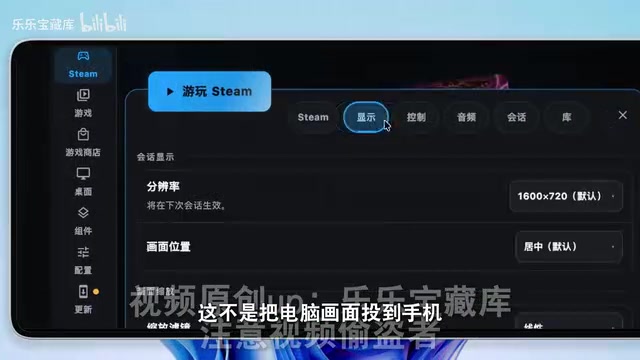
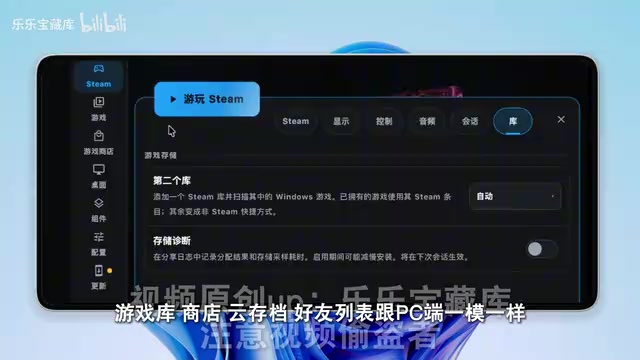
According to a Bilibili creator's introduction, DroidDeck has already garnered 18k+ stars on GitHub and is positioned as free, open-source software. It brings the Steam Deck experience to your phone: open it up and you get Steam Big Picture mode, with your game library, store, cloud saves, and friends list all consistent with the PC version. The core of this approach is "native execution" rather than "remote screen casting," which is especially critical for users with unstable network conditions.
The difference between ARM and x86: The Steam client and the vast majority of PC games are compiled for the x86 (Intel/AMD) instruction set, while Android phones generally use the ARM architecture — the two instruction sets are incompatible. So "running Steam natively on ARM Android" isn't a simple port; it typically requires x86 translation layers like Box64 or FEX-Emu to dynamically translate x86 instructions into ARM instructions, or relies on games and runtime libraries already compiled for ARM64. Translation incurs additional performance overhead, which is the fundamental reason such solutions demand high chip performance.
Virtual Gamepad and Upscaling Algorithms: Adaptations for Touchscreens and Performance
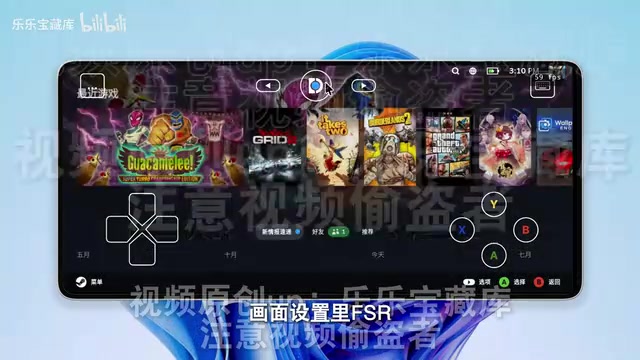
Playing PC games on a phone faces two natural obstacles: controls and performance. DroidDeck overlays a virtual gamepad directly at the bottom of the interface, complete with D-pad and ABXY buttons, so you can play right on the touchscreen.
On the performance side, the software offers graphics settings including FSR, Snapdragon GS, RNIS upscaling algorithms, and frame generation technology. The idea is to lower the rendering resolution first, then use algorithms to make up for image quality, achieving acceptable frame rates on mobile chips. For devices that support Bluetooth, connecting a keyboard and mouse or a controller turns the phone directly into a handheld console.
This combination of technologies isn't new, but integrating them into an open-source Android Steam environment lowers the barrier to entry for ordinary users. It should be noted that actual performance depends on the device's chip and the game itself; the original material doesn't provide quantitative frame rate data, so real-world experience still needs to be verified by users themselves.
The differences between FSR, Snapdragon GS, and RNIS: FSR (FidelityFX Super Resolution) is a spatial upscaling algorithm from AMD that boosts frame rates by rendering at low resolution and then scaling up; newer versions also incorporate temporal information. Snapdragon GS (Snapdragon Game Super Resolution) is Qualcomm's upscaling solution optimized for Snapdragon platforms, focused on low power consumption and mobile adaptation. RNIS is a neural-network-based upscaling algorithm that reconstructs high-resolution images using an inference network — it has higher image quality potential but also greater compute demands. The three have different positioning: FSR is highly versatile, Snapdragon GS leans toward mobile energy efficiency, and RNIS leans toward image quality; the actual choice requires weighing device performance against game requirements.
More Than Steam: Multi-Platform Game Libraries and a Linux Desktop
DroidDeck's ambitions go beyond Steam. According to the creator, games from GOG, Epic, Amazon, and other platforms can also be integrated, forming a unified multi-platform launcher.
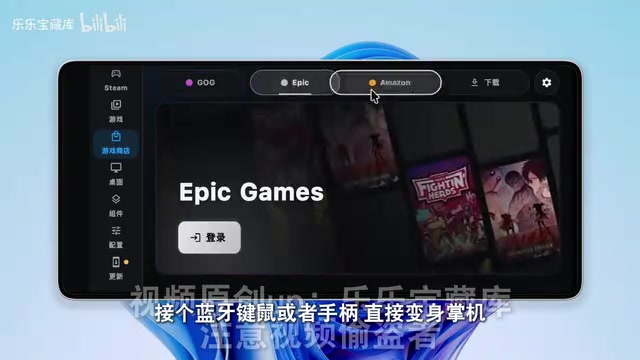
More unusually, it also includes a built-in Linux desktop environment with support for installing ARM64 FlatHub applications. That means the phone can be used as a mini PC beyond gaming. This "phone as computer" concept aligns with the current trend of rising mobile computing power and also provides the open-source community with an extensible experimental platform.
Flatpak and FlatHub: Flatpak is a sandboxed application packaging and distribution format on Linux — applications and their dependencies are bundled together, can run across different distributions, and permissions are isolated through sandboxing. FlatHub is the largest public Flatpak application repository. The phrase "ARM64 FlatHub applications" in the text refers to Flatpak packages compiled specifically for ARM64, which are far fewer in number than x86 versions, so the range of installable software is limited. Running a Linux desktop environment on Android typically relies on proot or container solutions rather than full virtualization — performance overhead is smaller, but there are limits to system call compatibility.
The Realistic Boundaries of an Open-Source Project
DroidDeck's 18k+ stars show strong community demand for "running Steam natively on Android." But as an open-source project, it still faces practical issues such as compatibility, driver adaptation, and performance tuning. The original material doesn't mention a specific device support list or game compatibility list, so users need to do their research before trying it.
From an industry perspective, DroidDeck represents a direction: as ARM chip performance improves and upscaling technology becomes widespread, mobile devices are evolving from "content consumption terminals" into "content production and execution platforms." Whether it can become a viable long-term solution depends on the sustainability of community maintenance, but at least for now, it offers players who want to play PC games on their phones a new option — free, open-source, and no need to turn on a computer.
Related articles
 Tech Frontiers
MuJoCo: An Analysis of DeepMind's Open-Source General-Purpose Physics Simulator
An in-depth analysis of Google DeepMind's open-source physics simulator MuJoCo: high-performance C++ kernel, MJCF modeling format, contact solving principles, MJX GPU acceleration, and robot reinforcement learning use cases.
 Tech Frontiers
Claude API Quick Start: The Official Quickstarts Project Collection
Anthropic's official claude-quickstarts project collection helps developers quickly build deployable apps with the Claude API. Nearly 20k stars, Python-based, great for beginners and prototyping.
 Tech Frontiers
AI Agents Connecting Directly to APIs: Which Calls Can Be Safely Allowed?
AI agents can call any API, but the real challenge is deciding which calls can be safely allowed. This article analyzes allowance decisions from three dimensions—intent matching, least privilege, and controllable impact—and argues that the control layer should sit outside the agent, combined with audit traceability to build a trustworthy API call governance mechanism.