Easy-Peasy.AI Launches AI Employee Teams: Division of Labor with Pre-Send Confirmation

Easy-Peasy.AI launches AI employee teams you can hire by role and collaborate with via group chat.
Easy-Peasy.AI launched AI Employees on Product Hunt, restructuring human-AI collaboration around a virtual team rather than a single assistant. Users can hire over 15 AI employee roles or define custom positions, with prompt engineering hidden behind job descriptions. Add your website as background knowledge, then assign tasks in a group chat where the lead splits work and members reply in threads. A default-on confirm-before-sending mechanism requires approval for emails, calendars, and app actions. Each employee has independent memory, a computer, and scheduled or email-triggered routines. The first employee is free; it received 66 votes and ranked 19th on Product Hunt.
In an era where AI assistants are everywhere, most products still operate in "solo" mode—you ask a question, it gives you an answer. But real work scenarios often require collaboration: someone coordinates, someone analyzes, someone designs, someone handles customer service. Easy-Peasy.AI's AI Employees, launched on Product Hunt, attempts to restructure human-AI collaboration around the idea of a "team" rather than an "assistant."
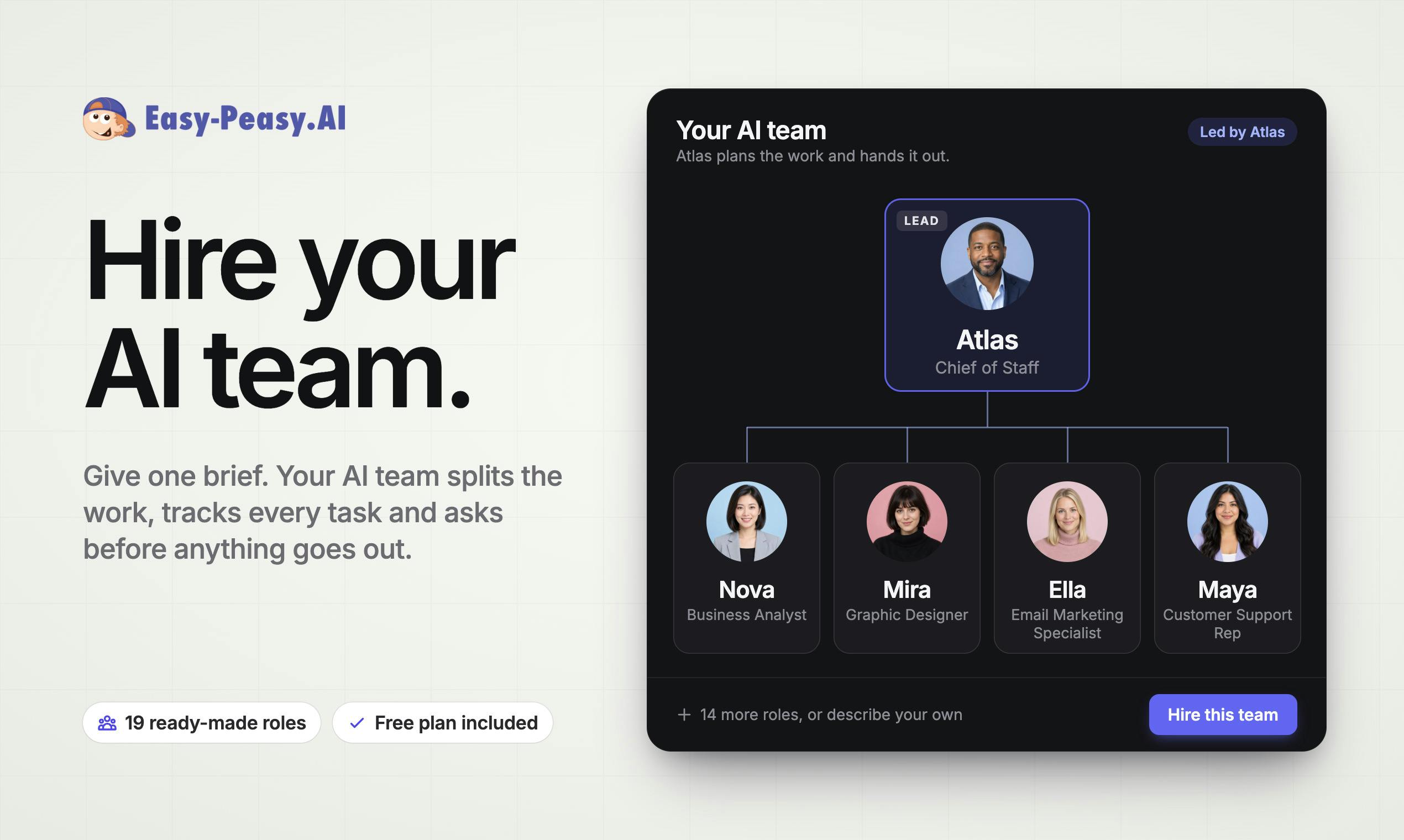
From Single-Point Q&A to Virtual Teams
The core selling point of AI Employees is straightforward: hire AI employees by role. The official description lists roles such as Chief of Staff, analyst, designer, and customer service representative—over 15 in total—and users can also describe the position they need in their own words. What's interesting about this design is that it hides "prompt engineering" behind "job descriptions"—you don't need to repeatedly tune a general-purpose model; you simply tell the system what kind of person you need.
After hiring, the workflow mirrors a real organization. Users add their website, and the team reads the site content as background knowledge; then they assign tasks to everyone in a group chat, where the lead breaks down the work, teammates reply in the same thread, and everything is ultimately consolidated into a complete deliverable. This "group chat-style collaboration" interaction is closer to how human teams work than traditional single-turn conversations.
Prompt Engineering refers to the practice of carefully designing input prompts to guide large language models toward desired outputs. In traditional single-model interactions, users must repeatedly adjust wording, supply context, and set roles before the model can reliably complete a specific task—creating a relatively high barrier to use. AI Employees hides this layer behind the product: users no longer face a general-purpose model directly but instead choose a preset job role (such as analyst or designer), with the corresponding role definition, task decomposition logic, and output format already encapsulated within the system. This "job description"-style abstraction is essentially prompt engineering turned into a product and templated, allowing non-technical users to obtain relatively stable professional output while reducing the cognitive burden of repeated tuning.
"Asks Before Sending": A Key Design for Trust
The most noteworthy part of the official tagline is actually the second half—asks before sending. By default, email sending, calendar changes, and app operations all wait for user confirmation.
This design addresses one of the biggest concerns when deploying AI agents: permission boundaries. Letting AI execute operations autonomously sounds great, but once external communication and scheduling are involved, the cost of errors rises sharply. Easy-Peasy.AI chooses to separate "execution" from "decision-making"—AI can plan, draft, and prepare, but a human still presses the send button in the end. For enterprise users, this may be a more persuasive selling point than "full automation."
AI Agents differ from ordinary chatbots in their "ability to act": they not only generate text but can also call tools, send emails, modify calendars, and operate apps—truly changing the external world. This capability brings significant efficiency gains but also introduces the "permission boundary" problem—once an agent autonomously performs an incorrect action, the cost of correction far exceeds editing a piece of text. A common industry approach is the Human-in-the-loop mechanism, which inserts a human confirmation step before key actions are executed. AI Employees' default-on asks before sending falls into this category: AI handles planning and drafting, while humans retain final approval authority. This "separation of execution and decision-making" model is a typical solution for balancing automation benefits and risk control when deploying enterprise-grade agents today.
Memory, Independent Computers, and Scheduled Routines
Beyond team collaboration, each AI employee has several noteworthy capabilities: its own memory, an independent "computer," and routines that can run on a schedule or be triggered by email.
Memory means employees can accumulate context rather than starting from scratch each time; an independent computer suggests each role has its own working environment rather than sharing the same session space; and the routines feature lets AI employees start automatically when an email arrives or execute tasks periodically on a schedule—moving them from "passive response" toward "proactive work." The official description also mentions that users can call these AI employees directly, further blurring the boundary between tool and colleague.
Multi-agent collaboration refers to a system architecture in which multiple AI agents with independent roles and capabilities divide the work toward a shared goal. Compared with a single general-purpose model handling all tasks, a multi-agent architecture gives each member a dedicated scope of responsibility, contextual memory, and tool environment—reducing interference between tasks and improving the stability of specialized output. Common collaboration patterns include a lead or coordinator responsible for task decomposition and result consolidation, while other members handle subtasks in parallel. AI Employees' group chat-style collaboration, independent memory, and independent computers are productized manifestations of this architecture. However, the actual effectiveness of multi-agent systems depends heavily on the reasonableness of task decomposition and the quality of information synchronization among members; if the coordination mechanism is imperfect, redundant work or fragmented context can easily occur.
Pricing and Market Feedback
The first AI employee is currently free—a low-barrier trial strategy. On Product Hunt, the product received 66 votes, ranked 19th, and has 7 comments—not explosive numbers, but given how crowded the Productivity and SaaS categories are, this starting performance shows it has tapped into some users' curiosity about "team-based AI."
Objectively, the concept of AI Employees is not entirely new; several frameworks and products on the market already focus on multi-agent collaboration. Its differentiation lies more in the degree of productization: out-of-the-box role templates, group chat-style task assignment, and a default-on human confirmation mechanism. Whether these designs can truly lower the barrier for enterprises to use AI still depends on the quality of collaboration in actual use—after all, an AI team that "knows how to divide the work" requires every member to be reliable enough.
For teams wanting to try it out, the free first employee lowers the cost of experimentation; but for users with serious business needs, it's advisable to start by validating with small-scope, low-risk tasks before gradually expanding permissions.
One-line Summary
Easy-Peasy.AI launches AI employee teams that can be hired by role and collaborate via group chat.
Paragraph Summary
Easy-Peasy.AI launched AI Employees on Product Hunt, restructuring human-AI collaboration around a "virtual team" rather than a "single assistant." Users can hire over 15 types of AI employees by role or define custom positions, with the system hiding prompt engineering behind job descriptions. After hiring, users add their website as background knowledge, and in a group chat the lead breaks down tasks while members reply in threads and consolidate output. The product has a default-on "confirm before sending" mechanism—emails, calendars, and app operations require user approval, emphasizing permission boundaries. Each employee also has independent memory, an independent computer, and routines triggered by schedule or email. The first employee is free; it received 66 votes and ranked 19th on Product Hunt.
Related articles
 Tech Frontiers
Coldframe: A Honeypot Disguised as a Supermarket Freezer Controller
Coldframe is a honeypot disguised as Danfoss AK-SM 800A and Dixell XWEB freezer controllers, built as a single Python file that detects CVE-2025-41450 attempts and is identified as real devices on Shodan.
 Tech Frontiers
GRFNet: A Lightweight PyTorch Model Designed for Multichannel Time-Series Classification
GRFNet is a lightweight PyTorch model for multichannel time-series classification, originating from EEG decoding research. With only 3,847 parameters, it is based on the ROCKET architecture, combining random convolution kernels with learnable spatial filters, supports arbitrary input lengths, and will soon be evaluated on the PhysioNet dataset.
 Tech Frontiers
CUDA-Accelerated Rocket League Simulator: A Player-Made Hardcore Experiment
A Reddit post shows a "100% Accurate" Rocket League simulator accelerated with CUDA. We analyze its technical context, CUDA's value in game physics simulation, and the significance and limitations of such community projects.