ElevenLabs Teams Up with SoundCloud: One-Click Publishing for AI Music

ElevenLabs connects the one-click publishing pipeline for AI music to SoundCloud, with over 25 million tracks generated cumulatively.
ElevenLabs announced that users can publish AI music generated by its music model directly to SoundCloud, connecting the complete pipeline from generation to distribution and compressing publishing into a one-click operation. Its music model has cumulatively generated over 25 million tracks, marking the transition of music generation from a novelty tool to a production tool with real output volume. Choosing to integrate with SoundCloud rather than build its own channel lowers the cost of reaching listeners, but it also brings new governance challenges: a massive influx of AI content could dilute exposure for human-created works, and copyright ownership, labeling obligations, and review rules all face pressure, while neither party has disclosed AI content labeling mechanisms. The article argues that the competitive focus is shifting from generation capability to the battle for the entry point of the AI music workflow, and creators' competition will increasingly hinge on creativity and curation ability.
From Generation to Publishing: AI Music Takes a Key Step
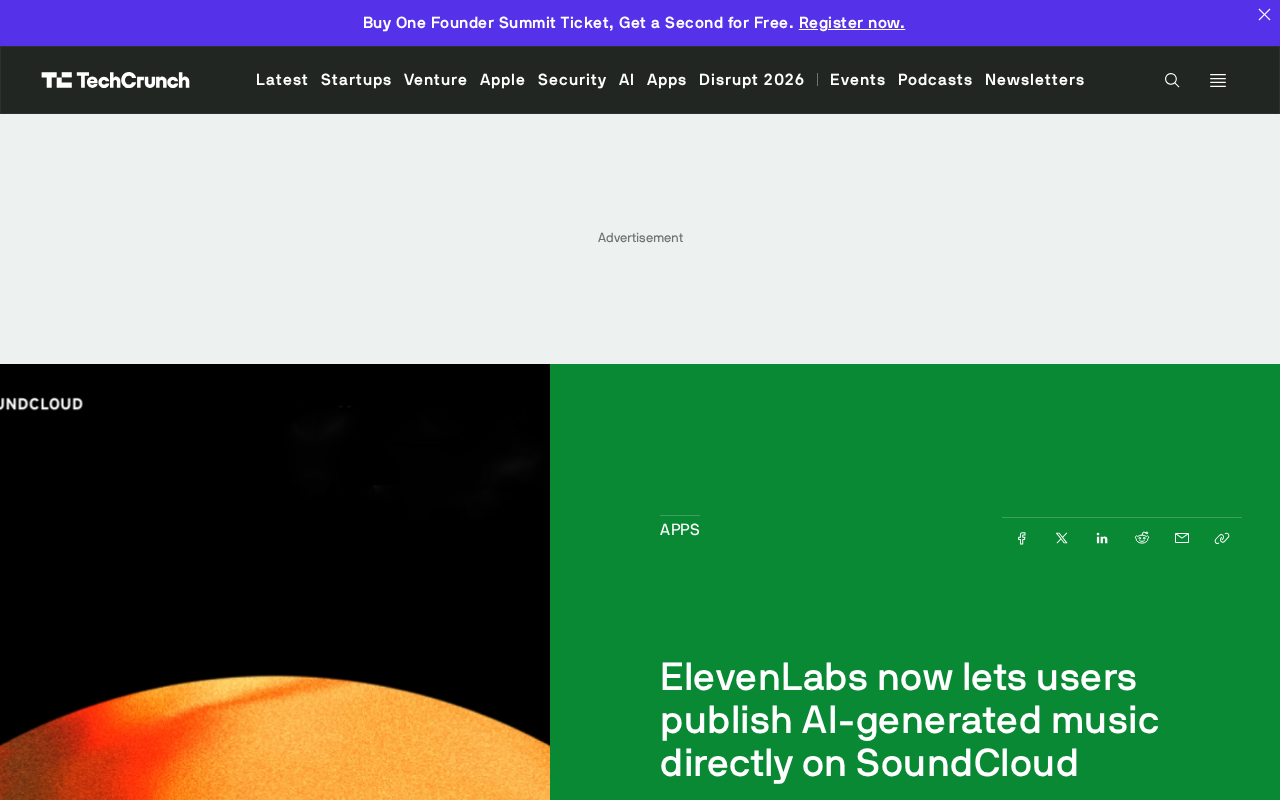
ElevenLabs, a leading player in the AI audio space, has announced that users can now publish AI music generated by its music model directly to the SoundCloud platform. This means AI music creation no longer stops at local export—it now has a distribution outlet aimed at real listeners.
The core message is straightforward: ElevenLabs has connected the "generate-to-publish" pipeline. In the past, users had to manually upload their generated music to streaming platforms after creating it, resulting in a fragmented workflow; now the integration between platforms compresses the publishing action into a one-click operation, officially bringing AI music into the "publicly listenable" stage.
ElevenLabs is an AI audio company that started with text-to-speech and voice cloning technology. Its core product is built on self-developed audio generation models, initially serving scenarios such as audiobook narration, dubbing, and podcast production. In recent years, the company has gradually extended its model capabilities from speech to music generation, launching AI music creation features for creators. Understanding this background helps clarify the significance of this integration: ElevenLabs is not a new player entering the music track from scratch, but rather extending its existing audio generation technology stack into the music category, with its user base and engineering accumulation forming the foundation for cross-sector competition.
What 25 Million Tracks Means
ElevenLabs revealed that its music model has generated over 25 million tracks cumulatively. This number is not insignificant in the broader landscape of AI-generated content—it shows that music generation has moved from a novelty toy to a tool with real output volume.
For content creators, this scale of change is worth noting. When the generation barrier is low enough and the output scale large enough, the scarcity of music creation shifts from "can you make it" to "can you choose well"—the value of curation, arrangement, and aesthetic judgment is amplified instead.
Impact on SoundCloud and the Creator Ecosystem
SoundCloud has long been a launchpad for independent musicians, and its open upload mechanism and community atmosphere make it a natural testing ground for AI music. ElevenLabs chose to integrate with SoundCloud rather than build its own distribution channel, which is logically lighter and makes it easier to reach existing listener groups.
However, this also brings new challenges for platform governance. A massive influx of AI-generated music could dilute exposure opportunities for human-created content, and copyright ownership, labeling obligations, and platform review rules will all come under pressure. Neither ElevenLabs nor SoundCloud has disclosed in public information any labeling mechanisms or filtering strategies for AI content—a gap worth continued observation.
Founded in 2007, SoundCloud is one of the world's larger open music-sharing platforms, known for low-barrier uploads, creator community interaction, and independent music premieres. It differs fundamentally from streaming platforms like Spotify and Apple Music, whose content libraries are primarily licensed from record labels, in terms of content sourcing mechanisms. Precisely because of its open uploads and relatively lenient review, SoundCloud has long been regarded as a testing ground for emerging music forms and independent artists. This characteristic makes it a natural landing channel for AI-generated music, but it also means the platform faces more direct content governance pressure than others.
Labeling obligations for AI-generated content are one of the focal points of current regulatory and industry discussion. The EU AI Act requires machine-readable marking of synthetic audio and other content, and China has also issued relevant regulations on labeling generative content. Major platforms are broadly exploring solutions such as audio watermarking and metadata tagging. For music platforms, whether to create separate zones for AI tracks or mandate labeling directly affects listeners' right to know and the fairness of exposure for human creators. ElevenLabs and SoundCloud have not yet made relevant mechanisms public—this gap is precisely the key variable for assessing the long-term impact of this integration.
Competitive Landscape in the Music Generation Track
ElevenLabs started with speech synthesis and is extending into music generation, expanding its capabilities on top of its existing audio technology stack. Compared with music-focused generation tools, its advantage lies in its overall accumulation in audio processing and existing user base; its challenge lies in the fact that musical aesthetics and production workflows are far more complex than speech.
Connecting generation results directly to a distribution platform is essentially about competing for the entry point of the "AI music workflow." Whoever can make the path from creation to publishing the shortest is more likely to retain creators. The significance of this move may exceed that of a single feature update.
A Few Questions Worth Watching
- How copyright ownership of AI music is defined at the publishing stage remains unclear;
- Whether SoundCloud will introduce AI content labeling or separate zones will affect the transparency of the ecosystem;
- At an output scale of 25 million tracks, can the platform's content discovery mechanisms effectively distinguish quality?
For content creators using AI tools to make music, this integration pipeline lowers publishing costs, but it also means the competitive pool will grow faster. Convenience at the tool level is already in place; what comes next is a contest of creativity and curation ability.
One-line Summary
ElevenLabs connects the one-click publishing pipeline for AI music to SoundCloud, with over 25 million tracks generated cumulatively.
Paragraph Summary
ElevenLabs announced that users can publish AI music generated by its music model directly to SoundCloud, connecting the complete pipeline from generation to distribution and compressing the publishing action into a one-click operation. Its music model has cumulatively generated over 25 million tracks, marking the transition of music generation from a novelty tool to a production tool with real output volume. Choosing to integrate with SoundCloud rather than build its own channel lowers the cost of reaching listeners, but it also brings new challenges for platform governance: a massive influx of AI content could dilute exposure for human-created works, and copyright ownership, labeling obligations, and review rules all face pressure—while neither party has disclosed AI content labeling mechanisms. The article argues that the competitive focus is shifting from generation capability to the battle for the entry point of the AI music workflow, and creators' competition will increasingly hinge on creativity and curation ability.
Related articles
 Tech Frontiers
Coldframe: A Honeypot Disguised as a Supermarket Freezer Controller
Coldframe is a honeypot disguised as Danfoss AK-SM 800A and Dixell XWEB freezer controllers, built as a single Python file that detects CVE-2025-41450 attempts and is identified as real devices on Shodan.
 Tech Frontiers
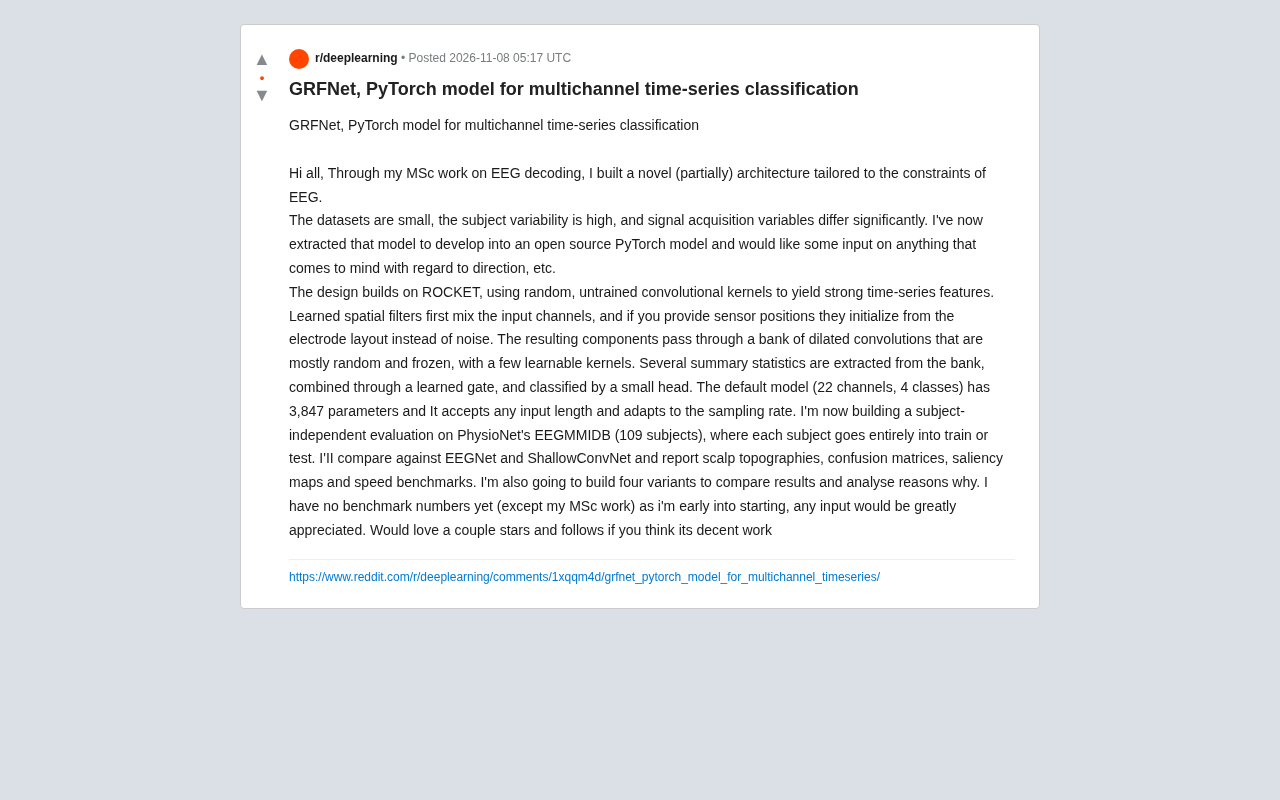
GRFNet: A Lightweight PyTorch Model Designed for Multichannel Time-Series Classification
GRFNet is a lightweight PyTorch model for multichannel time-series classification, originating from EEG decoding research. With only 3,847 parameters, it is based on the ROCKET architecture, combining random convolution kernels with learnable spatial filters, supports arbitrary input lengths, and will soon be evaluated on the PhysioNet dataset.
 Tech Frontiers
CUDA-Accelerated Rocket League Simulator: A Player-Made Hardcore Experiment
A Reddit post shows a "100% Accurate" Rocket League simulator accelerated with CUDA. We analyze its technical context, CUDA's value in game physics simulation, and the significance and limitations of such community projects.