Enterprise Analytics Agent Evaluation Framework Comparison: Stability, Detection, and Discovery

Evaluation framework information quantity determines evaluation quality; adopt trace-based evaluation plus red-teaming.
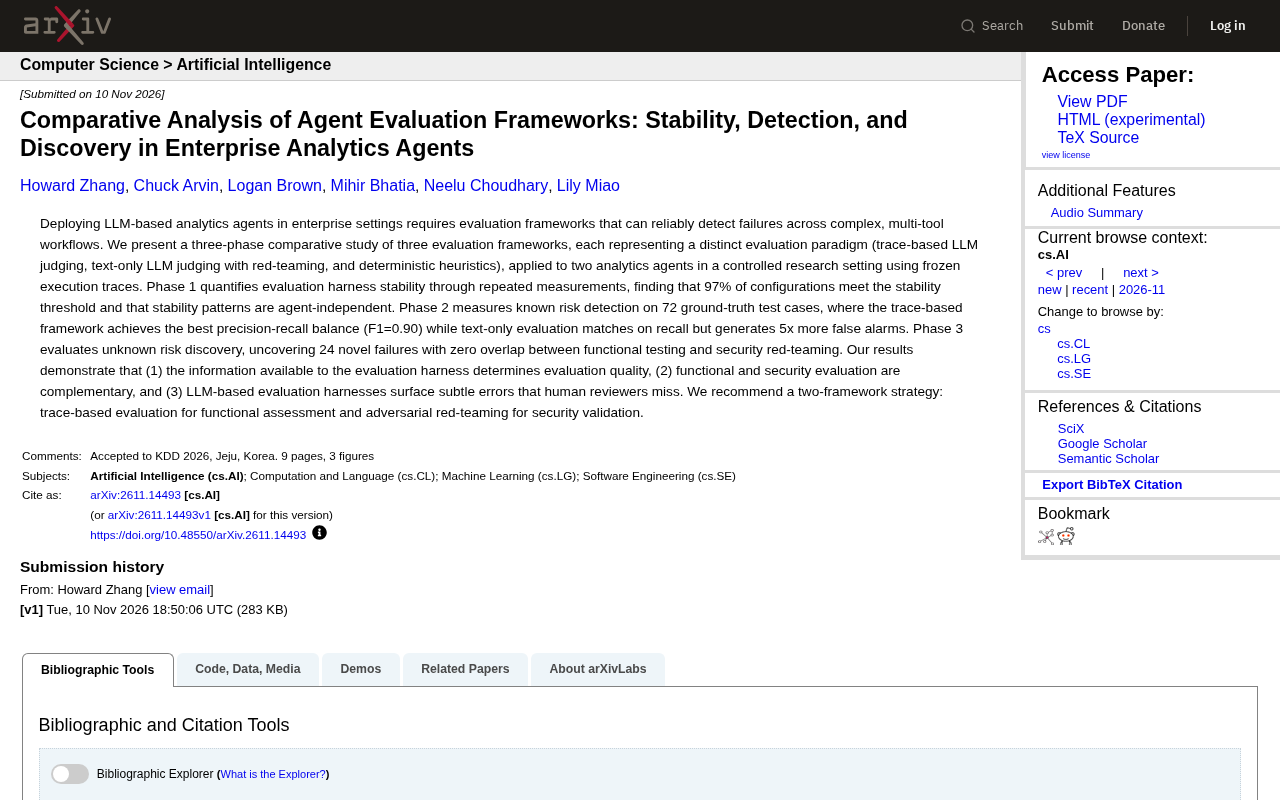
A comparative study of three agent evaluation paradigms on frozen execution traces reaches a core conclusion: an evaluation framework's information quantity sets the ceiling on evaluation quality. In three phases: 97% of configurations met stability thresholds, with stability independent of the agent; trace-based LLM judging achieves 0.90 F1 while text-only evaluation matches on recall but has 5x false positives; and 24 novel failure cases were found, with functional testing and security red-teaming showing zero overlap. The study recommends a dual-framework strategy of trace-based functional evaluation plus adversarial red-teaming.
Why Do Agent Evaluation Frameworks Need to Be "Evaluated"?
Deploying an LLM-based analytics agent in an enterprise environment means it must run continuously across complex, multi-tool, multi-step workflows. A seemingly minor error—selecting the wrong data table, misinterpreting aggregation logic, or crossing a permission boundary—can trigger cascading consequences. The evaluation framework itself must therefore be reliable: it needs to reproduce results consistently, accurately identify known risks, and surface unknown failures the team never anticipated.
A comparative study of three evaluation paradigms, testing two types of analytics agents on frozen execution traces in a controlled environment, delivers a highly practical conclusion: the amount of information an evaluation framework can access directly determines the ceiling on evaluation quality. The study also proposes a dual-framework strategy: trace-based evaluation for functional health checks, and adversarial red-teaming for security validation.
Three Evaluation Paradigms, Three Technical Approaches
The three frameworks compared in the study represent the mainstream approaches to agent evaluation today:
Trace-based LLM judging: The evaluator has access to the agent's complete execution trace, including every tool call, intermediate output, and reasoning step. This offers the most information and the strongest basis for judgment.
Text-only LLM judging with red-teaming: The evaluator sees only the final output or conversation text, without deep insight into the execution process; adversarial testing is introduced alongside to actively probe security boundaries.
Deterministic heuristics: Predefined rules perform the checks without relying on LLM judgment. Reproducibility is highest, but sensitivity to complex semantic errors is limited.
Each approach involves trade-offs, and the study's design runs all three on the same batch of frozen traces, stripping out runtime variability so that differences can be genuinely attributed to the evaluation framework itself.
Execution trace is the key concept for understanding this article. It refers to the complete record an agent leaves behind during a single task run: the input prompt at each step, the model's reasoning process, tool call parameters and return results, intermediate state changes, and the final output. Trace-based evaluation offers the most information precisely because the evaluator can follow this chain to locate which step the error occurred at—whether the retrieval stage selected the wrong data table, or the aggregation stage misinterpreted the metric definition. By contrast, text-only evaluation sees only the endpoint of the trace, losing process information. The "frozen traces" repeatedly mentioned in the study refer to saving traces produced by real runs in their entirety, then evaluating repeatedly on these fixed, unchanging traces—thereby eliminating interference from model sampling randomness and tool environment variability, so that differences between evaluation frameworks can be genuinely attributed to framework design itself.
Phase One: Stability Is the Prerequisite for Evaluation
If an evaluation framework is itself unstable, with repeated measurements producing erratic results, then any score it produces is untrustworthy. The first phase of the study quantifies the stability of the evaluation harness: through repeated measurements, it observes whether the same batch of traces yields consistent judgments across different configurations.
The results are relatively encouraging—97% of configurations met the stability threshold. A more interesting finding is that stability patterns are unrelated to the agent itself: that is, the stability of an evaluation framework depends more on framework design and configuration than on the characteristics of the evaluated subject. This has direct implications for enterprise practice: you can reuse the same validated evaluation configuration across agents on different business lines, without re-calibrating stability for each agent.
However, the remaining configurations that failed to meet the threshold also warrant attention. Failing stability often means evaluation results contain noise, potentially misclassifying occasional fluctuations as real defects, or conversely, masking real problems. Repeated-measurement validation of the evaluation harness before going live should become standard practice.
Phase Two: Detection Capability for Known Risks
The second phase uses 72 test cases with ground-truth answers to measure each framework's ability to detect known risks. The core metric is the balance between precision and recall.
The trace-based framework performs best, achieving an F1 of 0.90 and the best balance between precision and recall. Text-only evaluation matches it on recall—meaning it catches essentially all the problems it should—but at the cost of producing 5 times the false positives. This figure is telling: a text-only evaluator lacks execution context and easily misclassifies normal behavior as risk, generating a large volume of false alarms.
For enterprise teams, 5 times the false positives means not only higher evaluation costs, but more seriously, alert fatigue. When engineers grow accustomed to large numbers of false positives, genuinely severe problems may be overlooked. The study does not provide specific figures for deterministic heuristics in this phase comparable to the other two, but their limitation lies in limited rule coverage, making it difficult to catch complex semantic-level errors.
Precision and recall are the two fundamental dimensions for evaluating detection capability. Precision measures "how many of the risks the evaluator flags are real," while recall measures "how many of the risks that actually exist the evaluator catches." The two often trade off: tightening the criteria reduces false positives but increases missed detections; loosening them does the opposite. F1 is the harmonic mean of the two, used to comprehensively measure the degree of balance. Understanding this clarifies the meaning of the data in the article: text-only evaluation matches the trace-based framework on recall, indicating it does not miss the problems it should catch, but it flags large amounts of normal behavior as risk, so precision drops, ultimately manifesting as 5 times the false positives. For enterprises, the direct cost of false positives is investigation time, while the indirect cost is alert fatigue—engineers gradually become desensitized to alerts, and genuinely high-risk problems get drowned out.
Phase Three: Discovery Capability for Unknown Risks
The third phase focuses on whether evaluation frameworks can discover failure modes the team has not defined in advance. The study identified 24 novel failure cases in this phase, with a key observation: functional testing and security red-teaming produced zero overlap in findings.
What does zero overlap mean? Functional evaluation and security evaluation probe completely different failure spaces. Functional testing cares about "did the agent do the task correctly," while security red-teaming cares about "will the agent engage in dangerous behavior under adversarial input." Neither can substitute for the other; both are essential.
The study also notes that LLM-based evaluation harnesses can catch subtle errors that human reviewers easily overlook. This has practical implications for designing enterprise evaluation processes: human review remains important, but should not be the only discovery mechanism.
Red-teaming originates in security engineering and refers to one party playing the role of attacker, actively constructing adversarial inputs to systematically probe a system's weak points. In LLM agent scenarios, typical red-teaming techniques include prompt injection, inducing unauthorized access, crafting boundary-case data requests, and exploiting trust assumptions in tool call chains to produce dangerous behavior. Its fundamental difference from functional testing lies in the different objective: functional testing verifies whether the agent does the right thing under normal tasks, while red-teaming assumes malicious or extreme inputs exist and tests the agent's defensive boundaries. This explains the "zero overlap in findings" observed in the study—the two types of testing explore different failure spaces, and one framework cannot replace the other. Another characteristic of red-teaming is that its test cases often need continuous evolution, because each new class of attack surface discovered means new adversarial samples must be designed to cover it.
Dual-Framework Strategy: Functional and Security Roles Are Distinct
Based on the three-phase results, the study's recommendation is clear and pragmatic: adopt a dual-framework strategy.
Use trace-based evaluation for functional evaluation. It can leverage complete execution context to achieve the best precision-recall balance in known-risk detection, with controllable false positives.
Use adversarial red-teaming for security validation. Its discovery space barely overlaps with functional testing, specifically covering risks under adversarial scenarios.
The core argument behind this strategy is what the study repeatedly emphasizes: the amount of information the evaluation harness can access determines evaluation quality. To enable the evaluator to make accurate judgments, you must give it sufficient information; to ensure evaluation covers security boundaries, you must specifically design adversarial tests rather than expecting functional testing to incidentally uncover security issues.
Key Takeaways for Enterprise Deployment
First, framework selection is not about finding "the single strongest one," but about combining them by purpose. Functional evaluation and security evaluation have different objective functions; forcing one framework to cover all scenarios either leads to runaway false positives or incomplete coverage.
Second, stability validation should come first. The fact that 97% of configurations meet the threshold shows that infrastructure is reliable in most cases, but if those 3% noise sources are not investigated, they will amplify risk at critical decision points.
Third, freezing traces is an engineering practice worth adopting. Evaluating on fixed traces effectively isolates runtime variability, making comparisons between frameworks genuinely attributable.
Fourth, beware of evaluators that only look at outputs. The cost of 5 times the false positives becomes untenable at scale, and the alert fatigue they cause erodes the team's trust in the evaluation system.
The study's limitations also bear mention: experiments were conducted in a controlled research environment, covering only two types of analytics agents, whereas the tool ecosystems and permission models in real enterprise deployments are more complex. However, the principle that "information quantity determines evaluation quality," along with the conclusion that functional and security evaluation are complementary, have reference value beyond any specific framework.
One-line Summary
An evaluation framework's information quantity determines evaluation quality; enterprises should adopt a dual-framework strategy of trace evaluation plus red-teaming.
Paragraph Summary
A comparative study of three agent evaluation paradigms, testing two types of analytics agents on frozen execution traces, reaches a core conclusion: the amount of information an evaluation framework can access determines the ceiling on evaluation quality. The study unfolds in three phases: for stability, 97% of configurations met the threshold, and stability patterns are independent of the evaluated agent, allowing configurations to be reused across agents; for known-risk detection, trace-based LLM judging achieves an F1 of 0.90, while text-only evaluation matches on recall but produces 5 times the false positives; for unknown-risk discovery, 24 novel failure cases were identified, with functional testing and security red-teaming producing zero overlap in findings. Accordingly, the study recommends a dual-framework strategy: trace-based evaluation for functional health checks and adversarial red-teaming for security validation, neither of which can replace the other.
Related articles

Perplexity Decider Free for a Week, Plus Compute Grants and Credit Matching
Perplexity Decider V1.3 and Flash V1.3 are free on OpenRouter for a week, plus Infirst.net offers up to $10K compute grants for open-source AI projects and Cognition provides $15K Devin credits with 1:1 matching for startups.

Motorcycle Infiltration: Russia's Drone War of Attrition in Ukraine
An analysis of Russia's motorcycle infiltration tactics in Ukraine: using speed to cross drone kill zones, accepting high casualties to find gaps in Ukrainian defenses, and exploring drone suppression and two Ukrainian response paths.

200+ Model Experiments: Vision Encoder Pretraining Not Required, but Vision-Specific Parameters Are Indispensable
Meta FAIR and NYU trained 200+ MLLMs to decompose vision encoder design: encoder pretraining is optional, vision-specific parameters are essential, and the encoder need not precede the LLM. Experiments span 0.6B to 6.4B scales and 16 VQA benchmarks.