Enterprise Brain: A Memory System That Learns from Work

Enterprise Brain advocates letting enterprise memory passively learn from work processes rather than relying on active recording.
Enterprise Brain is a Hacker News concept centered on "Memory that learns from work," letting enterprise memory passively learn and evolve within workflows rather than relying on users to maintain a knowledge base. Traditional enterprise knowledge management only solves storage and retrieval, with delayed and incomplete records; Enterprise Brain embeds learning in work traces and addresses knowledge fragmentation from staff turnover, departmental silos, and fragmented tools. The article argues enterprise AI competition is shifting from model capability to context and memory, but public information is limited, leaving memory definition, noise control, and privacy permissions unresolved; at this stage it is a directional signal rather than an evaluable product.
What Is Enterprise Brain
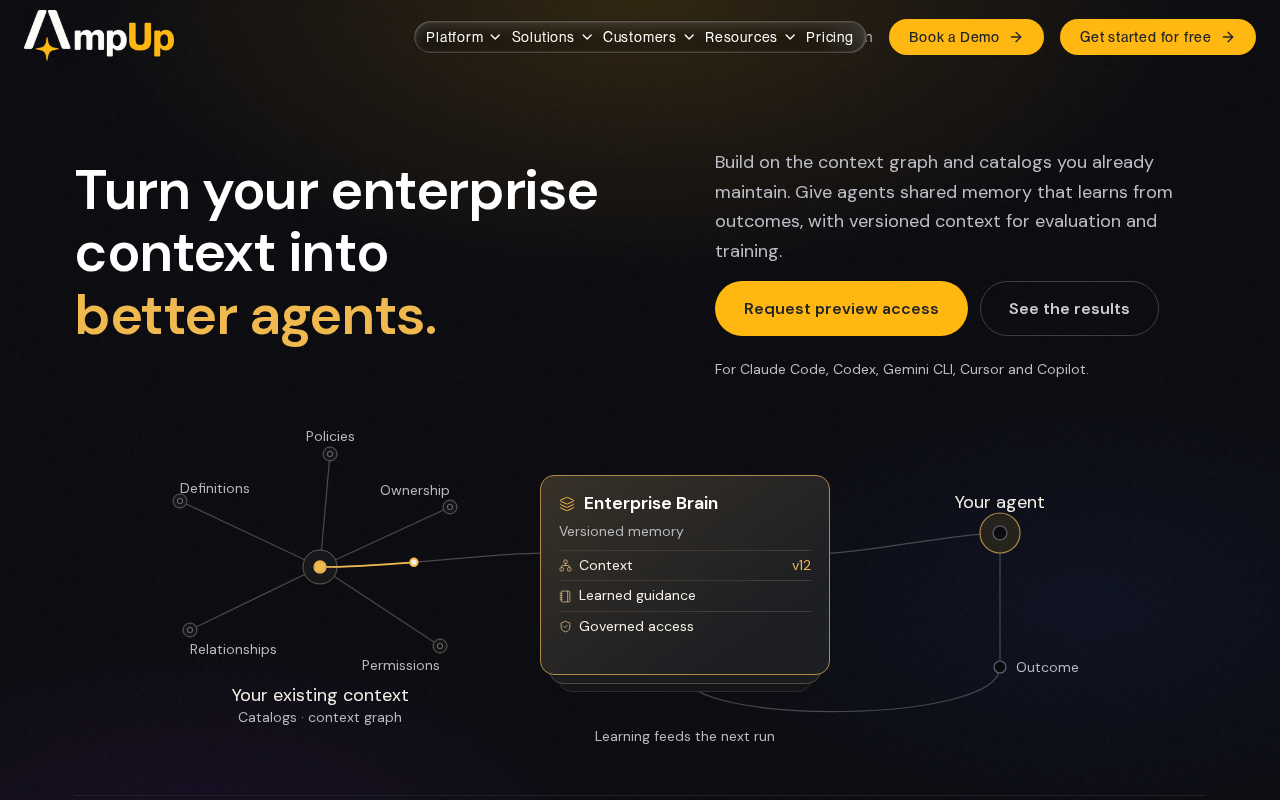
Enterprise Brain is a concept proposed on Hacker News, with the core proposition of "Memory that learns from work" — a system that automatically learns from and consolidates memory during the work process. It is not simply a knowledge base or document management tool, but rather an attempt to let enterprise memory continuously evolve as day-to-day work progresses.
This concept is worth attention because it touches on a key pain point in current enterprise AI applications: most tools only solve "storage" and "retrieval," but not "learning." Enterprise Brain is positioned more as an organizational memory that grows.
The Paradigm Shift from "Storage" to "Learning"
The logic of traditional enterprise knowledge management is: people write down knowledge, and the system handles storage and search. The problem with this model is that knowledge creation and knowledge recording are two separate things; recording is often delayed, incomplete, or even skipped entirely.
Enterprise Brain emphasizes "learns from work," meaning that learning is embedded in the workflow rather than being an additional recording action. This approach is consistent with the recent re-examination of "memory" in the AI field — memory is no longer a static database but a dynamic structure that is continuously updated through interaction.
According to discussions on Hacker News, the project focuses on enabling the system to extract reusable memory from actual work traces, rather than requiring users to actively maintain a knowledge system. This "passive learning" design orientation reduces dependence on user self-discipline.
In machine learning contexts, "passive learning" usually refers to a system extracting patterns from naturally generated data without explicit labeling or manual intervention; in the context of agents and memory systems, it is closer to "background memory consolidation": the system automatically summarizes, deduplicates, and structures conversation traces after interaction ends, rather than waiting for users to manually archive them. The opposite is "active recording" — relying on users to fill out documents or add tags. The key engineering problem of passive learning lies in the signal-to-noise ratio: work traces contain a large amount of temporary, repetitive, or context-missing content, and without filtering, the memory store will rapidly degrade. Common practices combine importance scoring, time decay, and access frequency to manage memory writes and eviction.
Memory Challenges in Enterprise Scenarios
Memory problems in enterprise environments are far more complex than in personal scenarios. Staff turnover, departmental silos, and fragmented tools all cause knowledge to break down across different carriers. When a project ends, the experience in participants' minds often dissipates with it, leaving only scattered documents and chat logs.
This is precisely the gap Enterprise Brain attempts to address. If the system can continuously learn from work, then organizational memory no longer depends entirely on individuals' willingness to retain it. This is especially meaningful for knowledge-intensive teams — work outcomes in consulting, R&D, legal, and other fields are highly dependent on the reuse of historical experience.
In AI systems, "memory" is generally divided into short-term context (information within the conversation window) and long-term memory (knowledge persisted across sessions). Long-term memory can be further subdivided into factual memory (who, what, when), semantic memory (concepts and rules), and episodic memory (specific events and decision processes). The particularity of enterprise scenarios is that memory must also be multi-subjective: people with different roles and different permissions share the same organizational memory, but with different visibility scopes. Therefore, enterprise-level memory systems usually need permission-aware retrieval at the retrieval layer and must handle memory conflicts — when two employees leave inconsistent records about the same process, the system needs a mechanism to merge them or annotate sources; otherwise, memory turns from an asset into a burden.
The Value of the Concept and What Remains to Be Verified
From a conceptual standpoint, the direction proposed by Enterprise Brain is reasonable. Competition in enterprise AI is shifting from "model capability" to "context and memory," and whoever can better carry the organization's history and experience is more likely to build a true moat.
However, it should be noted objectively that the discussion volume for this entry on Hacker News is currently very limited, lacking public technical details, implementation paths, and practical cases. How memory is defined, how to avoid noise accumulation, and how to ensure privacy and permission boundaries are all questions such systems must answer, and the available information is not yet sufficient to judge its solutions.
For readers interested in enterprise AI and knowledge management, this project is worth keeping an eye on, but at this stage it is more suitable as a directional signal than as a product that can be directly evaluated.
One-line Summary
Enterprise Brain advocates letting enterprise memory passively learn from the work process rather than relying on active recording.
Paragraph Summary
Enterprise Brain is a concept proposed on Hacker News, centered on "Memory that learns from work," i.e., letting enterprise memory passively learn and continuously evolve within the workflow rather than relying on users to actively maintain a knowledge base. The article points out that traditional enterprise knowledge management only solves storage and retrieval, with recording delayed and incomplete; Enterprise Brain attempts to embed learning into work traces, reducing dependence on individual self-discipline and addressing the knowledge fragmentation pain points caused by staff turnover, departmental silos, and fragmented tools. The article argues that competition in enterprise AI is shifting from model capability to context and memory-carrying capability, but the project's public information is limited, lacking technical details and cases; questions about memory definition, noise control, and privacy permissions remain unanswered, making it more suitable at this stage as a directional signal rather than an evaluable product.
Related articles
 Tech Frontiers
MuJoCo: An Analysis of DeepMind's Open-Source General-Purpose Physics Simulator
An in-depth analysis of Google DeepMind's open-source physics simulator MuJoCo: high-performance C++ kernel, MJCF modeling format, contact solving principles, MJX GPU acceleration, and robot reinforcement learning use cases.
 Tech Frontiers
Claude API Quick Start: The Official Quickstarts Project Collection
Anthropic's official claude-quickstarts project collection helps developers quickly build deployable apps with the Claude API. Nearly 20k stars, Python-based, great for beginners and prototyping.
 Tech Frontiers
AI Agents Connecting Directly to APIs: Which Calls Can Be Safely Allowed?
AI agents can call any API, but the real challenge is deciding which calls can be safely allowed. This article analyzes allowance decisions from three dimensions—intent matching, least privilege, and controllable impact—and argues that the control layer should sit outside the agent, combined with audit traceability to build a trustworthy API call governance mechanism.