Equivariant Representation Spectral Symmetry Fingerprint: A New Perspective for Geometric Deep Learning

The singular value spectrum of equivariant representations serves as a symmetry fingerprint for point group identification and breaking quantification.
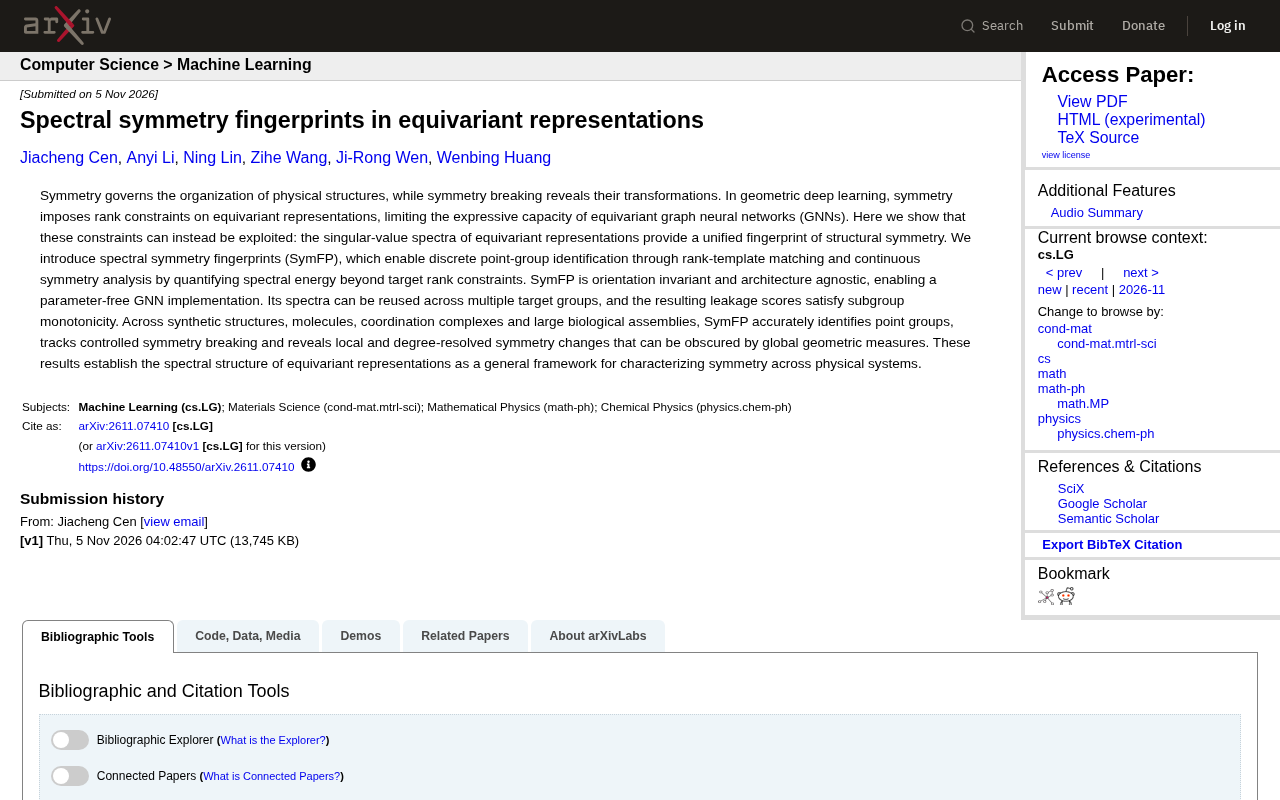
The article introduces Spectral Symmetry Fingerprint (SymFP), which turns equivariant rank constraints—often seen as an expressiveness bottleneck in geometric deep learning—into an analytical tool. The key insight is that the singular value spectrum of equivariant representations encodes complete structural symmetry features. SymFP enables discrete point group identification via rank template matching and tracks continuous symmetry breaking by quantifying spectral energy beyond target rank constraints (leakage score). It is direction-invariant and architecture-agnostic, with leakage scores satisfying subgroup monotonicity, providing a mathematical basis for symmetry hierarchy analysis. Experiments on synthetic structures, molecules, coordination compounds, and large biological assemblies show SymFP effectively identifies symmetry groups and reveals local symmetry changes masked by global measures.
Symmetry constraints in geometric deep learning are often seen as a bottleneck limiting model expressiveness, but recent research has turned them into a powerful analytical tool—the singular value spectrum of equivariant representations can serve as a unified fingerprint of structural symmetry. The Spectral Symmetry Fingerprint (SymFP) method proposed in this paper offers new ideas for discrete point group identification and continuous symmetry analysis, and its effectiveness has been validated on various physical systems.
Symmetry Constraints: From Limitation to Resource
In geometric deep learning, symmetry is imposed through equivariant representations via rank constraints, which are typically considered to limit the expressiveness of equivariant graph neural networks (GNNs). The traditional view treats these constraints as obstacles to be overcome, but the researchers thought in reverse: do these constraints themselves carry rich information about symmetry?
The paper points out that the singular value spectrum of equivariant representations actually encodes the complete characteristics of structural symmetry. By analyzing this spectrum, one can not only identify symmetry groups but also quantify the degree of symmetry breaking. This shift in perspective redefines constraints from "defects" to "sources of signal."
SymFP: Constructing a Unified Fingerprint
The proposed Spectral Symmetry Fingerprint (SymFP) comprises two core functions:
- Discrete point group identification: Through rank template matching, the singular value spectrum of equivariant representations is compared with the rank constraints of target point groups, enabling group classification without additional parameters.
- Continuous symmetry analysis: By quantifying the "spectral energy" beyond the target rank constraints, it tracks continuous changes in symmetry breaking.
SymFP is direction-invariant and architecture-agnostic, meaning it can be directly integrated into existing GNNs without modifying model structure, and it remains stable under transformations such as rotations of input data. Moreover, its spectral computation can be reused across multiple target groups, significantly improving efficiency.
Subgroup Monotonicity and Leakage Score
The leakage score introduced in the paper measures the spectral energy in equivariant representations that exceeds the constraints of the target group. A key property is subgroup monotonicity: when the target group is a subgroup, the leakage score satisfies a monotonic relationship. This provides a mathematical foundation for symmetry hierarchy analysis, enabling SymFP not only to identify a single group but also to reveal inclusion relationships between groups.
The design of the leakage score allows the model to distinguish between "fully symmetric" and "partially broken" states, and to output them as continuous values, facilitating tracking of gradual symmetry changes.
Cross-Scale Validation: From Molecules to Biological Assemblies
SymFP demonstrates its effectiveness across multiple scales:
- Synthetic structures: Accurately identifies preset point groups, validating the reliability of rank template matching.
- Molecules and coordination compounds: Identifies point groups in real chemical systems and tracks controlled symmetry breaking.
- Large biological assemblies: Reveals local and degree-resolved symmetry changes that are often obscured in global geometric measures.
In particular, you may not have noticed that SymFP can capture degree-resolved symmetry changes—that is, differences in symmetry around nodes of different connectivity—providing a more refined tool for analyzing complex biological structures.
Significance and Outlook
The core contribution of this work is establishing the spectral structure of equivariant representations as a general framework for symmetry characterization. It does not depend on specific network architectures and requires no additional training parameters, giving it broad applicability. From physical systems to biological macromolecules, SymFP provides a unified and interpretable approach to symmetry analysis.
In the future, this framework may inspire more research that transforms constraints in representation learning into analytical tools, advancing geometric deep learning from "leveraging symmetry" to "understanding symmetry."
One-line Summary
The singular value spectrum of equivariant representations can serve as a symmetry fingerprint, enabling point group identification and quantification of symmetry breaking.
Paragraph Summary
The article introduces a new method called Spectral Symmetry Fingerprint (SymFP), which transforms the equivariant rank constraints typically regarded as an expressiveness bottleneck in geometric deep learning into an analytical tool. Its core insight is that the singular value spectrum of equivariant representations encodes the complete characteristics of structural symmetry. SymFP achieves discrete point group identification through rank template matching and tracks continuous symmetry breaking by quantifying spectral energy beyond target rank constraints (leakage score). The method is direction-invariant and architecture-agnostic, and the leakage score satisfies subgroup monotonicity, providing a mathematical foundation for symmetry hierarchy analysis. Experiments on synthetic structures, molecules, coordination compounds, and large biological assemblies show that SymFP can effectively identify symmetry groups and reveal local symmetry changes obscured by global measures.
Related articles
 Tech Frontiers
Coldframe: A Honeypot Disguised as a Supermarket Freezer Controller
Coldframe is a honeypot disguised as Danfoss AK-SM 800A and Dixell XWEB freezer controllers, built as a single Python file that detects CVE-2025-41450 attempts and is identified as real devices on Shodan.
 Tech Frontiers
GRFNet: A Lightweight PyTorch Model Designed for Multichannel Time-Series Classification
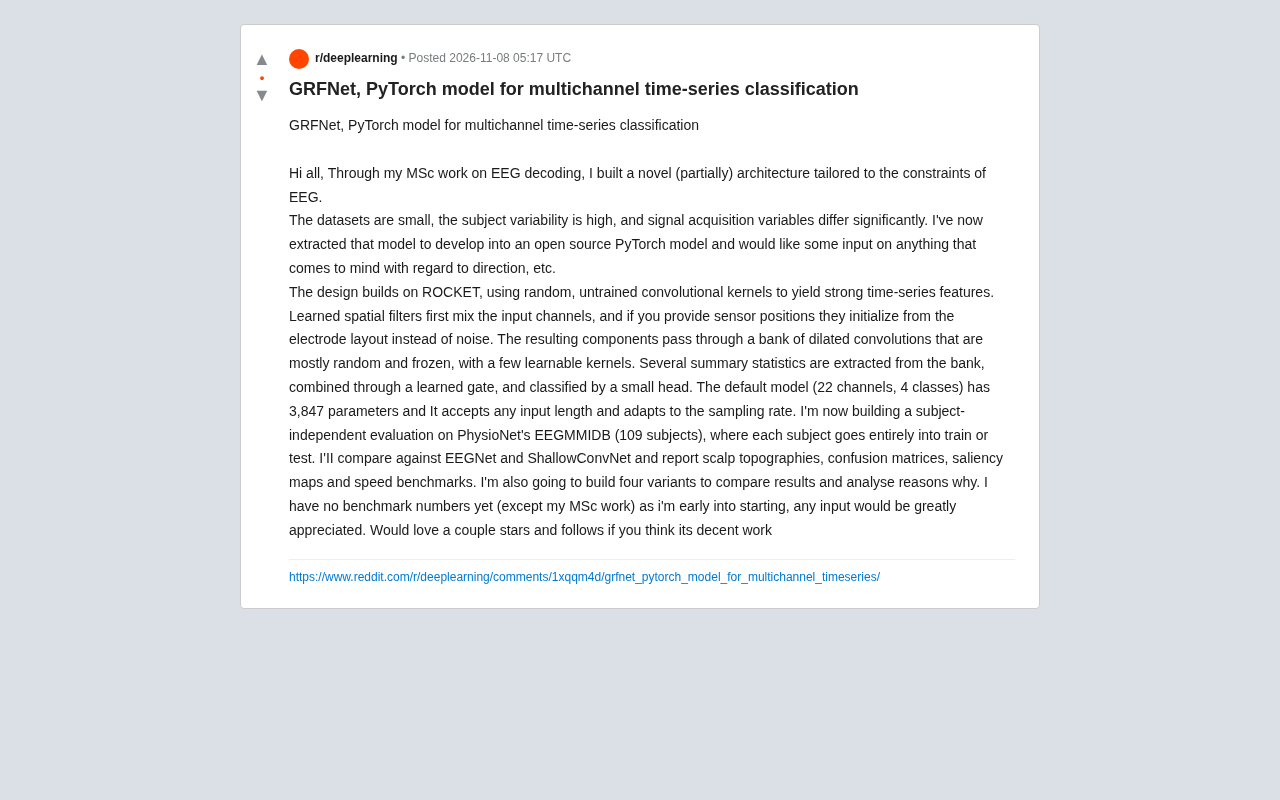
GRFNet is a lightweight PyTorch model for multichannel time-series classification, originating from EEG decoding research. With only 3,847 parameters, it is based on the ROCKET architecture, combining random convolution kernels with learnable spatial filters, supports arbitrary input lengths, and will soon be evaluated on the PhysioNet dataset.
 Tech Frontiers
CUDA-Accelerated Rocket League Simulator: A Player-Made Hardcore Experiment
A Reddit post shows a "100% Accurate" Rocket League simulator accelerated with CUDA. We analyze its technical context, CUDA's value in game physics simulation, and the significance and limitations of such community projects.