Ex-Tesla Team Raises $12.5M to Rebuild Supply Chains with AI Agents

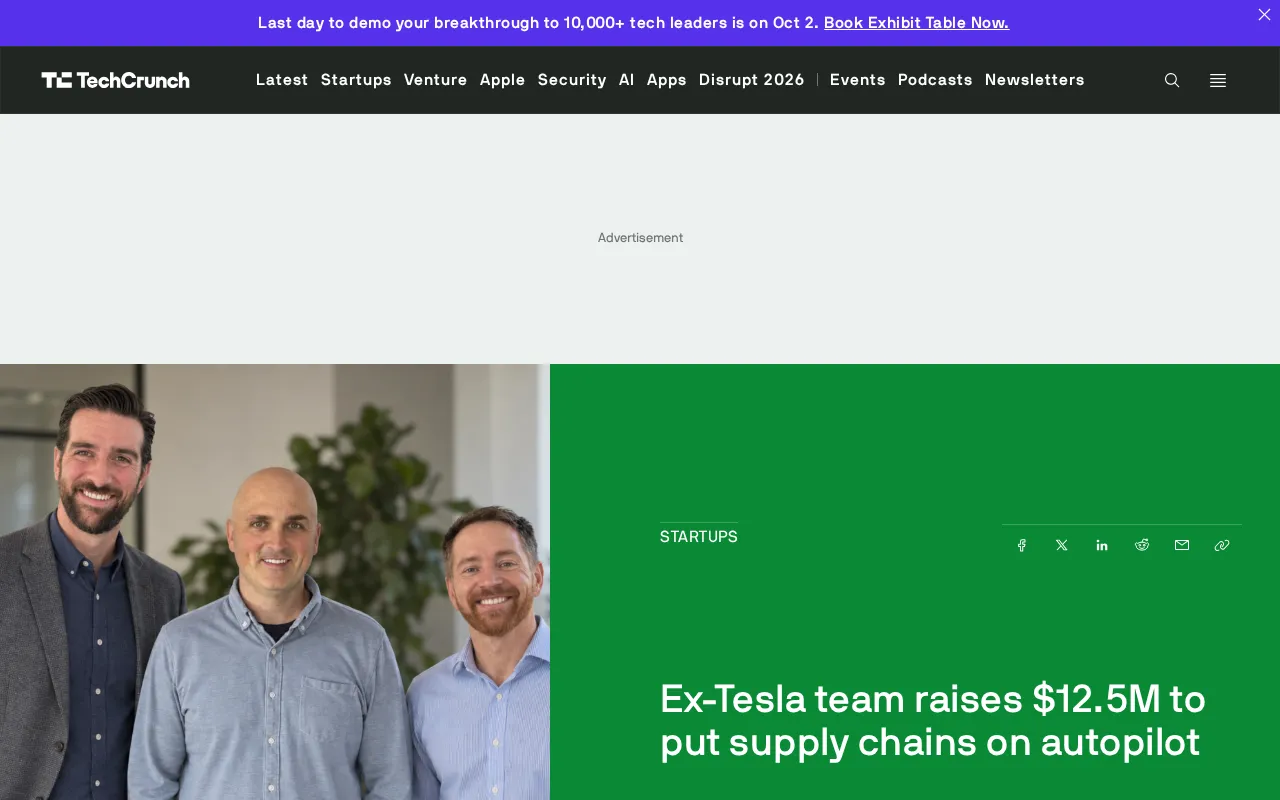
Ex-Tesla startup Atomic raises $12.5M to let AI agents autonomously manage supply chains.
Atomic, a supply chain AI startup founded by ex-Tesla team members, has closed a $12.5 million funding round. Its core product is agentic supply chain software — unlike traditional SCM systems that only provide dashboards and alerts, it can autonomously sense, decide, and execute, automatically handling procurement, scheduling, and restocking within authorized limits. DoorDash and HelloFresh are already live customers, validating the product in high-pressure, real-time environments. The raise reflects the broader trend of agentic AI moving from the conversation layer into enterprise execution — though balancing autonomy with controllability in core operations remains a long-term challenge.
Tesla DNA Meets Supply Chain Management
Atomic, a startup founded by former Tesla team members, has closed a $12.5 million funding round with a bold ambition: to put enterprise supply chains on "autopilot." The analogy is no accident — the automation expertise this team built up in Tesla's manufacturing and logistics operations is now being applied to the broader world of supply chain management.
Supply chain management has long been considered one of the most complex, experience-dependent areas of business operations. From demand forecasting and inventory allocation to supplier coordination, every step involves massive data judgment calls and human decision-making. Atomic aims to replace these repetitive, high-pressure manual processes with AI agents (agentic software) — systems that can autonomously sense conditions, make decisions, and take action.
What Is "Agentic Supply Chain Software"?
Atomic's core offering is agentic supply chain software — a fundamentally different approach from traditional Supply Chain Management (SCM) systems. Rather than simply displaying data dashboards and triggering alerts, agentic software can proactively take action on behalf of the business.
"Agentic" refers to software with a meaningful degree of autonomy: it can assess the current situation based on real-time data, plan a response, and automatically execute operations like purchasing, scheduling, or restocking within authorized boundaries. This model is analogous to self-driving — humans set the goals and guardrails, while the system handles specific decisions in a dynamic environment.
For operations teams, this means shifting from "manual monitoring + human intervention" to "system runs automatically + humans supervise exceptions." In industries with frequent supply chain volatility and massive SKU counts, this shift has the potential to dramatically reduce operational burden.
Traditional SCM products like SAP SCM and Oracle Supply Chain are fundamentally "record and alert systems" — they collect data, generate reports, and trigger warnings, but final decisions and execution still depend on humans. "Intelligent supply chain" solutions that emerged over the past decade introduced machine learning for demand forecasting, but the execution layer remained manual. The key breakthrough with agentic AI is closing the complete loop of "sense → decide → act": rather than telling operations staff "inventory may be running low," the system directly triggers a replenishment order, adjusts delivery routes, or contacts backup suppliers. This paradigm shift was made possible by the maturation of large language models (LLMs) and tool-use capabilities, enabling AI agents to directly operate ERP, WMS, and other enterprise systems via API — without humans as the intermediary.
DoorDash and HelloFresh as Early Adopters
Notably, Atomic's software has already reached commercial deployment, with customers including delivery giant DoorDash and meal kit company HelloFresh.
Both companies operate in industries that are acutely sensitive to supply chain performance. DoorDash must coordinate large numbers of merchants, drivers, and on-demand delivery requests — any upstream delay directly impacts the customer experience. HelloFresh faces the time-sensitivity challenges of fresh ingredients, where poor inventory management leads to significant waste. Both scenarios demand extreme real-time precision from supply chain operations, making them ideal environments for AI agents to prove their value.
Earning validation from marquee customers like these is a significant signal for an early-stage company — it demonstrates that the product works not just in concept, but in real, high-pressure business environments.
The Investment Logic Behind $12.5M
A $12.5 million raise is a solid early-stage amount, reflecting investor confidence in the "AI + supply chain" direction and aligning with the broader trend of agentic AI moving into enterprise applications.
AI agents are graduating from chat interfaces to genuine execution layers, and supply chain is one of the most commercially compelling application areas: it has clear cost-saving metrics, well-defined decision chains, and a wealth of accumulated data. The team's Tesla background also gives Atomic a differentiated edge in manufacturing and logistics automation.
That said, the challenges of supply chain automation are equally real. Enterprises tend to be cautious about automating decisions in core operational areas. Striking the right balance between autonomy and controllability — and ensuring the system reliably hands off to humans in edge cases — will be a long-term product challenge.
The supply chain AI space has attracted substantial capital in recent years, but most early products focus on predictive analytics. Players who have genuinely landed "autonomous execution" remain relatively rare. On the competitive landscape, established supply chain software vendors like Coupa and o9 Solutions are pushing toward AI, while vertical agentic AI startups like Pactum (autonomous negotiation) and Keelvar (procurement automation) are going deep in niche segments. Atomic's differentiation lies in positioning the "full-chain agent" as its core identity — not a point-solution optimizer. The ex-Tesla team's engineering DNA means they have first-hand knowledge of manufacturing cadence control and just-in-time (JIT) production — expertise that is relatively rare among comparable AI supply chain startups. The seed/Series A funding size also suggests the company is still in the stage of using customer validation to drive growth; scaling replication is the capability that still needs to be proven.
Conclusion
Atomic's funding round is a microcosm of agentic AI's journey from technical demonstration to enterprise-grade deployment. When the logic of autopilot is applied to a core operational function like supply chain management, the commercial value of AI agents takes on a much more concrete form. Adoption by DoorDash and HelloFresh confirms that genuine market demand exists — but whether supply chain automation can achieve widespread scale will ultimately depend on continued improvements in reliability and trust.
Related articles

14 Core Concepts of Reasoning Models: From Chain of Thought to GRPO Explained
A systematic breakdown of 14 core concepts of reasoning models: chain of thought, test-time compute, verifiers, RLVR and GRPO, distillation, and reward hacking, plus rules for controlling thinking-token costs to help you decide when reasoning is worth paying for.

OpenAI's Claimed Refutation of ETH Sparks Debate, Meta Bets Big on AI Infrastructure
OpenAI claims an AI-assisted discovery that challenges the Exponential Time Hypothesis (ETH) and launches the mid-tier GPT-6.1 Tera. Cloudflare discloses a cross-customer data leak postmortem, and Meta plans $95B in AI infrastructure financing.
Data Scraping, AI Proofs, and Open Source Contracts: This Week's Deep Dive into the Tech World
From the 3D model crawler controversy and OpenAI's Lean formal proofs to AI agents challenging Brooks' Law and Debian rejecting LLM review, this week's tech discussions center on openness and verifiability.