FDE (Forward Deployed Engineer): A New Species in the AI Era, from Beginner to Enterprise Practice
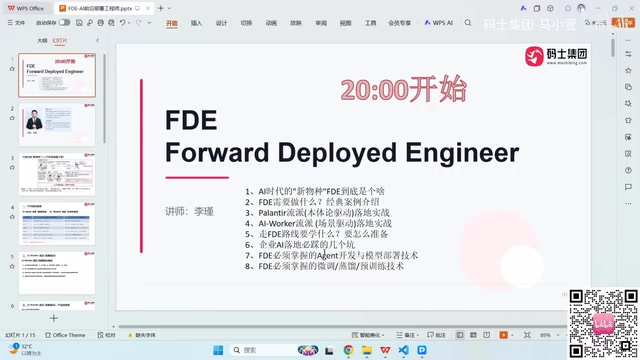
FDE is a forward deployment engineer who bridges the gap between AI technology and business, and needs to master agents, fine-tuning, and private deployment.
The article introduces the origin and value of FDE (Forward Deployment Engineer), an emerging role in the AI era. FDE originated from Palantir's practice, aiming to solve the problem of standardized products becoming distorted through layers of requirement handoffs by having engineers face customers directly and iterate in real scenarios. FDE is divided into the ontology-driven Palantir school and the scenario-driven AI Walking school, suited respectively to complex data scenarios and agile implementation needs. The skill stack includes three layers: AI agent development, model fine-tuning and distillation, and private model deployment, with fine-tuning being the key to breaking through the 90-point bottleneck in business acceptance. The main resistance to enterprise implementation lies in the difficulty of validating fine-tuning effects and unclear ROI; FDEs need to establish evaluation systems to prove value and design deployment plans flexibly according to customer budgets.
What Is an FDE? A New Species in the AI Era
FDE, short for Forward Deployment Engineer, is becoming a hot role in the AI implementation space. According to a share by Bilibili creator Teacher Li Jin, this concept gained rapid traction in 2026, and its core value lies in bridging the gap between AI technology and business scenarios. An FDE is not a traditional algorithm engineer or backend developer, but a hybrid talent who can go deep into the customer's site, understand business pain points, and rapidly build AI solutions.
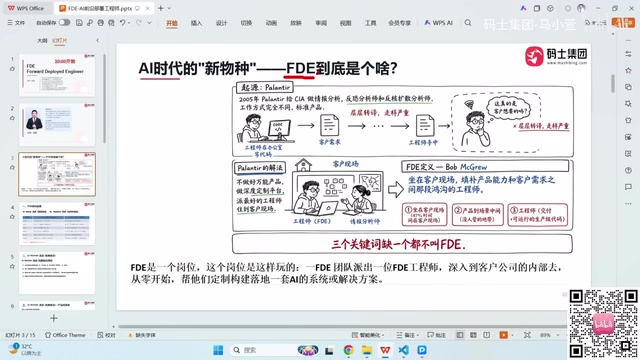
The birth of the FDE is closely tied to Palantir. This company, which provides intelligence analysis services to government agencies such as the CIA, found that standardized products are often designed by programmers off the top of their heads and become severely distorted after layers of requirement handoffs. The customer wants A, but what gets delivered is E—this kind of requirement distortion is common in software outsourcing. The FDE model emerged in response: engineers face customers directly and iterate solutions in real scenarios.
The Two Schools of FDE: Ontology-Driven and Scenario-Driven
Teacher Li Jin divides FDE practice into two major schools. The Palantir school emphasizes "ontology-driven" work, that is, first building a domain knowledge graph and ontology model, then developing AI applications on top of it. This approach suits government and financial scenarios with complex data and dense relationships, and requires FDEs to have strong abstract modeling skills.
The other school is the AI Walking school, which is more scenario-driven. It starts from specific business problems and rapidly combines technologies such as agents and RAG retrieval to validate value with a minimum viable product. This school places higher demands on engineering implementation speed and suits agile transformation in internet and traditional enterprises. The two schools are not opposed to each other; they apply to different stages and customer types.
Ontology here does not mean the philosophical study of existence, but a term in knowledge engineering that refers to an explicit, formal description of the concepts, attributes, and interrelationships within a domain. In Palantir's practice, an ontology is a semantic model layer between raw data and upper-layer applications: it abstracts entities scattered across databases, logs, and documents (such as people, organizations, events, and locations) and their relationships into a unified object graph, enabling AI applications to reason and query based on consistent semantics. Building an ontology usually requires collaboration between domain experts and engineers to complete entity recognition, relationship definition, and constraint rule writing, producing a machine-readable schema. Its value lies in giving complex data an interpretable structure that supports cross-source correlation analysis and decision-making. The cost is high upfront investment, high maintenance costs, and the need for the ontology to evolve in sync when the domain changes, so it is better suited to government and financial scenarios with stable data relationships and high analytical depth requirements.
What Do You Need to Learn to Follow the FDE Path?
If you plan to enter the FDE field in 2026, you need to build a three-layer skill stack. First is AI agent development, including multi-agent collaboration, tool calling, and RAG retrieval augmentation—the basic entry-level skills for an FDE. Second is model fine-tuning and distillation. Teacher Li Jin points out that doing only agent development may leave a project stuck at 90 points, while business acceptance often requires 95 points; at that point, fine-tuning becomes critical.
In terms of technical difficulty, fine-tuning is less difficult than distillation, and distillation is less difficult than pre-training. He suggests starting with fine-tuning and gradually going deeper. Finally comes private model deployment. Enterprise-level scenarios usually require deploying models with more than 8B parameters; by 2026, models below 8B are no longer meaningful. Deployment cost depends on model scale and customer budget—customers such as financial institutions and hospitals may procure hardware worth up to 2 million, while traditional companies may be willing to spend only 20,000, so FDEs need to design flexibly according to the scenario.

Knowledge distillation refers to using a larger, more capable "teacher model" to guide the training of a smaller "student model," so that the student model approximates the teacher model's output distribution as closely as possible despite a greatly reduced parameter count. A common practice is to have the student model fit both the true labels and the soft labels (probability distributions) given by the teacher model, thereby learning the relative relationships between categories. The significance of distillation lies in reducing inference costs and deployment barriers: enterprises often cannot deploy hundred-billion-parameter models for every scenario, but distillation can transfer the capabilities of large models to 8B or even smaller models, adapting them to edge devices or customers with limited budgets. Compared with fine-tuning, distillation requires additional teacher-model inference and training process design, has higher engineering complexity, and the student model's capability ceiling is constrained by the teacher model and the quality of distillation data. Therefore, Teacher Li Jin suggests mastering fine-tuning first before advancing to distillation.
The Pitfall Every Enterprise Implementation Hits: Validating the Value of Fine-Tuning
When FDEs implement solutions in enterprises, they encounter a typical contradiction: many companies "lack the conditions for fine-tuning," when in reality they are unwilling to do fine-tuning because the effect is hard to validate. A friend of Teacher Li Jin who runs a company once reported that "the more we tune, the worse it gets." Hiring a dedicated fine-tuning specialist costs several hundred thousand per year, and outsourcing also costs money; if the return cannot be proven, companies naturally back off.
Behind this is the ROI problem. FDEs need to help customers establish an evaluation system before and after fine-tuning and prove value with business metrics. Only when customers recognize that fine-tuning can bring significant returns will they create the conditions for it. In addition, distortion caused by layer-by-layer subcontracting of requirements is also a common pitfall; FDEs must maintain direct communication with customers and avoid working in isolation.
ROI (return on investment) in enterprise AI projects is usually reflected in the comparison between fine-tuning investment and business returns. The cost items of fine-tuning include: manpower for labeling data, GPU computing power rental or procurement, salaries of dedicated algorithm engineers (annual cost can reach several hundred thousand), and the time cost of iterative trial and error. The benefit items may be quantifiable business metrics such as improved customer service resolution rates, reduced document processing error rates, and reduced manual review hours. The difficulty is that benefits are often delayed and dispersed, making it hard to attribute them precisely to the act of fine-tuning in the short term. The FDE's approach is to agree with the customer on baseline metrics and acceptance criteria before fine-tuning, compare performance before and after fine-tuning using the same batch of test samples, and translate technical metrics (such as accuracy and F1) into business language (such as how many work hours are saved per month and how many refunds are reduced). Only when customers see verifiable incremental benefits will fine-tuning move from "lacking conditions" to "creating conditions."
Classic Cases and Practical Paths
The live course previewed enterprise-level project practice for both the Palantir school and the AI Walking school. Although the materials do not elaborate on specific case details, Teacher Li Jin emphasizes that FDEs must master the full-chain technologies of agent development, model deployment, fine-tuning, distillation, and pre-training. He himself has a background in biometrics and facial recognition, and in recent years has focused on integrating microservices with multi-agent systems and RAG, possessing end-to-end development capabilities.
For beginners, it is recommended to first do AI agent development and private model deployment, then gradually go deeper into fine-tuning. Do not challenge pre-training right away; that requires deep algorithm expertise and computing resources. The FDE growth path is: agents → fine-tuning → distillation → pre-training, with each step corresponding to different business scenarios and acceptance criteria.
Conclusion: The FDE Is a Connector Between Technology and Business
The FDE is not a purely technical position, but a hybrid role that requires business acumen, engineering capability, and communication skills. In 2026, as enterprise AI transformation deepens, demand for FDEs will continue to grow. Whether choosing ontology-driven or scenario-driven approaches, the core is to go deep into the site, validate quickly, and iterate continuously. For developers, filling the gaps in fine-tuning and deployment will be a key step toward becoming an FDE.
Related articles
Claude Code Practical Guide: Installation, Permission Modes, and Productivity Tips
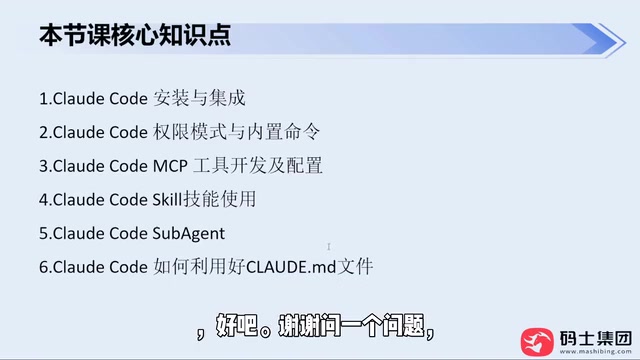
Based on a Bilibili creator's hands-on sharing, this guide covers Claude Code installation (NPM recommended), permission modes, slash commands, CLAUDE.md configuration, context management, and practical tips for stable use and avoiding account bans.
The Essential Difference Between AI Agents and Traditional AI: From Functions to Autonomous Task Executors
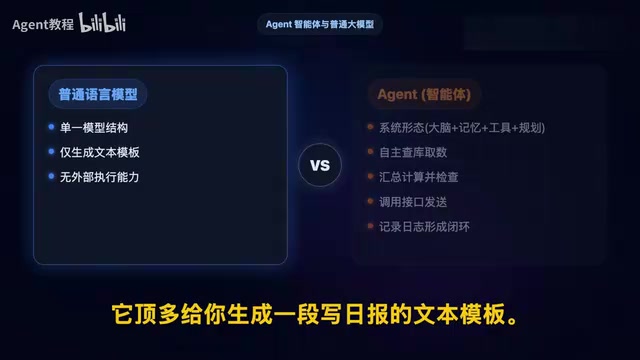
What is the essential difference between AI Agents and traditional AI? This article systematically breaks down the nature of Agents from six core components, dynamic decision-making authority, boundaries with Chatbots and Workflows, safety boundaries, and observability, helping you understand key concepts in LLM application development.
Dify Low-Code AI in Practice: RAG and Agents Made Easy
Based on a Bilibili Dify course, this article systematically covers Dify's five application types (Chat Assistant, Text Generation, Agent, Chat Flow, Workflow), Windows + Docker deployment, MySQL connection configuration, model integration strategies, and application publishing methods, helping beginners quickly build their own intelligent assistants.