FDE Forward Deployment Engineer Beginner's Guide: From the Palantir School to Enterprise-Level Implementation in Practice

FDE is a hybrid engineer in the AI era who understands both technology and business, and must progress from agent development to fine-tuning and distillation.
The article introduces FDE (Forward Deployment Engineer), a new role in the AI era whose core is understanding AI technology while also being able to implement it in enterprise business scenarios. FDE practice is divided into two major schools: Palantir's ontology-driven approach and scenario-driven practice, with the choice depending on enterprise size and data foundation. The technical progression path starts with agent development and then goes deeper into fine-tuning, distillation, and pretraining, with increasing difficulty. The core reason enterprises are unwilling to do fine-tuning is that performance verification is difficult and costs are high, so FDEs need to account for economics. Enterprise-level deployment is recommended to use models of at least 8B, and hardware budgets vary enormously by industry. The article also gives beginner advice: start with agent development and private deployment, and gradually advance.
What Is FDE? A New Species in the AI Era
FDE, short for Forward Deployment Engineer, has been called "a new species in the AI era" by some practitioners. According to Bilibili creator Teacher Li Jin in a livestream course, this concept is becoming hot in 2026. Its core positioning is: someone who both understands AI technology (agent development, model fine-tuning, retrieval augmentation, etc.) and can go deep into enterprise business scenarios to truly land technology on the customer's site.
Unlike traditional algorithm engineers, FDEs do not sit in an office tuning parameters; they directly face customers' real problems. Teacher Li Jin himself works on FDE-related work. He mentioned that if you wanted to hire people with FDE experience in the past, you might have had to poach from the US company Palantir, but now many Chinese enterprises are also carrying out FDE-oriented transformation.
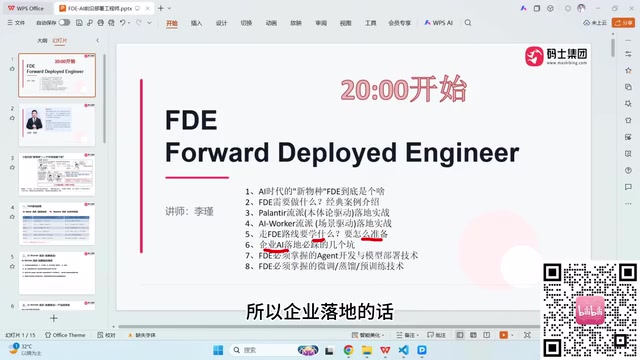
The Two Major FDE Schools: Ontology-Driven vs. Scenario-Driven
Teacher Li Jin divides FDE implementation practice into two main schools:
The Palantir School (ontology-driven): Originating from Palantir's practice, it emphasizes using "ontology" as the core to organize data and business logic and to build enterprise-level knowledge graphs and decision systems. This school suits large enterprises with complex data and long business chains.
The scenario-driven school: It leans more toward starting from specific business scenarios and quickly using AI agents to solve real problems. This path is flexible and delivers results quickly, making it suitable for small and medium-sized projects or vertical scenarios.
The two schools have no absolute superiority or inferiority; the choice depends on enterprise size, data foundation, and budget.
Ontology here does not mean ontology in the philosophical sense, but rather a structured data model used by companies such as Palantir to describe enterprise business objects, attributes, and their relationships. It abstracts entities such as customers, orders, equipment, and events as nodes, and relationships such as transactions, ownership, and dependencies as edges, thereby building a computable knowledge graph. Based on ontology, AI systems can perform reasoning, querying, and decision-making on a unified semantic layer, avoiding the problem of inconsistent data definitions across departments. The cost of this approach is high upfront modeling cost and the need to deeply sort out business processes, so it is more suitable for large enterprises with large data volumes, long business chains, and some existing data governance foundation.
What Do You Need to Learn to Follow the FDE Path?
Teacher Li Jin gives a clear technical progression path: first do AI agent development, then go deeper into model fine-tuning, distillation, and pretraining.
He particularly emphasizes that the acceptance criteria for many enterprise-level projects will require agents to go through fine-tuning, distillation, or even pretraining. If you stay only at the agent level, the results may get stuck at 90 points and cannot go higher, while business acceptance may require 95 points.
In terms of difficulty, the technical threshold for fine-tuning is lower than that for distillation, and distillation is lower than that for pretraining. Therefore, he suggests starting with fine-tuning and gradually going deeper. In addition, FDEs also need to master technologies such as model private deployment, local deployment, and retrieval-augmented generation (RAG). Teacher Li Jin mentioned that his research direction over the past two years has been deeply combining traditional microservices with multi-agent systems and RAG retrieval, possessing end-to-end implementation capability from underlying algorithms to AI applications.
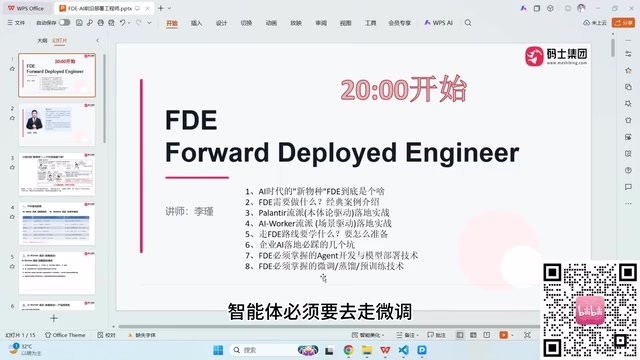
Model fine-tuning, distillation, and pretraining are three technologies at different levels. Fine-tuning means continuing to train an existing pretrained model with domain-specific data so that the model adapts to a specific task, usually requiring only a small amount of data and compute; distillation means using the outputs of a large model (teacher model) to guide the training of a small model (student model), allowing the small model to maintain relatively high performance while reducing deployment costs; pretraining means training a foundation model from scratch using massive general data, requiring enormous compute and data investment. The three increase in difficulty, and FDEs should choose the appropriate technical level based on project budget and acceptance criteria rather than blindly pursuing the most complex solution.
Retrieval-augmented generation (RAG) is a technology that combines external knowledge bases with large language models: the system first retrieves relevant snippets from enterprise documents, databases, or knowledge graphs based on the user's question, and then passes these snippets as context to the model to generate an answer. RAG can alleviate model hallucinations and support question answering over private data without retraining the model, so it has become a common method for FDEs to implement enterprise scenarios. It is usually combined with agents, with the agent deciding when to retrieve and what to retrieve, thereby completing multi-step business tasks.
The Pitfall You Will Definitely Encounter in Enterprise Implementation: Not Everyone Is Willing to Do Fine-Tuning
During the livestream, an audience member asked, "Many companies do not have the conditions for fine-tuning." Teacher Li Jin corrected this, saying it is not that they lack the conditions, but that many companies are unwilling to do it. The core reason is: the performance difference before and after fine-tuning is difficult to verify. He said friends who run companies reported that sometimes performance actually gets worse after fine-tuning, and hiring a dedicated person for fine-tuning may cost hundreds of thousands of yuan a year; hiring an external team to do it also costs money. Therefore, unless an enterprise is confident that fine-tuning will bring significant returns, it will not proactively invest.
This reveals a reality of FDE implementation: technical solutions must account for economics. Teacher Li Jin also mentioned hardware costs—for enterprise-level deployment, it is generally recommended to use models with at least 8B parameters, and deploying models below 8B in 2026 is of little significance. Hardware costs vary by customer: customers such as financial institutions and hospitals may purchase hardware costing more than 2 million yuan, while traditional companies may be willing to pay only 20,000 yuan. "What can 20,000 yuan do?" he asked rhetorically. This reminds FDE practitioners that they must understand customers' budget constraints and business returns.

Model parameter scale (such as 8B) refers to the number of trainable parameters in a model, usually measured in B (Billion). Generally, the more parameters, the stronger the model capacity and generalization ability, but the higher the requirements for GPU memory, compute, and deployment cost. An 8B model can still be deployed on consumer-grade or single-GPU servers, while larger models often require multiple GPUs or specialized inference hardware. In enterprise scenarios, model size selection needs to balance performance, latency, and hardware budget. Therefore, the article recommends at least 8B because smaller models show obvious performance degradation in complex business scenarios and find it difficult to meet acceptance criteria.
Advice for Beginners
Teacher Li Jin's course covers everything from the origin of the concept and practical enterprise-level projects in the two schools to technical details such as agent development, model deployment, fine-tuning, distillation, and pretraining. For those who want to follow the FDE path, he suggests not starting by diving into pretraining, but instead starting with agent development and private model deployment and gradually progressing to fine-tuning and distillation.
During the livestream, he also mentioned that his teaching style starts from zero, so even people without a technical background can follow along. For beginners, this step-by-step path is more practical than plunging directly into algorithmic details.

Conclusion
FDE is not a single technical position, but a combination of technical capability and business implementation capability. The Palantir school and the scenario-driven school provide two implementation approaches; fine-tuning, distillation, and pretraining form a ladder of technical depth; and enterprise budget and performance verification challenges are realities every FDE must face. Teacher Li Jin's sharing comes from frontline practice and has direct reference value for those who want to enter this direction.
One-line Summary
FDE is a hybrid engineer in the AI era who understands both technology and business, and needs to progress from agent development to fine-tuning and distillation.
Paragraph Summary
The article introduces FDE (Forward Deployment Engineer), a new role in the AI era whose core is understanding AI technology while also being able to implement it deeply in enterprise business scenarios. FDE practice is divided into two major schools: Palantir's ontology-driven approach and the scenario-driven approach, with the choice depending on enterprise size and data foundation. The recommended technical progression path starts with agent development and then goes deeper into fine-tuning, distillation, and pretraining, with increasing difficulty. The core reason enterprises are unwilling to do fine-tuning is that performance verification is difficult and costs are high, so FDEs need to account for economics. Enterprise-level deployment is recommended to use models of at least 8B, and hardware budgets vary enormously by industry. The article also gives beginner advice: start with agent development and private deployment, and gradually advance.
Related articles

The Truth Behind Titanic's Sinking: Key Decisions and Communication Failures in the National Geographic Documentary
National Geographic's The Unsinkable Ship uses survivor testimony to reconstruct Titanic's fatal decisions—from the missing MSG telegram prefix and the broken boiler-room-to-bridge link to how 'unsinkable' thinking delayed damage control and evacuation.

74M-Parameter Open-Source Model Partially Outperforms Jev AI in Testing
Fastino AI's Glider 2.5 models, with just 74M–300M parameters, reportedly outperform Jev AI in some guardrail benchmarks per YouTube testing, run on consumer hardware, and even play Doom. We analyze small models' competitiveness and deployment value on specific tasks.

Gemini 4 Argon Hands-On: Aggressive Pricing, 3D Capabilities Need Coaching
Gemini 4 Argon hands-on: limited-time $2/$10 pricing, million-token output, strong 3D and reverse-engineering work, but weak front-end aesthetics and zero-shot ability need coaching.