Fitbit Edge Returns: Can Retro Design Make Waves Again?

Fitbit Edge returns with a screenless retro design for minimalist health tracking, differentiating itself amid smartwatch homogeneity.
The Fitbit Edge is a screenless capsule-shaped wearable that interacts via LED lights and vibration, inheriting its design from early Fitbit Flex and Zip. It keeps optical heart rate, sleep tracking, multiple exercise modes, and 50m water resistance, while achieving over a week of battery life by dropping the screen. Its target users are digital minimalists and retro fans, positioned between basic bands and smartwatches with a 'less is more' strategy.
Introduction: When We Talk About Fitbit Edge, What Are We Talking About?
Recently, the tech world has been buzzing about a new device called the Fitbit Edge. Interestingly, both its name and design language inevitably bring to mind classic products from years past. As Rust Cohle famously said in the first season of True Detective: "Time is a flat circle. Everything we've ever done or will do, we're gonna do over and over and over again." This line seems more apt than ever when describing today's wearable device market.
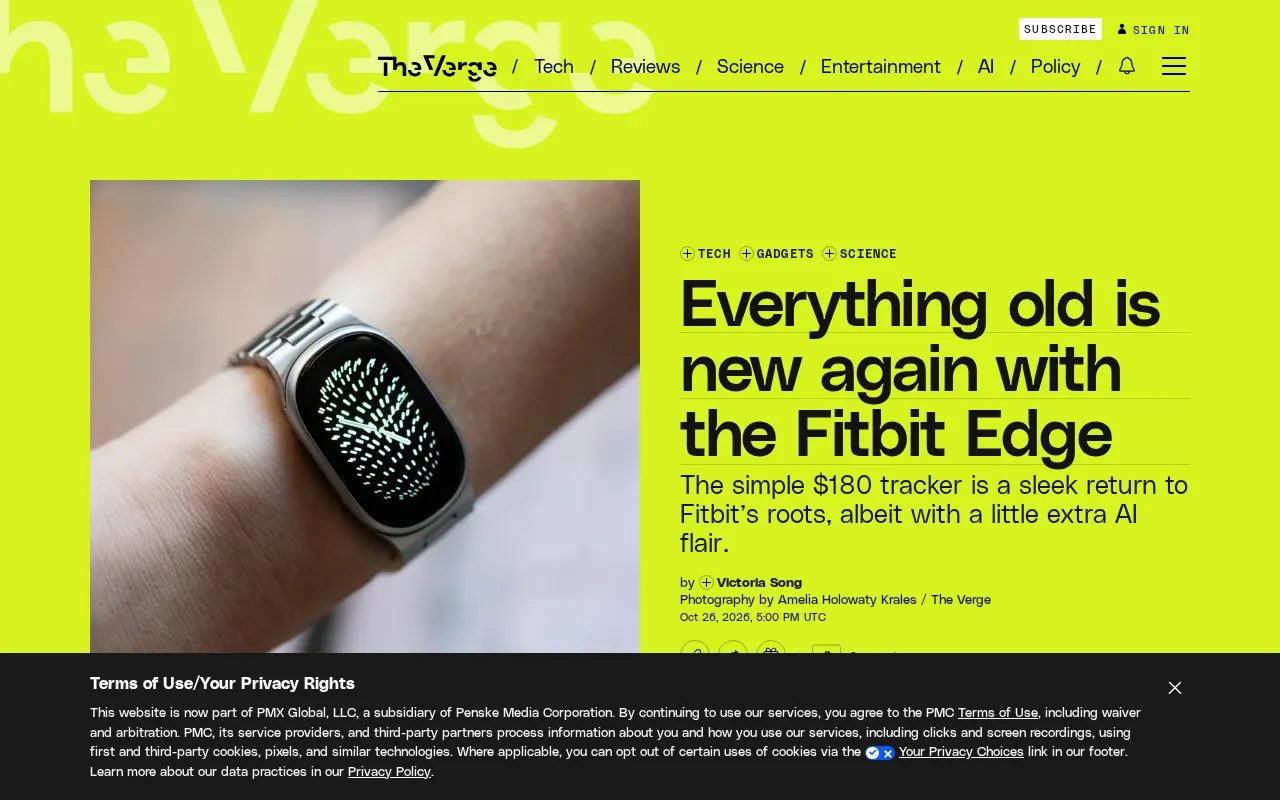
In an era where smartwatches are increasingly homogeneous, the Fitbit Edge has chosen a "retro-futurist" path. It retains the simple, screenless purity of early Fitbit bands while incorporating modern sensor technology. Is this "old bottle, new wine" strategy a nostalgia cash-grab, or a precise insight into user needs?
Design Philosophy: The Return of Minimalism
Appearance: A Familiar Formula, A Familiar Feel
Judging from the leaked images, the Fitbit Edge features a classic capsule shape—a small metal or plastic module paired with a skin-friendly silicone strap. It has no dazzling color screen, not even touch interaction; all data is conveyed through individual LED indicator lights. This design language is directly descended from the early Fitbit Flex and Fitbit Zip.
While smartwatches chase the idea of a "smartphone on your wrist," the Fitbit Edge goes the opposite direction, subtracting rather than adding. It focuses only on the most essential functions: steps, heart rate, sleep, and activity tracking. This restraint hits exactly the pain point for a segment of users—they don't need to scroll short videos on their wrist, just a quiet companion that records their body data.
Fitbit Flex and Fitbit Zip are two early products Fitbit launched around 2013, establishing the brand's initial form of "screenless bands." The Flex featured a capsule-shaped body with a silicone wristband, displaying step progress through a row of LEDs; the Zip was a clip-on tracker that could be attached to clothing. Neither had a display, relying on indicator lights and vibration for interaction—a route entirely different from today's "screen-on-wrist" smartwatches. Understanding these two products helps grasp the design DNA inherited by the Fitbit Edge: completing basic health data collection with minimal cognitive load, rather than pursuing richness of information display.
Interaction: The Zen of No Screen
No screen means no information anxiety. You don't need to frequently raise your wrist to check notifications, nor worry about screen glare in sunlight. All feedback is delivered through vibration and LED lights. This "invisible" interaction lets the device truly blend into life rather than become a distraction.
Feature Analysis: Old Bottle, New Wine—How Does It Taste?
Core Health Tracking: Everything You'd Expect
Despite its retro appearance, the Fitbit Edge doesn't cut corners on sensors. It's equipped with an optical heart rate sensor capable of all-day heart rate monitoring and providing heart rate zone alerts during exercise. Sleep tracking is also retained, automatically identifying light and deep sleep stages. Additionally, it supports multiple exercise modes—including running, cycling, and swimming—and offers 50-meter water resistance.
Optical heart rate sensors (PPG, photoplethysmography) illuminate blood vessels beneath the skin with LED light, inferring heart rate from the periodic changes in blood's light absorption. Their advantage is that they require no chest strap and enable continuous monitoring, but they're susceptible to motion artifacts, strap tightness, and skin tone, with accuracy dropping during high-intensity exercise or vigorous wrist movement. Current mainstream wearables typically use multi-wavelength LEDs combined with accelerometer fusion algorithms to compensate for errors. This also explains why screenless devices still need well-designed optical module layouts—sensor performance doesn't compromise just because the screen is omitted.
Battery Life: Rediscovering the Joy of "Charge Once, Last a Week"
With no power-hungry screen, the Fitbit Edge's battery life is stunning. The official claim is that a single charge can last over a week. For users accustomed to charging their watch daily, this "effortless charging" experience is undoubtedly liberating.
Market Positioning: Who Will Buy the Fitbit Edge?
Target Users: Digital Minimalists
The Fitbit Edge's target users are clear: those who want to reduce screen time, care about their health, but don't want to be burdened by complex features. They might be retro enthusiasts, or young people pursuing a minimalist lifestyle.
Digital Minimalism was systematically articulated by computer scientist Cal Newport in his 2019 book of the same name. It advocates consciously curating digital tools, retaining only technologies that truly serve one's deeper values, rather than passively accepting all notifications and information feeds. Under this philosophy, a device's value lies not in how many features it has, but in whether it reduces attention fragmentation. Screenless wearables are thus seen as a typical example of "low-interference recording tools"—they continuously collect data without actively demanding attention, contrasting with the design philosophy of smartwatches that frequently push notifications.
Competitive Landscape: Breaking Out Through Differentiation
In the current wearable market, the Apple Watch and Android smartwatches dominate the high-end segment, while the low-end is flooded with various band products. The Fitbit Edge's position is somewhat delicate: more refined than ordinary bands, purer than smartwatches. Whether this positioning succeeds depends on how many users are willing to pay for the philosophy of "less is more."
Conclusion: Retro Is Another Form of Innovation
The emergence of the Fitbit Edge shows us another possibility in the wearable market. In an age of relentless technological advancement, occasionally looking back may reveal forgotten needs. As the line from True Detective goes, time is a circle, and what we've done will repeat. But each repetition isn't a simple reincarnation—it's a reinterpretation of old ideas against a new technological backdrop.
Whether the Fitbit Edge can win the market with its retro design remains to be seen. But it at least reminds us: not all innovation requires a bigger screen.
One-line Summary
Fitbit Edge returns with a screenless retro design for minimalist health tracking, seeking differentiation amid smartwatch homogeneity.
Paragraph Summary
The Fitbit Edge is a screenless capsule-shaped wearable that interacts through LED indicator lights and vibration, with a design language inherited from early products like the Fitbit Flex and Zip. It retains core features including optical heart rate, sleep tracking, multiple exercise modes, and 50-meter water resistance, while achieving over a week of battery life by omitting the screen. The article argues its target users are digital minimalists and retro enthusiasts, positioned between ordinary bands and smartwatches, responding to current market homogeneity with a "subtraction" strategy. Whether retro design can win the market remains to be tested, but it suggests that innovation doesn't necessarily mean a bigger screen.
Related articles

Fifty Years Studying Power: Robert Caro's Writing and Insights on Power
Robert Caro reflects on 50 years studying power: Lyndon Johnson's persuasion and leverage, Robert Moses's transformation from idealist to ruthless builder, the dilemmas of large-scale construction, and his methods of compressing themes and solitary focus in biography writing.

Can a $20,000 Robot Do Your Chores? The Test Results Are Surprising
A YouTube test video shows how a $20,000 robot responds to commands like washing dishes, turning off lights, taking out trash, and feeding the dog. This article analyzes its real capability boundaries, the state of voice interaction technology, and how far household robots are from mainstream adoption.
The Complete Guide to Running AI Models Locally: Inference Engines and Tool Stack Explained
A systematic breakdown of the complete local LLM tool stack: from PyTorch and GGML compute libraries to llama.cpp, vLLM, SGLang inference engines and Ollama, LM Studio wrapper layers, with benchmark data on performance differences and selection logic.