Five Years of Proof: How Olaf Sakkers Cracked the Emerging Manager Dilemma

Sakkers proves through five years of sustained commitment that the emerging manager squeeze is not insurmountable.
Using venture capitalist Olaf Sakkers' five-year practice as a case study, the article discusses the "emerging manager squeeze" facing first-time fund managers. Limited fundraising channels, high LP trust thresholds, and low brand recognition form a triple barrier, essentially reflecting capital concentrating toward established institutions with track records when uncertainty rises—creating a deadlock where no performance means no capital, and no capital means no performance. Sakkers' breakthrough lies not in replicating established institutions' playbook but in trading time for trust: extending the proof period, building verifiable judgment records, and differentiating into niche sectors.
The Emerging Manager Dilemma Is Not Unsolvable
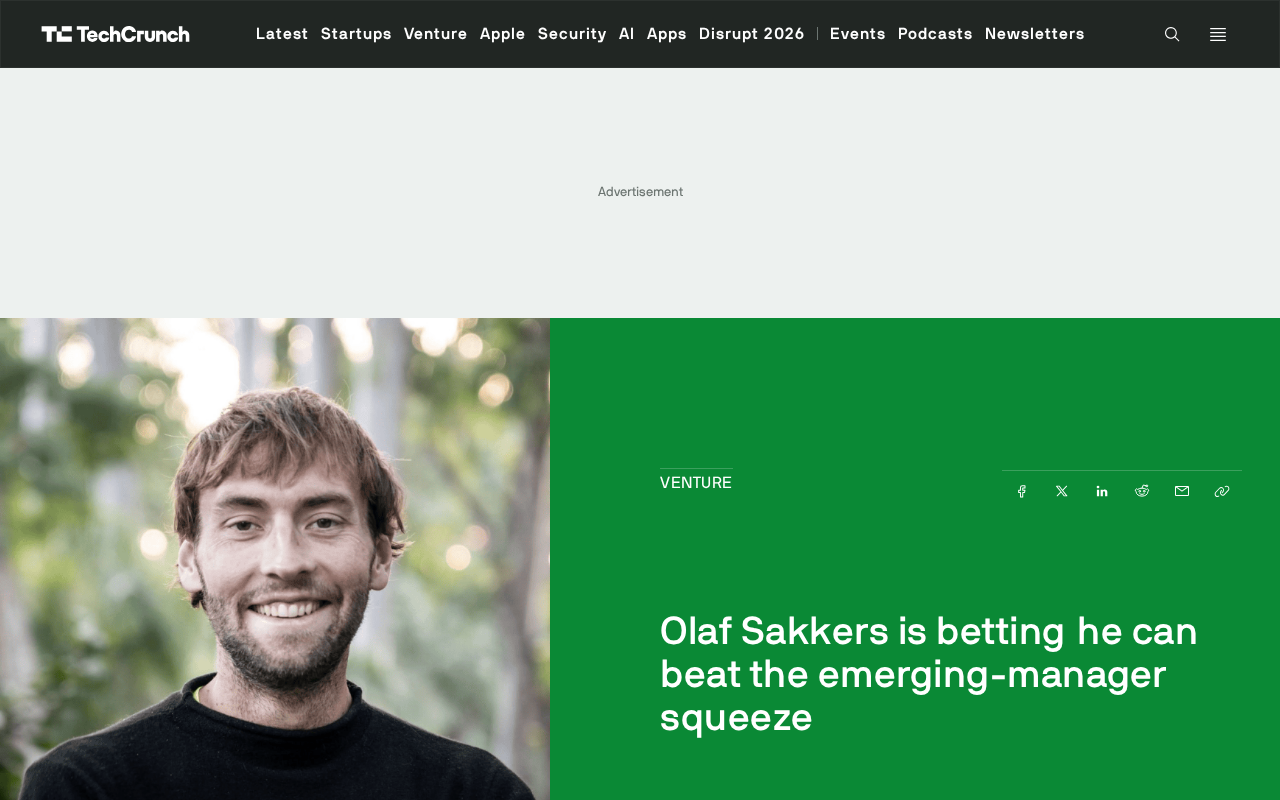
The venture capital industry has never been kind to first-time fund managers. Limited fundraising channels, high LP trust thresholds, and low brand recognition form a triple barrier for emerging managers. Olaf Sakkers offers a counterexample over five years: difficulty does not equal impossibility.
According to an RSS source report, Sakkers has continuously validated this proposition over the past five years. Rather than sidestepping the industry's structural challenges, he sought breakthroughs in practice. This path holds reference value for emerging managers who are similarly just getting started.
The Real Causes of the Emerging Manager Squeeze
The so-called "emerging manager squeeze" is essentially the result of capital allocation concentrating toward the top. When uncertainty rises, LPs tend to choose established institutions with long-term track records, while first-time fundraisers are pushed to the margins. Longer fundraising cycles, shrinking committed capital, and mounting operating cost pressures combine to form a negative feedback loop.
This structural pressure is not a short-term fluctuation. For first-time fund managers, the biggest challenge is: without historical performance to show, you cannot prove investment capability; and without capital, you cannot build a track record. Sakkers' five-year practice is precisely centered on breaking this deadlock.
GP and LP: GP (General Partner) refers to the founding and management team of a venture capital fund, responsible for investment decisions and daily operations, and bearing unlimited joint liability (often isolated through a limited liability company in practice); LP (Limited Partner) is the fund's capital provider, typically pension funds, fund-of-funds, family offices, or high-net-worth individuals, with liability limited to their contributed capital. In the venture capital context, LPs decide whether to entrust their money to a particular GP, while the GP is responsible for screening projects, post-investment management, and exits. Emerging managers are GP teams establishing a fund for the first time or at an early stage, whose core challenge is the lack of a track record that LPs can evaluate, placing them at a structural disadvantage in fundraising.
Track record: Refers to the complete performance data of a fund manager's past investments, including investment amounts, valuation changes, exit methods (IPO, M&A, equity transfers, etc.), and ultimately realized return multiples and internal rate of return (IRR). LPs rely heavily on track records during due diligence to judge a GP's investment capability, discipline, and risk control level, because it is the most intuitive and horizontally comparable quantitative evidence. For emerging managers raising their first fund, the absence of formal fund performance does not mean there is no record to show at all—early angel investments, personal projects, and judgment demonstrated in advisory roles can all serve as alternative evidence. However, this is usually less persuasive than formal fund performance, which is why the Sakkers case emphasizes "trading time for trust."
Lessons from the Sakkers Path: Trading Time for Trust
The Sakkers case shows that the breakthrough point for emerging managers is not to replicate the playbook of established institutions, but to build a differentiated trust-accumulation mechanism. The five-year time span itself sends a signal: this is not a short-term arbitrageur, but an operator willing to commit for the long haul.
For emerging managers facing the same squeeze, the core of this path lies in transforming "no track record" into a narrative of "currently building a track record." LPs' concerns about first-time funds can be partially offset by the manager's own sustained commitment and transparency.
Practical Reference for Emerging Managers
Several actionable principles can be distilled from Sakkers' practice:
- Extend the proof period: Don't aim to prove everything with the first fund; instead, demonstrate judgment across multiple consecutive cycles.
- Build verifiable records: At the stage without formal fund performance, establish credibility through other forms of documented investment judgment.
- Differentiated positioning: Avoid head-on competition with established institutions in the same sectors; seek overlooked niche areas.
These principles do not guarantee success, but they transform "impossible" into "difficult but worth attempting." The sample value of Sakkers' five-year effort lies precisely in proving that the emerging manager squeeze is not monolithic.
Conclusion
The barriers to entry in the venture capital industry will not lower in the short term. But the Sakkers case reminds us that there is space between structural difficulty and individual feasibility. For emerging managers, the key is not to wait for the industry environment to improve, but to continuously create verifiable records amid the squeeze.
Background Supplement
First-time Fund and Fundraising Cycle: A first-time fund refers to the first venture capital fund a manager establishes with institutional LPs as the primary capital source. Unlike established institutions that can complete fundraising in a matter of weeks, first-time funds often have average fundraising cycles of 12 to 24 months, and committed capital is usually smaller. LPs' concerns about first-time funds center on three points: team stability, maturity of the investment process, and predictability of exit paths. Many institutional LPs also have explicit or customary restrictions against "investing in first-time funds," further raising the threshold. Understanding this helps clarify why the "emerging manager squeeze" is not merely a branding issue, but the combined result of capital allocation mechanisms, LP internal governance, and the performance-proving cycle.
Related articles

Replit at Web Summit Lisbon: AI Coding Platform Accelerates European Expansion
Replit participated in Web Summit Lisbon 2026 Day 1 as Replit Live. This article examines its transition from an online IDE to an AI app-building platform and analyzes its European market opportunities and compliance challenges.

Codex Integrates with Zotero: Batch Literature Review and Deep-Read Tools Tested
Hands-on testing of two new Codex functions for Zotero: batch literature reviews by collection and screening key papers for deep reading. Covers comparison tables, citation verification, the three-layer method and experiment analysis, plus a complete workflow.

Codex + Obsidian + Zotero: An AI-Powered Automated Paper Reading Workflow
A Codex + Obsidian + Zotero paper management and retrieval workflow: Zotero manages references, Codex calls GPT for close reading and notes, Obsidian with DataView builds indexes, enabling Q&A with your paper library and quick literature review material — includes close-reading template and two Skill setup steps.