Foreign Trade Worker Builds GreenShield Decryption Assistant: F8 One-Key Application + AI Agent Auto-Approval

Foreign trade employee uses AI to write an F8 one-key decryption request tool and wraps it as an MCP Server, letting the Agent autonomously go through the approval process.
The article recounts the practice of Bilibili creator Jed Bro (a foreign trade practitioner at a major pharmaceutical company) using AI Agent to develop an open-source little tool. Every day he needs to send hundreds of GreenShield-encrypted files externally, each requiring manual multi-step clicks like "Request Decryption" in the client—time-consuming and flow-breaking. He compressed the process into selecting a file and pressing F8 to automatically initiate a decryption request, but emphasized not bypassing the company's official approval chain, with approval permissions unchanged. Furthermore, he wrapped the tool as an MCP Server, enabling the AI Agent to autonomously initiate requests when encountering unreadable encrypted files, poll approval status, and continue executing tasks once approved. Through this, the author illustrates that MCP is like a socket, turning closed enterprise software into capability nodes that Agents can invoke, and shares the positive cycle from "AI teaches me MCP" to "I use AI to write MCP."
Every day, sending contracts, packaging drafts, and COAs to clients means clicking "Request Decryption" in the GreenShield encryption software until your fingers ache—this is daily life for many foreign trade and business roles. Bilibili creator Jed Bro (who works in foreign trade at a major domestic pharmaceutical company) simply used AI Agent to write an open-source little tool that compresses this string of repeated clicks into a single F8 press, and further wrapped it as an MCP Server so the AI coding assistant can request decryption itself, wait for approval itself, and continue working once approved.
Pain Point: Hundreds of Files a Day, Four Clicks Each
According to Jed Bro's description in the video, he sends hundreds of files every day, and each file requires going through the process in the GreenShield client: "Email → Encryption Menu → Request Decryption → Wait → Click Send Request." Each file takes at least four clicks, and over a day it adds up to a considerable amount of repetitive operation.
The more insidious cost is the interruption of flow. The decryption request itself isn't complicated, but it chops continuous writing, checking, and sending into fragments, forcing you to regain your state each time. Jed Bro defines this type of work as "low-level repetitive tasks that are going to be sent to clients anyway," and believes there's no need for a human to repeatedly operate them.
F8 One-Key Request: Only Simplifies the Process, Doesn't Bypass Approval
The core logic of this tool is simple: select a file, press F8, the program automatically pops up the GreenShield window, automatically uploads, and automatically clicks the "Request Decryption" button. The remaining approval still goes through the company's official chain—whoever should approve still approves.
The author specifically emphasizes in the video that this is not a cracking tool and has no illegal design—it only works in environments where you could already manually click "Request Decryption." It doesn't change approval permissions, doesn't skip any steps; the only thing it does is click those few times for you. This is crucial in compliance-sensitive corporate environments: the tool's value comes from "reducing the number of operations," not "bypassing controls."
The AI Agent's Dilemma: Can See Files, But Can't Read Content
When Jed Bro used AI, he discovered an awkward reality: the Agent encounters exactly the same problem as a human. Once files are encrypted by GreenShield, AI can "see" that the file exists but cannot read its contents—like a blindfolded brain that can only stare blankly at whatever file it encounters.

On one side is the most capable AI model, on the other is traditional data loss prevention software, and the two collide directly on office computers. If the decryption request step isn't solved, the Agent's automation capability within the corporate intranet will be hard-stuck.
Transparent encryption (such as GreenShield) works by intercepting and encrypting/decrypting read/write operations of specified processes at the operating system's file system layer: when a legitimate process (such as trusted office software) opens a file, the driver restores plaintext in memory, while the file on disk always remains ciphertext. Therefore, unauthorized processes—including the file-reading interfaces called by AI Agents—can only obtain ciphertext, manifesting as "can see the file but can't read the content." Such solutions usually also come with process whitelists, outbound approval, and audit logs to form a complete DLP closed loop. Precisely because of this, any automation tool must operate within the existing authorization and approval framework, and cannot directly decrypt files.
MCP Server: Giving the Agent a "Hand to Request Decryption"
The author's solution is to further wrap the F8 program as an MCP Server. In the video, MCP (Model Context Protocol) is compared to a "socket": the Agent plugs into external capabilities through it. After connecting to this GreenShield decryption MCP, the Agent gains the permission to initiate decryption requests, and it still goes through the official approval chain.
The demo flow is roughly like this: copy the prompt to the Agent, the Agent starts executing the task, encounters an encrypted file it cannot read, automatically calls the MCP to initiate a decryption request, then waits for approval. Throughout the entire process the author doesn't intervene, and the cursor doesn't move at all. After the superior approves, the Agent detects the status change and continues to complete the task.
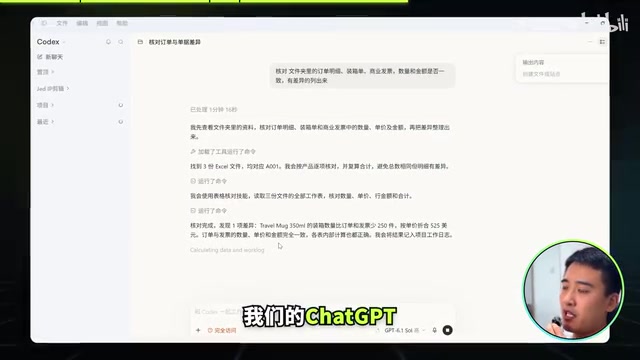
The clever part of this design is that "waiting" is also incorporated into automation: the Agent doesn't just wait blindly—it calls the interface to check status itself, requests when it finds encryption, waits if not approved, and continues immediately once approved. For enterprise scenarios that need to process a large number of encrypted files, this is equivalent to turning the approval process into a tool node that the Agent can perceive and invoke.
MCP (Model Context Protocol) is a protocol proposed and open-sourced by Anthropic at the end of 2024, used to standardize the connection between large model applications and external tools and data sources. It adopts a client-server architecture: the host application (such as various AI coding assistants) has a built-in MCP client, which connects to one or more MCP Servers through standard transport methods (usually stdio for local processes, HTTP/SSE for remote services). The Server declaratively exposes three types of capabilities: Tools (functions that can be called by the model), Resources (data that can be read), and Prompt templates (Prompts). Developers only need to implement a Server once, and it can be reused by all MCP-compatible clients—this is the technical source of the "socket" metaphor in the article.
MCP Is a Socket; What You Connect Depends on the Workflow
Jed Bro extended this idea in the video: the same method can connect the Agent to GitHub for code syncing, to Supabase for database management, and to graphic tools to generate web sketches. The value of MCP lies not in any specific tool, but in turning "software that humans originally operated manually" into "capabilities that Agents can invoke."

This is also the most inspiring part of the project: enterprises have a large number of encryption software, approval systems, and internal tools, which may not have open APIs, but as long as someone is willing to write an adaptation layer, the Agent can gain the ability to act in these closed environments. The GreenShield Decryption Assistant is a concrete sample of this idea landing on a specific pain point.
From "AI Teaches Me MCP" to "I Use AI to Write MCP"
At the end of the video, the author shares a relatable realization: concepts like MCP, Skill, and CLI were initially explained to him by AI, and reading text alone made them hard to truly understand—he remained in a state of half-understanding. It wasn't until he took AI to tackle real pain points in his work that he suddenly fully understood what they actually are.
This positive cycle is addictive—AI teaches knowledge, practice deepens understanding, results come quickly, and the sense of accomplishment drives continued learning. Previously AI taught him what MCP is; now he uses AI to write an MCP, which in turn helps AI remove the "blindfold" on the company's encrypted files. The tool is already open-sourced on GitHub, and the author is soliciting the next pit to fill in the comments.
For ordinary practitioners, the barrier to this case is not as high as imagined: no need to crack any system, no need to change the company's approval system—just identify the link in the workflow that has "the most repeated clicks and the most frequent interruptions," then wrap it with a thin layer of automation. F8 solves the human's fingers, MCP solves the Agent's blind spot; the two are actually two sides of the same thing.
Related articles

The Truth Behind Titanic's Sinking: Key Decisions and Communication Failures in the National Geographic Documentary
National Geographic's The Unsinkable Ship uses survivor testimony to reconstruct Titanic's fatal decisions—from the missing MSG telegram prefix and the broken boiler-room-to-bridge link to how 'unsinkable' thinking delayed damage control and evacuation.

74M-Parameter Open-Source Model Partially Outperforms Jev AI in Testing
Fastino AI's Glider 2.5 models, with just 74M–300M parameters, reportedly outperform Jev AI in some guardrail benchmarks per YouTube testing, run on consumer hardware, and even play Doom. We analyze small models' competitiveness and deployment value on specific tasks.

Gemini 4 Argon Hands-On: Aggressive Pricing, 3D Capabilities Need Coaching
Gemini 4 Argon hands-on: limited-time $2/$10 pricing, million-token output, strong 3D and reverse-engineering work, but weak front-end aesthetics and zero-shot ability need coaching.