From Bookmarks to Second Brain: Auto-Building a Knowledge Base with Feishu + AI

Deliver links via Feishu, parse with Codex scheduled tasks, and auto-build a personal Obsidian knowledge base
The article introduces an automated personal knowledge management system that solves the "save and forget" problem. Users paste links into a Feishu document and optionally note why they saved them; a scheduled task configured through Codex periodically scans the table for new unorganized links, extracts text, captures video screenshots, analyzes video content, and writes raw information plus parsed results into an LLM Wiki-structured knowledge base in Obsidian. The knowledge base is layered into summaries, concepts, transferable methods with applicable conditions, verification approaches, entities, concept comparisons, and practical guides, while keeping a RAW directory for source materials. The author believes this shifts organizing effort to the background and lowers the barrier to knowledge management, though parsing accuracy and compatibility with complex pages remain untested.
Watch a valuable video or post, tap "save," and tell yourself you'll organize notes later—then never touch it again. This problem plagues many people. Watching lots of videos without internalizing or applying them is barely different from not watching at all. A Bilibili creator built a personal knowledge base to solve this, letting links in the bookmark folder automatically "grow" into structured knowledge.
From Bookmarks to Knowledge: The Full Workflow
The core pipeline of this system isn't complicated: paste a link into a Feishu document, and a scheduled task on your computer scans the document for unorganized links, parses the text information and video content, produces raw information and analysis results, then organizes everything into the knowledge base in an "LLM Wiki"-like manner.
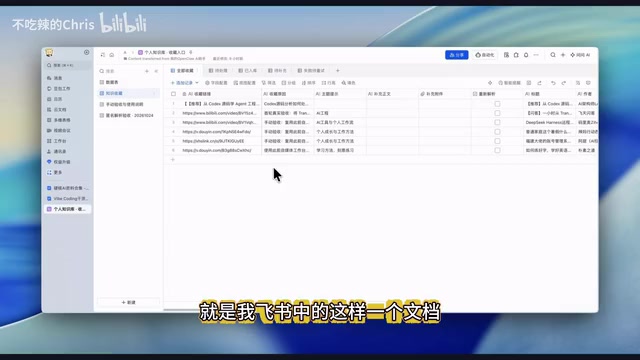
In practice, the user just adds a new record in the Feishu document, pastes the link, and optionally writes down the reason for saving and any notes—the rest is left to the automation. By configuring scheduled tasks through Codex, the workflow scans the Feishu table for new links at set intervals, first extracting text information, then capturing video screenshots and analyzing the video content, and finally writing the raw information and parsing results into the Wiki knowledge base in Obsidian.
Codex is a cloud-based software engineering agent launched by OpenAI that can directly write code, execute commands, read and write files, and run tests based on natural language instructions. It's commonly used for building automation scripts and orchestrating tasks. The "configuring scheduled tasks through Codex" mentioned in the article refers to using this kind of coding agent to generate or adjust the automation code responsible for scanning Feishu documents and fetching link content, which is then periodically triggered by an OS-level scheduling mechanism (such as cron). Note that Codex itself doesn't handle "waking up on schedule"—the scheduling depends on a timer in the runtime environment, and the two together form the complete automation pipeline.
Structure Design of the Knowledge Base
The knowledge base isn't just a pile of notes—it has a clear hierarchy. Under the Wiki directory on the left, it organizes summaries, raw note information, concepts, transferable methods and their conditions of use, verification approaches, entities (new terms mentioned in videos), comparisons and trade-offs between concepts, and step-by-step practical guides.
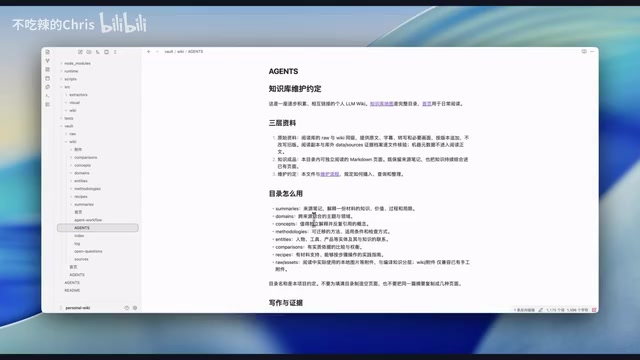
This organization draws on the structure of a traditional Wiki: keep a RAW directory for the most original notes or web page information, then let the Agent embed and distill knowledge from it, automatically categorizing it into the appropriate directories. Separating raw information from structured knowledge preserves the basis for traceability while keeping the knowledge layer clean.
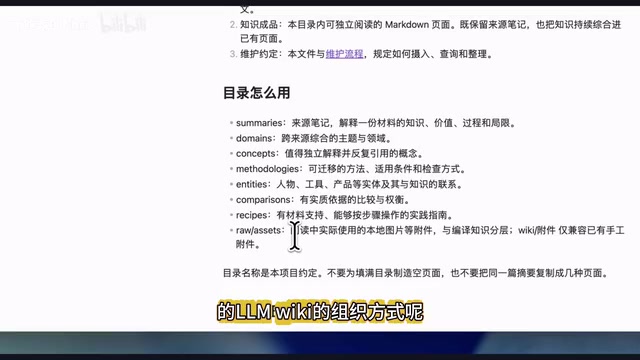
You might not have noticed that the knowledge base also supports manual import of raw information. Users can also place scattered notes or web content into the RAW directory and manually trigger the embedding operation, letting the Agent reorganize the knowledge. Feishu integration and manual entry coexist, covering both automatic collection and proactive organization scenarios.
Obsidian is a note-taking software based on local Markdown files. All notes are stored as plain text in the user's own folders, connecting scattered notes into a networked knowledge graph through bidirectional links ([[note name]]), and supporting a graph view to visualize the connections between concepts. Because the data is fully local and the format is open, Obsidian is very well suited as a target repository for Agent automatic writing and reading—the program only needs to generate Markdown files and directory structures according to the convention, and the generated content seamlessly integrates into the user's existing knowledge system. This is also why it was chosen as the carrier for the Wiki knowledge base in the article.
LLM Wiki refers to a wiki-style knowledge organization method automatically generated and maintained with the help of large language models: the model reads the raw material, extracts concepts, definitions, methods, and entities, writes each as an independent entry, and establishes references and comparisons between entries, forming a structured network that can be expanded layer by layer. Compared with a traditional manually written Wiki, its entries are produced in batches by the model and continuously updated with new material; compared with a purely vector-retrieval knowledge base, it retains readable, editable written entries rather than fragmented embedding vectors. The "organizing in an LLM Wiki-like manner" mentioned in the article means having the Agent take on the work of distilling and categorizing from raw notes to structured entries.
Scheduled Tasks and Automation
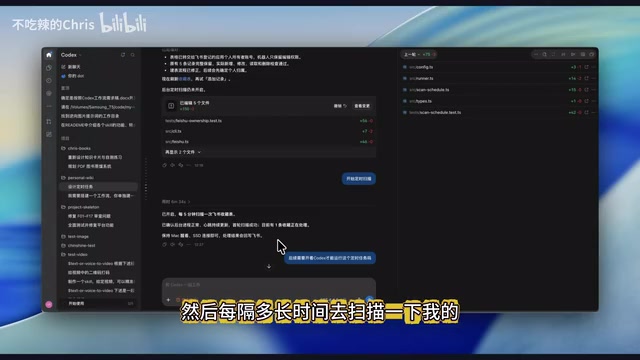
The entire workflow is triggered by scheduled tasks: the user sets the knowledge base directory to scan the Feishu table from a certain time to a certain time each day, at a certain interval. Newly scanned links enter the analysis pipeline, completing the transformation from link to raw information to knowledge. The creator mentioned that the process of building the Feishu-integrated knowledge base will later be open-sourced as a skill, with the goal of letting anyone deliver links through Feishu anytime and anywhere, automatically organizing the corresponding knowledge into their own knowledge base.
The significance of this design lies in lowering the startup cost of knowledge management: the saving action stays the same, and the organizing action is handed off to the background. For people long troubled by "bookmarks gathering dust," this approach of moving the entry point to Feishu and handing the processing to an Agent provides a reusable paradigm for personal knowledge management. However, the video doesn't show details such as parsing accuracy or compatibility with complex pages, so the actual effectiveness still needs to be tested on real content.
One-line Summary
Deliver links via Feishu, parse with Codex scheduled tasks, and automatically build a personal knowledge base in Obsidian
Paragraph Summary
The article introduces an automated personal knowledge management system that solves the "save and forget" problem. Users paste links into a Feishu document and optionally note the reason for saving; a scheduled task on the computer (configured through Codex) periodically scans the table for unorganized new links, extracts text information, captures video screenshots, and analyzes video content, then writes the raw information and parsing results into an LLM Wiki-structured knowledge base in Obsidian. The knowledge base is divided into levels such as summaries, concepts, transferable methods and applicable conditions, verification approaches, entities, concept comparisons, and practical guides, while retaining a RAW directory for raw materials for traceability, and also supporting manual content import and triggered embedding. The author believes this approach shifts the organizing cost to the background and lowers the threshold for knowledge management, but parsing accuracy and compatibility with complex pages still need to be tested.
Related articles

T3 Code: The Open-Source AI Coding Assistant's Comeback Story
T3 Code is an open-source AI coding assistant that unifies subscriptions like Codex and Claude, with powerful remote control and parallel task management.

Never Elected, Yet Ruled New York for 30 Years: The Ultimate Case Study in the Mechanics of Power
Robert Caro's biographies reveal how unelected Robert Moses ruled New York for 30 years through legal drafting and public authorities, and how Lyndon Johnson built leverage as a "powerless" Senate Majority Leader. Unpacking the underlying logic of accumulating and sustaining power.

The CPython 3.10 Recursion Trap and Synthetic Recovery in TokenGuard, an LLM Circuit Breaker
TokenGuard's author recounts a recursion crash caused by OrderedDict.pop in CPython 3.10 and introduces v0.3.0's Loop Nudge synthetic recovery, inline DLP scanning, and other new LLM agent circuit-breaker capabilities.