From n8n to Agent OS: Is AI Automation Being Replaced by Agentic Systems?
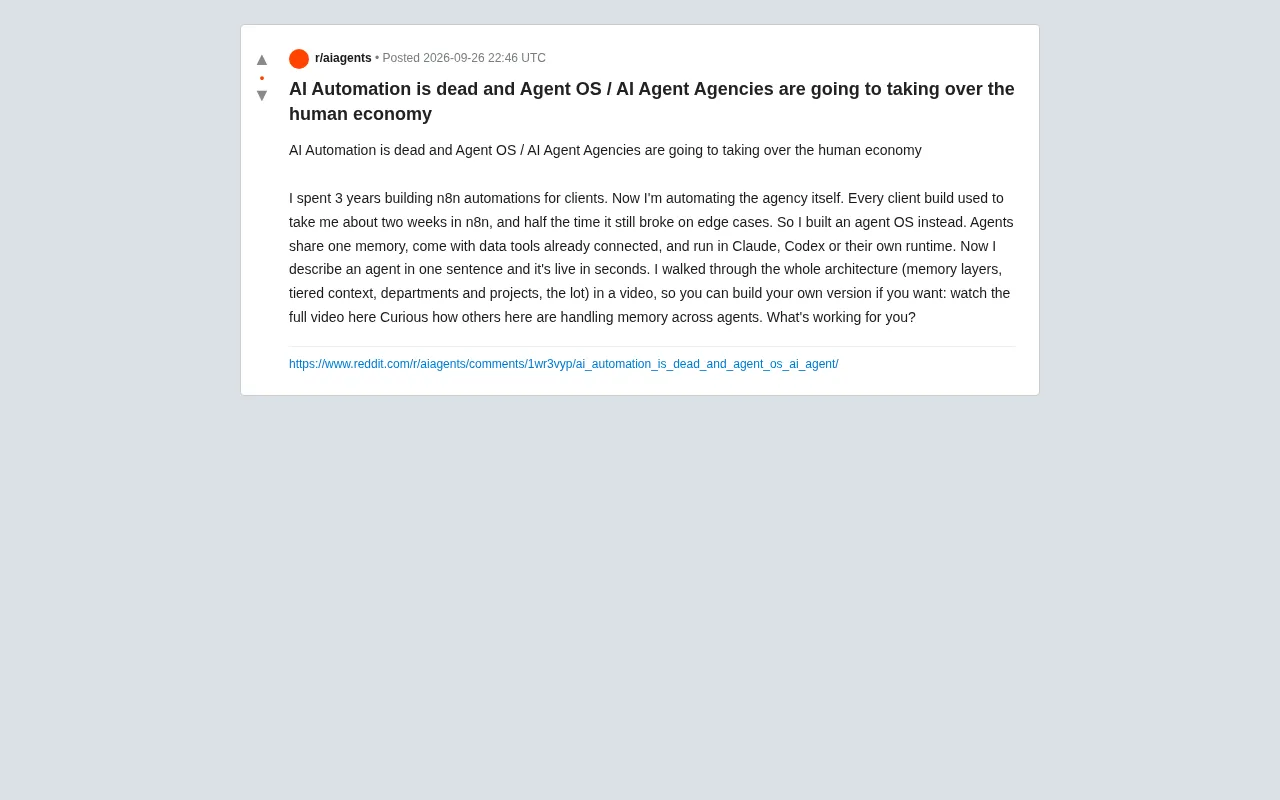
An n8n developer builds an Agent OS with shared memory layers, claiming agents will replace deterministic automation — but key challenges remain unsolved.
A developer with three years of n8n experience shared an architectural pivot on Reddit: traditional workflow automation — slow to build (roughly two weeks per project) and prone to breaking on edge cases — is being replaced by an "Agent OS" built around shared memory layers, tiered context, pre-connected data tools, and multi-runtime support for Claude and Codex. The author claims delivery time has collapsed from two weeks to seconds. The article argues this reflects a real industry shift from deterministic orchestration to autonomous agents, but dismisses "AI automation is dead" as an overstatement — both paradigms have their place, and the author's own plea to the community for memory-sharing solutions confirms the field is still in early days.
A Practitioner's Pivot
A developer sharing their experience on Reddit put forward a provocative argument: traditional AI automation is dying, and it will be replaced by an "Agent OS" and "AI Agent Agencies." The author claims to have spent three years building n8n automation workflows for clients — and has now started handing off the automation-building process itself to agents.
Their core frustration is specific: each client project in n8n typically took about two weeks to build, and roughly half of them would break on edge cases. For anyone who has worked in workflow automation, this pain point — slow to build, hard to maintain, one small change breaks everything — is all too familiar. It was this recurring brittleness that pushed the author to rethink the underlying architecture of automation.
What Agent OS Actually Changes
The author's proposed alternative is a system called "Agent OS" (Agent Operating System). Rather than manually orchestrating nodes and flows like in traditional automation, this system introduces several key design decisions worth unpacking:
Shared Memory Layer
Multiple agents share a single memory system, meaning different agents can exchange context rather than operating in silos. The author references concepts like "memory layers" and "tiered context" — storing and retrieving information in layers based on importance and access frequency. This is one of the most challenging and critical engineering problems in modern multi-agent systems.
Memory management in multi-agent systems is one of the central challenges in AI engineering today, and it generally breaks down into three layers: short-term memory (the context window for a single conversation or task), long-term memory (persistent cross-session storage, typically implemented with vector databases like Pinecone or Weaviate), and working memory (intermediate state during active task execution). "Tiered context" refers to the system dynamically deciding what information stays in the model's context window (high cost, fast response) versus what gets stored in an external database and retrieved on demand (low cost, but requires an additional retrieval step). The hard part of sharing memory across agents is the consistency problem: when multiple agents concurrently read from and write to the same memory layer, how do you prevent conflicting information and keep each agent's understanding of world state in sync? There's no industry consensus on this yet — which is exactly why the author turned to the community for answers.
Pre-connected Data Tools
Agents come with data tools already connected out of the box. In the traditional n8n model, connecting every API and data source requires manual configuration. Here, that connectivity is a default capability, dramatically reducing the repetitive setup work on every new project.
Multi-Runtime Support
These agents can run on Claude, Codex, or their respective runtimes. This runtime flexibility means the system isn't locked into any single model or platform.
The author sums up the experiential leap in one line: client projects that used to take two weeks to deliver can now go live in seconds from a single natural-language description. They also recorded a full walkthrough of the entire architecture — memory layers, tiered context, and how departments and projects are organized — for others to reference when building their own versions.
Is "Automation Is Dead" a Real Thesis or Just Marketing?
The headline is attention-grabbing, but it deserves a sober reading. From a technical evolution standpoint, the shift the author describes does reflect a genuine trend: moving from deterministic workflow orchestration (tools like n8n and Zapier, built on nodes and triggers) toward LLM-powered autonomous agents. The former requires humans to predefine every step; the latter lets agents make decisions and invoke tools on their own in pursuit of a goal.
Both paradigms have their place. Deterministic automation remains reliable in predictable, compliance-heavy contexts; agentic systems have the edge when handling ambiguous requirements and tasks that demand flexible adaptation — which maps directly onto the author's pain point of workflows constantly breaking on edge cases.
That said, calling "AI automation dead" is still an overstatement. Agentic systems face their own unsolved problems: memory consistency, hallucinations, cost control, and auditability. In fact, at the end of the post, the author openly asks the community: "How are you all handling shared memory between agents? Any solid solutions?" — which is itself evidence that cross-agent memory management has no mature answer yet, and the entire field is still in exploration mode.
The deterministic workflow orchestration represented by n8n and Zapier is essentially a Directed Acyclic Graph (DAG) execution model: each node corresponds to a deterministic operation, trigger conditions are explicit, and outputs are predictable. The advantages are auditability, debuggability, and low execution cost. The disadvantage is that every branch must be enumerated in advance by a human — and the real world will always produce unforeseen edge cases that halt the workflow. By contrast, LLM-powered autonomous agents use a ReAct (Reasoning + Acting) loop of perceive–reason–act. The agent dynamically decides at runtime which tools to call and in what order, giving it the theoretical ability to handle scenarios it has never seen before. But this flexibility comes at the cost of non-determinism: the same input may produce different outputs, debugging becomes significantly harder, and each inference consumes substantial tokens — making cost control one of the primary obstacles to scaling these systems in production.
Takeaways for Practitioners
For teams currently doing automation work or considering a shift toward agentic architectures, this case offers a few practical observations:
- Repetitive work is a signal to evolve: If you find yourself rebuilding similar workflows for every new client, abstracting that build process into a reusable agentic system may deliver more long-term value than continuing to stack individual workflows.
- Memory architecture is your core competitive advantage: Layered memory and tiered context aren't nice-to-haves — they're the foundation that determines whether a multi-agent system can operate reliably at all.
- You don't have to throw out your existing tools: Rather than "automation is dead," think of it as automation being wrapped and upgraded by an agent layer. The two can coexist.
As a practitioner's firsthand account, the value of this post isn't in its headline slogan — it's in what it reveals about the real anxieties and proactive adaptations of front-line developers navigating rapid AI tool iteration. Grand proclamations like "AI agents will take over the human economy" are conversation hooks, not verifiable predictions.
Related articles

DeepSeek Open-Sources DeepInfer: What Is an Inference Framework Actually For?
DeepSeek open-sources its inference framework DeepInfer under Apache 2.0, supporting DeepSeek V4.1 Flash offline inference. This article explains its request scheduling, FlashMLA/DeepGEMM compute optimization, DSPark speculative verification acceleration, and what it means for developers and ordinary users.

Open-Source AI Learning Agent: A Full Workflow Experience from Topology Graphs to Exam Generation
Explore an open-source AI learning agent: built on DeepSeek API, it constructs knowledge systems via topology graphs, with automatic document generation, notes, super documents, and exams. Learn about its Agent workflow and design highlights.

DeepSeek Whale Girl Open-Source MV Meme: AI Industry Coded Slang About Pivoting to Closed Source
Bilibili's DeepSeek Whale Girl rap MV uses fictional memes to tease the AI open-source vs. closed-source debate, with lyrics full of industry slang. This article explains the meme culture, the Whale Girl symbol, and the open/closed tension.