From Zero to LLM Development: A Four-Phase Learning Roadmap

A four-phase roadmap for switching into LLM development: from awareness to engineering deployment and a job-hunting closed loop.
The article presents a four-phase roadmap for transitioning into LLM application development: phase one builds a cognitive map of the role; phase two hones Prompt engineering, RAG, and Agent architecture with hands-on projects; phase three focuses on engineering deployment—API wrapping, streaming, state management, evaluation, and cost monitoring—the watershed between demos and live systems; phase four covers job-hunting, translating experience into problem-solution-result narratives and preparing for interviews.
Title
From Zero to LLM Development: A Four-Phase Learning Roadmap
Meta Description
What should you learn to switch into LLM development from scratch? This article lays out a four-phase learning path: from understanding the role, through core Prompt/RAG/Agent skills, to engineering deployment and job-hunting practice—helping you build a clear capability map and avoid detours.
Article Content
When switching into LLM development, the biggest pitfall isn't math or code—it's fragmented information. Online tutorials either pile up model theory and mathematical derivations that leave you unable to build a working application, or chase trendy buzzwords with no implementation details. A developer who published a systematic course on Bilibili distilled a four-phase path from zero to engineering deployment, based on his own interview and job-hunting experience and the pitfalls he encountered training newcomers.
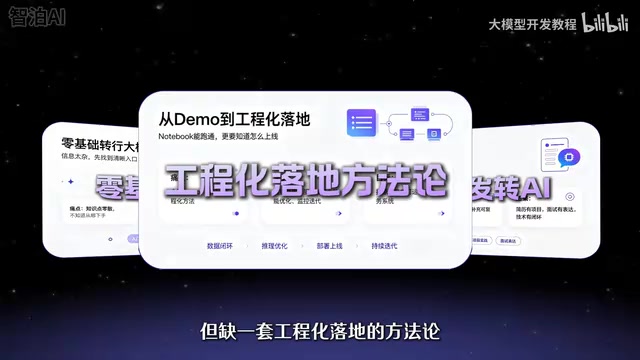
First, Confirm: Who This Roadmap Is For
The course clearly defines three target groups with quite precise positioning:
- Zero-background career changers who are overwhelmed by scattered online information and don't know where to start;
- Traditional developers with two or three years of experience who want to add an AI label to their resume but freeze up when interviewers ask about RAG or Agents;
- Those who can run models and tweak demos but can't grasp the methodology for engineering deployment, lacking a system that can actually go live.
The author's core promise isn't "you'll know it all after finishing"—it's to transform your perception of the role from "seems hot" into a roadmap you can actually follow. This positioning is far more pragmatic than slogans like "from novice to expert in seven days."
Phase One: Building Awareness—Understand the Role's Boundaries First
Many career changers dive straight into papers and give up two weeks later. The author's logic is the opposite: build the framework first, understand what capabilities the role requires, then fill in skill points one by one.
Phase one addresses questions including: the essential differences between LLM application development and traditional backend development, the model's capability boundaries (what it can and can't do), the role of tokens and context windows, how the temperature parameter affects output, API calling and billing logic, and what each mainstream model excels at.
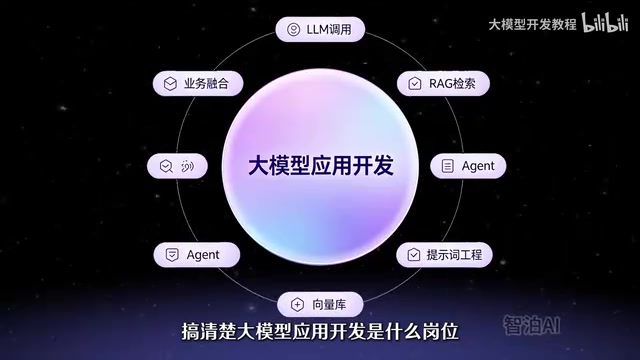
The author particularly emphasizes dissecting job descriptions line by line. The reason is straightforward: without understanding these, the systems you write are castles in the air, and you'll be exposed the moment an interviewer probes. The output of this phase isn't code—it's an accurate cognitive map of the role.
Phase Two: Three Core Skills—The Fundamentals for Interviews and Work
The core skills are broken into three blocks, each paired with a hands-on project:
Prompt Engineering—from being able to write prompts to writing them reliably, covering role setting, few-shot examples, and structured output.
RAG (Retrieval-Augmented Generation)—from principles to implementation, involving embeddings, vector databases, chunking strategies, retrieval tuning, and troubleshooting when retrieval accuracy won't improve.
Agent Architecture Design—how to orchestrate multi-step tasks, how to integrate Function call and MCP, and how to handle tool-call failures gracefully.
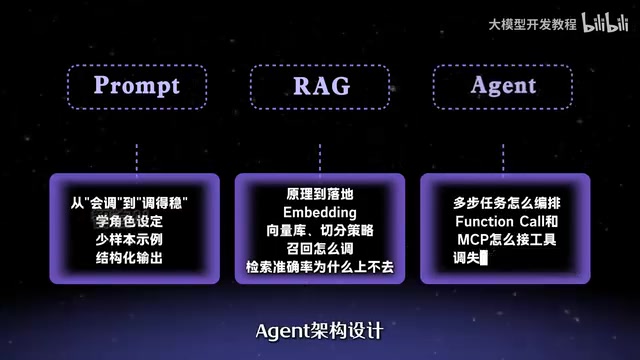
The corresponding hands-on projects are RAG document Q&A and Agent automation workflows. These three blocks are core interview topics and the fundamentals of daily work—missing any one makes it hard to independently take on application development tasks.
RAG (Retrieval-Augmented Generation) is a technical paradigm that combines external knowledge retrieval with LLM generation. Its core workflow: first split documents and convert them into vectors stored in a vector database; when a user asks a question, retrieve the most relevant fragments, then feed these fragments as context to the LLM to generate an answer. This mitigates model hallucination, overcomes the timeliness limitations of training data, and makes answers verifiable. The difficulty of RAG isn't getting a demo running—it's retrieval accuracy: chunking granularity, embedding model choice, and recall strategy all affect the final result.
Agent refers to an LLM application form that can autonomously plan, call tools, and execute multi-step tasks. Unlike single-turn Q&A, an Agent decomposes goals, selects tools (such as search, calculation, APIs), observes results, and decides the next step. Function call is the mechanism by which models invoke external functions, while MCP (Model Context Protocol) is a standardized protocol that lets models connect to various tools and data sources in a unified way. The engineering challenges of Agents lie in graceful fallback for tool-call failures, termination conditions for infinite loops, and the orchestration reliability of multi-step tasks.
Phase Three: Engineering Deployment—Turning Demos into Systems That Can Go Live
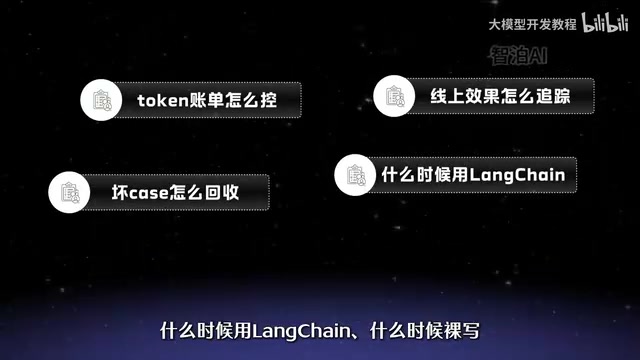
This is the link commonly missing from courses on the market. Between a working demo and a live system lies a great deal of engineering detail: wrapping APIs with FastAPI, how to do streaming output, how to manage session state, how to add logging and instrumentation, how to build an evaluation (Eval) system, how to design test cases covering scenarios where the model "acts up," how to control costs and token bills, how to track online performance, and how to collect bad cases.
There's also a frequently agonized-over question: when to use LangChain and when to write it bare. The author places the answer in this phase. This content isn't sexy, but it determines whether what you deliver is a toy or a product.
Eval (Evaluation) system is an easily overlooked but crucial part of engineering LLM applications. Traditional software testing relies on assertions to judge right from wrong, but LLM outputs are stochastic—the same input may yield different results—so a quantitative evaluation mechanism is needed: prepare a test set with standard answers or scoring criteria, score using rule matching, similarity computation, or "model-as-judge," and run it after every prompt change, model swap, or retrieval strategy adjustment to use data to judge whether the change is an improvement or a regression. Without Eval, optimization is all guesswork and online quality can't be guaranteed.
LangChain is an LLM application development framework that encapsulates common components such as model invocation, Prompt templates, retrieval chains, and Agents, accelerating prototyping. But its abstraction layer is thick, making troubleshooting chains long when problems arise, and it iterates quickly with unstable APIs. So when logic is simple or fine-grained control is needed, calling the model SDK directly and writing it bare is often clearer and more controllable. The criteria for choosing a framework versus writing bare are usually: process complexity, team maintenance cost, and requirements for control over underlying behavior.
Phase Four: Job-Hunting Practice—Translating Experience into Competitiveness
The final phase targets concrete outcomes: each experience on your resume should clearly state what problem was solved, what solution was used, and what the result data was; prepare answers to high-frequency interview questions in advance, such as how to cure RAG hallucination, how to break Agent infinite loops, and how to reduce costs; your portfolio should be deployed and online, giving interviewers a link they can click.
From preparation to landing an offer, this forms a closed loop.
The Value and Limitations of This Roadmap
Its greatest strength is binding "what to learn" together with "why learn it"—every step makes clear what you can do after completing it, preventing career changers from getting stuck in theoretical details. The four phases progress layer by layer, from awareness to skills to engineering to job-hunting, with self-consistent logic.
One caveat: this is a course outline rather than independently verified learning-outcome data, and "employment upon completion" remains promotional language. Actual mastery depends on whether the hands-on projects at each phase are solidly completed—especially the engineering training in phase three, which is the watershed between "can tweak a demo" and "can do the job." For zero-background career changers, treating this roadmap as a navigation map is more valuable than treating it as a get-rich-quick promise.
One-line Summary
A four-phase roadmap for switching into LLM development: from building awareness to engineering deployment and a job-hunting closed loop.
Paragraph Summary
The article introduces a four-phase roadmap for switching into LLM application development, summarized by a Bilibili developer. Phase one builds a cognitive map of the role, clarifying capability boundaries and job requirements; phase two hones three core skills—Prompt engineering, RAG, and Agent architecture—with accompanying hands-on projects; phase three focuses on engineering deployment, covering API wrapping, streaming output, state management, evaluation systems, and cost monitoring—the watershed between demos and live systems; phase four targets job-hunting, translating experience into a problem-solution-result structure and preparing high-frequency interview questions. The author notes the roadmap comes from interview and mentoring experience, and its value lies in binding what to learn with why—but learning outcomes still depend on the quality of hands-on project completion.
Related articles

T3 Code: The Open-Source AI Coding Assistant's Comeback Story
T3 Code is an open-source AI coding assistant that unifies subscriptions like Codex and Claude, with powerful remote control and parallel task management.

Never Elected, Yet Ruled New York for 30 Years: The Ultimate Case Study in the Mechanics of Power
Robert Caro's biographies reveal how unelected Robert Moses ruled New York for 30 years through legal drafting and public authorities, and how Lyndon Johnson built leverage as a "powerless" Senate Majority Leader. Unpacking the underlying logic of accumulating and sustaining power.

The CPython 3.10 Recursion Trap and Synthetic Recovery in TokenGuard, an LLM Circuit Breaker
TokenGuard's author recounts a recursion crash caused by OrderedDict.pop in CPython 3.10 and introduces v0.3.0's Loop Nudge synthetic recovery, inline DLP scanning, and other new LLM agent circuit-breaker capabilities.