Full Breakdown of the LangChain + LangGraph + MCP + Agent Enterprise Development Learning Path
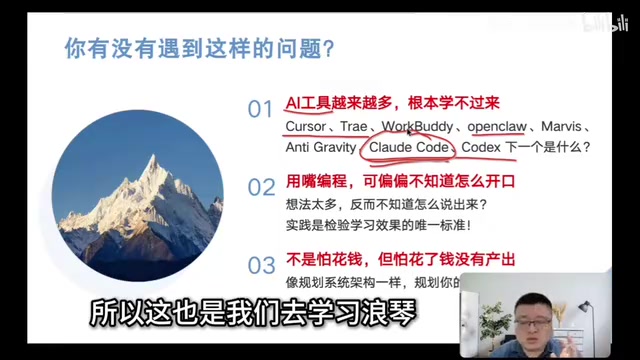
A systematic four-stage path to learn Agent development, emphasizing underlying frameworks and ideas over tool dependence.
Around Bilibili creator Loulan's course *LangChain+LangGraph+MCP+Agent Enterprise Development in Practice*, this article outlines a systematic Agent development learning path. The course argues that the barrier to basic application development is being flattened by large models, while Agent development with planning, tool-calling, and closed-loop execution remains a scarce competency; rather than chasing endless AI tools and bearing lock-in risks, it's better to master the underlying frameworks. The path has four stages: basic concepts; principles and ReAct/CoT paradigms; reinforcement learning, multi-agent systems, and Prompt tuning; and hands-on deployment of two to three practical projects. The course unifies LangChain and LangGraph into an "Agent underlying foundation," emphasizes systems, practice, and ideas, and highlights MCP/Skill ecosystem responsiveness, token cost optimization through time travel, and the significance of local model deployment for enterprise data security.
Agent development is becoming the most core competency in the large model field. Knowing only basic RAG and simple API calls is no longer enough—being able to independently develop intelligent agents with planning, tool-calling, and closed-loop execution capabilities is what's truly scarce in today's AI jobs. The course LangChain+LangGraph+MCP+Agent Enterprise Development in Practice published by Bilibili creator Loulan attempts to explain this thoroughly through a four-stage path. This article combines the course content with the current Agent development ecosystem to outline an actionable learning path.
Why You Must Systematically Learn Agent Development Now
The course opens with a judgment: the barrier to basic application development is being flattened by large models, but Agent development still requires systematic capability. Agents can plan on their own, call tools, and solve complex tasks in a closed loop—this capability directly translates into competitiveness in three directions: job hunting, taking on projects, and building intelligent products.
More critically, the speed of tool iteration. From early Cursor to the various AI programming products that followed, new tools keep emerging, and chasing after them easily leads to fatigue—and what you learn may not even solve your own problems. The creator's view is: tools are products built on underlying frameworks, and only by understanding the underlying frameworks can you reference or even customize tools. For ordinary people, the goal is often not to build a product for everyone but to solve specific problems around them—in this case, learning the underlying frameworks is more cost-effective.

The Risk of Tool Dependence
The course devotes considerable space to discussing tool lock-in, using Claude Code's tightened security measures for domestic users as an example: stopping service, banning accounts, capturing IP time zones and private information, and even tagging enterprises controlled more than 50% by domestic companies. The creator's wording is blunt—forced use is neither safe nor private. Rather than relying on a single product, it's better to master the underlying framework and build similar functionality according to your own needs. This view has a certain stance, but it does raise a question worth considering for learners: are you using tools, or are you bound by them?
The Four-Stage Learning Path: From Concepts to Project Deployment
The course's path is divided into four stages, progressing layer by layer.
Stage 1: Basic Introduction, Mastering Core Concepts
First, grasp the theoretical framework of Agents themselves, understand the core components, and become familiar with basic concepts such as the reasoning and planning module, memory module, and tool calling of large language models. The goal of this stage is to build a solid foundation without rushing to write code.
ReAct (Reasoning and Acting) is an Agent paradigm that lets large models alternate between reasoning and acting: the model first outputs a chain-of-thought-style reasoning, decides which tool to call next, then continues reasoning based on the tool's returned result, looping until the task is complete. It couples "thinking" and "doing" in the same loop, enabling the model to compensate for its own knowledge or computational limitations through external tools. CoT (Chain-of-Thought) guides the model in the prompt to unfold its reasoning step by step, thereby improving accuracy on complex problems. The difference between the two: CoT only involves internal reasoning within the model and does not interact with the environment; ReAct adds tool calling and observation feedback on top of reasoning and is the foundational paradigm for building executable Agents. Understanding these two paradigms helps grasp the design motivations behind nodes, edges, and state transitions in LangGraph later.
Stage 2: Core Advancement, Mastering Principles and Paradigms
Understand how Agents operate, learn to handle difficult problems in development, and expand into classic Agent paradigms such as ReAct and CoT. Upgrading from "understanding concepts" to "understanding principles" is the key step that distinguishes knowing how to use from knowing how to tune.
Stage 3: Reinforcement and Improvement, Optimizing Output
Covers reinforcement learning, multi-agent collaboration logic, and Prompt tuning techniques. How multiple Agents divide and coordinate work, and how Prompts enable Agents to output more precisely, are the problems to be solved at this stage.
Stage 4: Practical Deployment, Connecting to Real Business
Hands-on implementation of two to three practical projects, such as an intelligent decision-making assistant, an automated office Agent, and a multi-agent collaboration system, running through the entire development, debugging, and optimization process. The course emphasizes that the output of this step should directly add value to your resume.
Course Design Approach for LangChain and LangGraph
Compared with the earlier LangChain 0.3 version, this course has been significantly upgraded, covering modules such as LangChain, LangGraph, and Deep Agents. The course design has three clear principles: emphasis on system over features, emphasis on practice over theory, and emphasis on ideas over code.
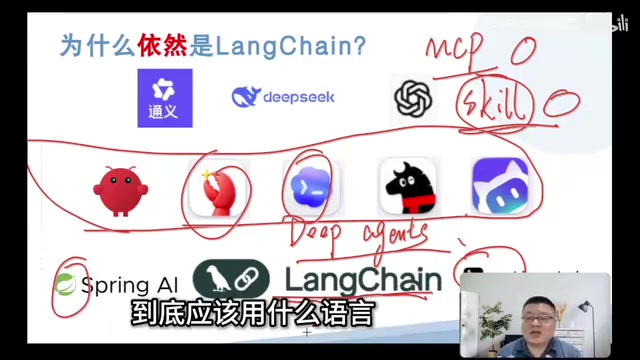
One notable change is the unification of LangChain and LangGraph. In the past, the two were often taught as separate courses, but they both belong to the larger LangChain framework and share common underlying parts. The course extracts the basic capability of interacting with large models and calls it the "Agent underlying foundation," making the construction approaches of the upper layers—LangGraph, LangChain, and Deep Agents—interconnected, so one course can cover them all.
Why Enterprises Use Graph More and Chain Less
The course candidly points out that in actual enterprise use, LangGraph is far more common than LangChain, because the Chain pattern is not flexible enough; Graph can do basically everything Chain can do, and often more elegantly. But the course still retains LangChain content because it is a classic Agent construction philosophy—the more approaches you encounter, the more complete your foundation. Analogous to learning databases: without understanding how databases interconnect with other technologies and where they sit in the architecture, it's impossible to learn deeply.
LangChain initially centered on the "Chain" abstraction, stringing together steps such as prompt templates, model calls, and output parsing into a linear pipeline, suitable for simple processes with fixed structure. LangGraph models Agents as graphs: nodes are execution units (such as calling models or executing tools), edges define transition conditions, and everything operates around a persistable shared state. This design naturally supports loops, branching, human intervention, and checkpoint recovery, exactly matching the real needs of Agents that reason repeatedly and choose paths conditionally. Because graph structures have stronger expressive power, complex enterprise-level business tends to favor LangGraph; while Chain's linear thinking remains a classic entry point for understanding Agent orchestration, so the course treats it as a conceptual supplement rather than the main tool.
MCP and Skill: Ecosystem Vitality Determines Framework Lifespan
The course recommends LangChain for two reasons: first, it is the earliest framework and has accumulated the most problems and experience; second, its ecosystem is active, allowing new technologies to be integrated quickly. MCP and Skill were originally product standards proposed by Claude Code and later widely referenced; LangChain soon provided direct support—in the Deep Agents module, after downloading Skill, you can handle it directly with the API. The course also guides students to hand-write a Skill system to help understand the underlying implementation.
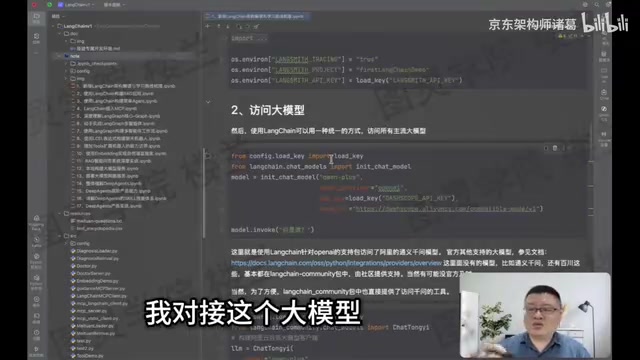
This speed of ecosystem response means that even if new standards emerge in the future, the framework can keep up quickly. In addition, LangChain sits at the core of the ecosystem storm; once you master it, surrounding frameworks naturally open up: LangChain has LangChain4j, LangGraph has LangGraph4j, and Spring AI also has a corresponding Graph module—language is no longer a barrier.
MCP (Model Context Protocol) is a standardized protocol for enabling large model applications to connect to external tools, data sources, and services in a unified way—similar to defining a universal "plug" standard on the model side, avoiding the need to write separate adapter code for each tool. Skill, on the other hand, packages the instructions, scripts, and resources for a certain type of task into a reusable capability unit that Agents load and invoke when needed. Both originate from the Claude Code ecosystem and have been widely adopted; LangChain provides direct support in its Deep Agents module. The value of standardized protocols lies in reducing integration costs and improving portability, which is also an important signal for judging whether a framework can survive long term.
An Easily Overlooked Practical Detail: Time Travel
The course mentions a capability that isn't cutting-edge but is very practical: time travel. When mainstream Agent products handle task failures, they either report an error directly or rerun from the beginning—or even replan—with token consumption flowing like water. The time travel provided by LangChain can save the task execution process and restart from the step where the error occurred, so previously completed steps don't need to consume cost again.
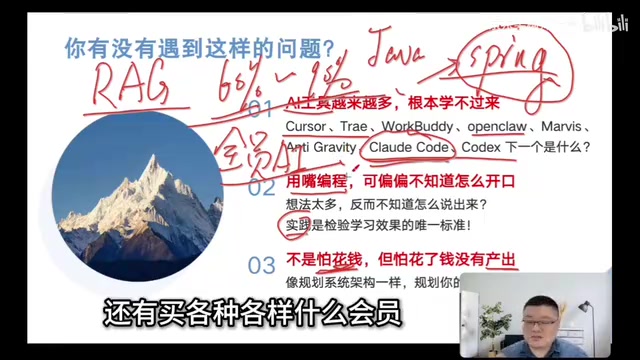
Behind this is the issue of token cost planning. The course mentions that companies such as Microsoft, Amazon, and Google went all-in on AI early on but later began limiting tokens, because using large models without regulation leads to bottomless consumption. Ordinary users spend a lot of money buying tokens, tools, and memberships, yet the output is hard to measure. Planning tokens like planning system architecture is the way to spend money where it counts.
A Misconception About Prompt
The course questions the claim that "if the Prompt is well written, the results will be good." Natural language interaction is hard to simply score at 60% to 90%—even in human communication, clearly explaining a requirement doesn't guarantee the other party gets it, so why assume a large model will definitely understand? Prompts need to be validated through practice; quickly building small demos to verify ideas is the only way to get trustworthy results. Without practice, whatever you propose is empty.
Time travel in LangGraph is implemented through the checkpoint mechanism: the framework saves a complete state snapshot of the graph after each execution step, forming a history that can be replayed step by step. When a task fails, execution can be resumed from any checkpoint without rerunning previously completed nodes; you can also modify a historical state and branch out into a new execution path for debugging or comparing different decisions. For multi-step Agents, this directly reduces repeated model calls and is a key engineering means of controlling token costs, while also making the debugging process reproducible and auditable.
Local Model Deployment and Enterprise Needs
The course adds a section on building large model services locally, for two reasons: simple problems don't warrant wasting tokens on remote model calls; and large enterprises, due to data security considerations, tend to prefer local deployment over calling cloud services. The course covers building a local model system as well as practical techniques such as using new API as a relay station.
Who Should Learn, and a Pragmatic Suggestion
The course is aimed at application developers, not at requiring memorization of every API. For those unfamiliar with Python or without an application development background, the course's advice is to follow along with a few projects and the skills will come naturally. For those concerned about GPU costs, the course offers cloud service platforms and customized services.
In my view, the most valuable part of this path is not the four stages themselves but the positioning of "emphasis on ideas over code." Agent development APIs will change and frameworks will upgrade, but underlying ideas such as planning, memory, tool calling, and multi-agent collaboration are relatively stable. Build the system first, and subsequent small API adjustments won't be an obstacle. As for the statements in the course about the security measures of specific tools, these are the instructor's personal stance, and readers can judge based on their own circumstances.
The future brought by AI is blurry, but the direction can become clearer as you go. As the course concludes: AI is the future, but you must be the driver.
One-line Summary
Learn Agent development systematically through a four-stage path, emphasizing underlying frameworks and ideas rather than tool dependence.
Paragraph Summary
Centered on Bilibili creator Loulan's course LangChain+LangGraph+MCP+Agent Enterprise Development in Practice, this article outlines a systematic learning path for Agent development. The course argues that the barrier to basic application development is being flattened by large models, while Agent development with planning, tool-calling, and closed-loop execution remains a scarce competency; rather than chasing endless AI tools and bearing lock-in risks, it's better to master the underlying frameworks. The path has four stages: basic concepts; principles and ReAct/CoT paradigms; reinforcement learning, multi-agent systems, and Prompt tuning; and hands-on deployment of two to three practical projects. The course unifies LangChain and LangGraph into an "Agent underlying foundation," insists on emphasizing systems, practice, and ideas, and highlights MCP/Skill ecosystem responsiveness, token cost optimization through time travel, and the significance of local model deployment for enterprise data security.
Related articles

Gemini 4 Carbon Tops Global Rankings as AI Productivity and Open-Source Ecosystems Surge
Google DeepMind's Gemini 4 Carbon tops global benchmarks, built for complex agents and system security. ByteDance launches Doubao Work integrated with Feishu, Anthropic's AI autonomously breaches 5 system-level attack chains, and ModelBest and Fudan open-source on-device multimodal and image generation models.

Overseas Creator Breaks Down N8n AI Agent Business Playbook: From Tooling to Monetization
An overseas creator breaks down the N8n AI agent business playbook: comparing Zapier, Make, and N8n, detailing four monetizable automation categories—lead capture, WhatsApp follow-up, booking, and content pipelines—plus agency pricing and a sales playbook.

Empacer: The Voice-First AI Assistant for Small Business Owners That Topped Product Hunt
Empacer is a voice-first AI assistant for small business owners: three-question setup, voice requests turned into customer replies, social posts, and invoices—all owner-approved. It won #1 Product of the Day on Product Hunt with 231 upvotes and 47 comments.