Gemini 4 Carbon Released: AI Morning Brief Unveils Google's New Model and Industry Updates
Google releases Gemini 4 Carbon to top the intelligence index, GitHub launches multi-model orchestration, and earnings and TPU developments draw attention.
Google DeepMind released Gemini 4 Carbon, which topped the Artificial Analysis Intelligence Index V5 with a score of 59, focusing on long-horizon agentic coding and cybersecurity and released on a restricted basis due to its vulnerability exploitation capabilities. GitHub launched Copilot Fusion, cutting costs in half and time by 40%, with agent-initiated pull requests exceeding 40%. Microsoft and Alphabet earnings show rapid Azure and Google Cloud growth, and OpenAI plans to buy Google TPUs, signaling diversified compute supply. Open-source releases include NVIDIA's speech model and a domestic diffusion language model; governance efforts shift toward business value, with only 3% of enterprises achieving AI-driven cost reduction.
Gemini 4 Carbon Released: AI Morning Brief Unveils Google's New Model and Industry Updates
Two weeks after releasing Argon, Google DeepMind launched its next-generation frontier model Gemini 4 Carbon, which focuses on long-horizon agentic coding and cybersecurity capabilities. On the Artificial Analysis Intelligence Index V5, the model topped the overall leaderboard with a score of 59, with pricing unchanged. However, due to its outstanding performance on vulnerability discovery and exploitation benchmarks, this week's initial release is limited to select cyber defense agencies, and it is participating in the U.S. government's pre-release safety testing.
Model and Platform Updates
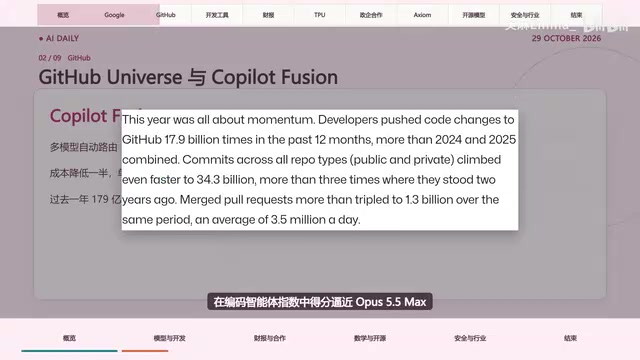
At its annual Universe conference, GitHub introduced the GitHub Copilot app as well as Copilot Fusion, a multi-model orchestration system. Fusion can automatically route among multiple models based on reasoning, debugging, and tool-calling needs, scoring close to Opus 5.5 Max on the coding agent index while cutting costs in half and reducing task time by 40%.
The annual report released the same day shows that over the past year GitHub saw 17.9 billion code pushes and 1.3 billion merged pull requests. As of September, more than 40% of pull requests were initiated by developers using agents, up from 17% in March. Microsoft also opened up the underlying Copilot Harness framework to enterprises through Foundry.
At the Android Developer Summit, Google announced that Android Studio now officially connects to third-party coding agents through an open protocol, allowing developers to install and simultaneously run more than 40 tools, including Cloud Agent and Codex, within the editor. On the same day, Replayit released Ybench 2.0, a long-horizon benchmark that requires agents to build a complete software product from scratch; in testing, GPT 6.1 SO ranked first with a 65% one-pass success rate.
The Artificial Analysis Intelligence Index is a composite capability leaderboard for models maintained by the independent evaluation organization Artificial Analysis. It aggregates scores from multiple public benchmarks (such as reasoning, math, coding, and knowledge Q&A) and weights them into a single score for cross-vendor comparison of frontier models. Because its evaluation methodology is public and updated frequently, it is often used by media and developers as a reference point for model capabilities. The index does not directly reflect performance in real production environments, so there may be gaps between leaderboard scores and actual task completion; when reading it, it is advisable to also consider specific benchmarks (such as the coding agent index and vulnerability discovery benchmarks).
Multi-model orchestration refers to systems that do not rely on a single model but instead dynamically route requests to different models based on task type, latency requirements, and cost budgets, chaining multiple models together when necessary to complete subtasks. Its core value lies in using smaller models for simple requests and stronger models for complex requests, thereby balancing quality and cost. GitHub Copilot Fusion is one such example: it automatically selects models based on needs such as reasoning, debugging, and tool calling, so it can approach top-tier models on the coding agent index while significantly reducing cost and time.
Earnings and Compute Trends
Microsoft and Alphabet released their latest quarterly earnings on the same day. Microsoft's total revenue for the quarter was $92.3 billion, and Azure quarterly revenue, disclosed separately for the first time, reached $33.17 billion, up 48% year over year. Regulatory filings also show that Microsoft received about $10 billion in revenue during the quarter from commercial arrangements related to OpenAI. Alphabet's annualized revenue run rate reached $500 billion, with Google Cloud revenue surging 103% year over year, and first-party model APIs processing close to 321 tokens per minute.
On the compute and capital markets front, according to reports from Bloomberg and other media, OpenAI plans to purchase Google's TPU chips, and Jagiwen also announced the same day that starting in 2027 it will deploy Google TPUs in its own cloud infrastructure — the first time the chip has entered a hyperscale cloud provider other than Google. Meanwhile, Cognition, the parent company of Devon, after completing a funding round at a $48 billion valuation in September, has recently received valuation offers of $70 billion to $80 billion.
TPU (Tensor Processing Unit) is Google's self-developed specialized AI accelerator chip, originally designed for internal inference and training workloads and for years primarily serving Google Cloud and its own model training. Compared with general-purpose GPUs, TPUs are more energy-efficient for certain matrix operations, but their software ecosystem (such as the XLA compiler) differs from the CUDA ecosystem, making migration costs higher for external customers. OpenAI's plan to purchase TPUs and third-party cloud providers' announcements to deploy TPUs mean that TPUs are beginning to move from Google's internal infrastructure to external commercial supply, seen as a signal that the AI compute supply landscape is shifting from reliance on a single GPU to diversification.
Partnerships and Industry Applications
OpenAI announced an expanded partnership with ServiceNow, launching a plugin within ChatGPT to support querying tickets and assessing change risk, while previewing for U.S. Pro users the ability to assign tasks to the Dot agent via text message.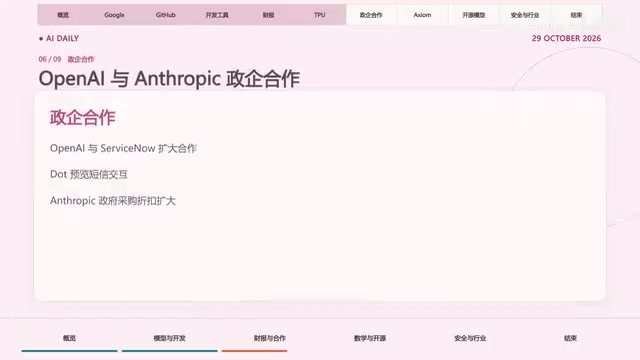 Anthropic expanded its agreement with the U.S. General Services Administration, extending a 40% procurement discount to U.S. state and local governments and covering all product forms for the first time, while also launching legal-specific components for contract review and citation verification.
Math AI startup Axium announced that its agent cluster spent 24 days completing a full machine formal verification of the classification theorem of finite simple groups. The team translated the original proof, scattered across more than 500 papers totaling about 15,000 pages, into more than 43.1 million lines of Lean code, with no unproven steps left behind, and in the process found multiple discrepancies in the published literature.
The classification theorem of finite simple groups is one of the largest achievements in 20th-century group theory. Its proof is scattered across hundreds of papers totaling tens of thousands of pages and has long relied on computer-assisted computation and extensive case analysis, making it one of the longest and hardest proofs in mathematical history to fully verify. "Machine formalization" means using proof assistants (such as Lean) to write each step of reasoning as code that can be checked line by line by a computer, thereby eliminating gaps that manual review might miss. This process places extremely high demands on AI agents' long-horizon planning, context retention, and error self-checking capabilities, so it is often used as a landmark test of whether agents can handle ultra-long-cycle tasks.
Open-Source Model Progress
NVIDIA open-sourced the speech model Animotion 3.5 Transcribe, which supports transcription in 40 languages and ties for the top spot among open-source models with a 2.8% word error rate.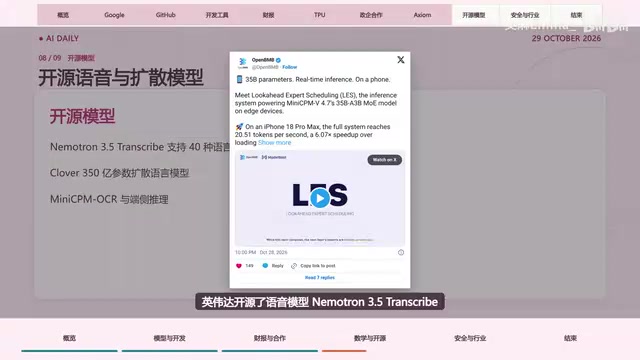 The domestic diffusion intelligence team open-sourced Cover, a 35-billion-parameter diffusion language model, which the team says surpasses autoregressive models of the same size in coding ability and can generate 5 to 10 times faster. ModelBest released a 1-billion-parameter OCR model that can run locally on phones, as well as an engine that supports real-time inference of 35B models on mobile devices.
Security and Industry Governance
Security startup Cathedral disclosed that its AI agent penetrated Anthropic's internal systems through third-party software and within 12 hours accessed meeting notes, payroll data, and Slack messages. On enterprise management, Amazon updated its engineer evaluation guidelines, explicitly using actual business value rather than AI usage counts or token consumption as the evaluation standard. Cathedral's latest survey shows that currently only 3% of enterprises have achieved cost reduction and efficiency gains through AI, but 85% of enterprises still plan to continue increasing AI budgets next year.
One-line Summary
Google releases Gemini 4 Carbon to top the intelligence index, GitHub launches multi-model orchestration, and earnings and TPU developments draw attention.
Paragraph Summary
Google DeepMind released its next-generation frontier model Gemini 4 Carbon, which topped the Artificial Analysis Intelligence Index V5 with a score of 59, focusing on long-horizon agentic coding and cybersecurity. Due to its outstanding vulnerability exploitation capabilities, it is being released on a restricted basis and is participating in U.S. government safety testing. GitHub launched the Copilot Fusion multi-model orchestration system, cutting costs in half and reducing time by 40%, and disclosed that more than 40% of pull requests are now initiated by agents. Earnings from Microsoft and Alphabet show rapid growth in Azure and Google Cloud, while OpenAI plans to purchase Google TPUs, signaling diversification in compute supply. On the open-source side, NVIDIA and domestic teams released speech and diffusion language models respectively; on governance, enterprise evaluation is shifting toward business value, with only 3% of enterprises achieving AI-driven cost reduction and efficiency gains.
Related articles

Why Does Self-Play AI Always Get Crushed by Cheap Units? An RTS Developer's Account of the Dilemma
An independent developer trained an RTS commander AI with pure self-play, only to find it dominated historical versions but was crushed by human players using cheap tier-1 units. This article analyzes the causes of self-play strategy collapse, explores solutions such as exploiters, diversity rewards, and reward design, and introduces the open Bot Kit and AI league plan.
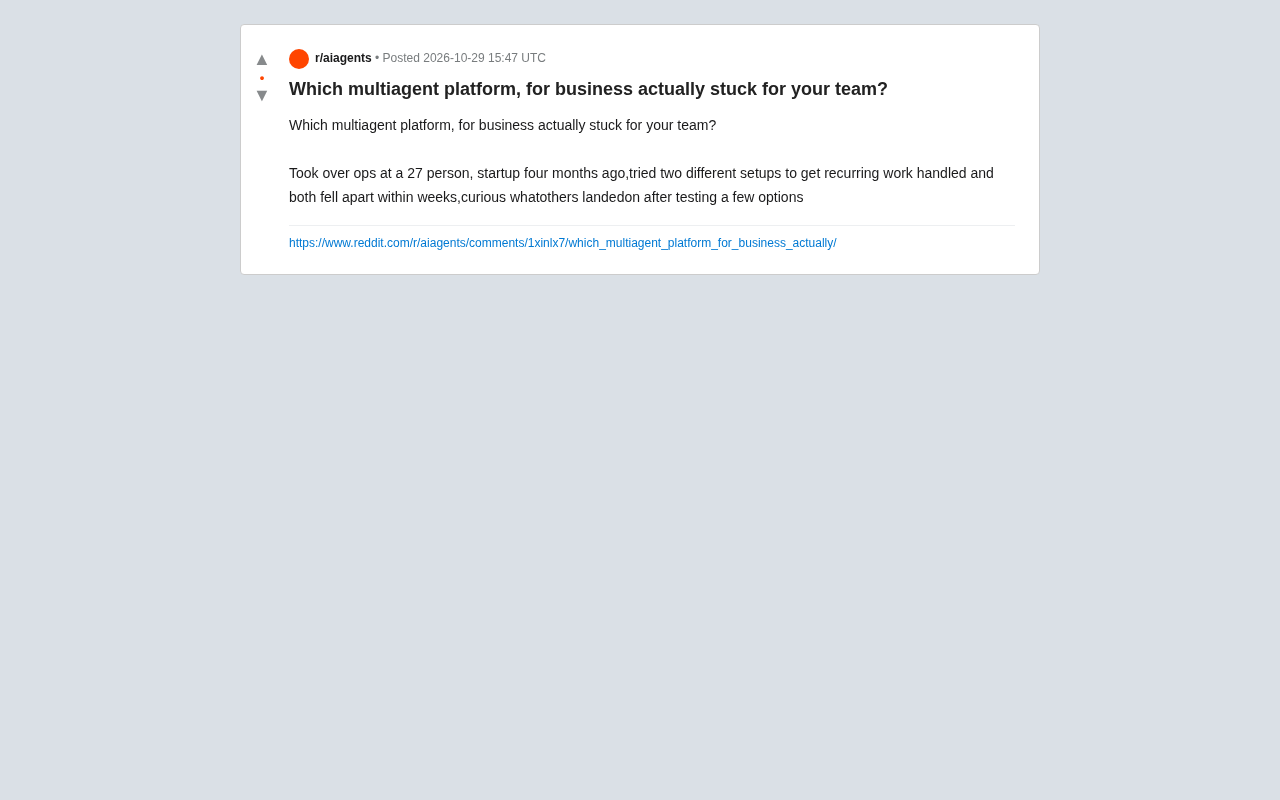
Which Multi-Agent Platform Wins? A Small Team's Battle Scars and Selection Considerations
A 27-person startup's ops lead tried two multi-agent platforms in four months and both failed. This article analyzes why small-team deployments break down, and offers selection guidance on integration depth, observability, and progressive rollout.

Thrive Holdings Takes ADT Private in $7.6 Billion Deal
Thrive Holdings acquires ADT for $7.6 billion in an all-cash take-private deal expected to close in Q1 2027. Analysis of the deal structure, ADT's asset value, and impact on the smart home security industry.