Gemini 4 Carbon Released: Google's New Model Sparks Debate

Google releases Gemini 4 Carbon, sparking community debate while substantive information awaits official details.
Google released the new model Gemini 4 Carbon on its official blog, and related discussion received 467 points and 394 comments on Hacker News, indicating high engagement. However, the original material captured by the site only contains links to the blog and comments, lacking substantive content such as model parameters, capability benchmarks, context length, and pricing. Based on this, the article offers a framework for interpretation: high scores and high comment counts indicate strong topic relevance and disagreement, but heat does not equal product strength; it recommends using the official blog as the first-hand information source, distinguishing official information from community speculation, and evaluating the new model from the three dimensions of capability, availability, and ecosystem, making technical and selection judgments only after details are disclosed.
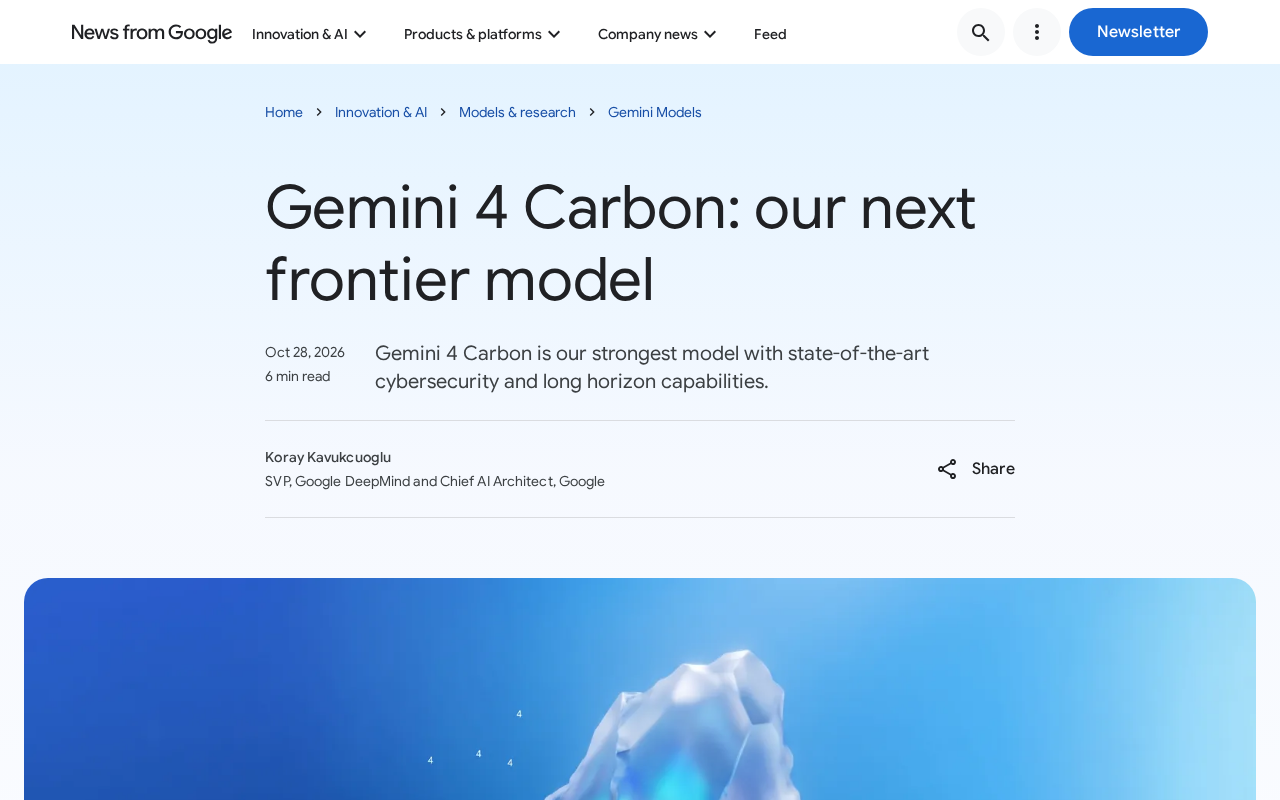
Google has released a new model called Gemini 4 Carbon on its official blog. The news quickly sparked discussion on the tech community Hacker News, where the related post received 467 points and 394 comments — a notably high level of engagement.
Our site picked up this development while aggregating information sources, but the original material only contained links to the blog and the comment thread, without substantive details such as model parameters, capability benchmarks, or pricing. This article therefore uses the event itself and community reaction as its线索 (thread), offering a framework for interpretation, while recommending that specific details be verified against the official original text.
What the Hacker News discussion heat indicates
A combination of 467 points and 394 comments on Hacker News typically means two things: enough people consider the topic "relevant to themselves," and there is enough disagreement to make it worth debating.
Each previous iteration of the Gemini series has generated concentrated discussion in this community, covering topics such as capability comparisons, developer experience, and ecosystem strategy. The name "Carbon" itself is also easy to interpret as carrying some positioning implication, but based on the available material, it is not possible to confirm the official explanation for the name.
A reasonable judgment is: the volume of discussion reflects sustained market attention to new versions of leading models, but heat does not equal product strength. The high-density discussion in the comments often mixes anticipation, skepticism, and the continuation of pre-existing positions.
Hacker News is operated by Y Combinator, the startup incubator, and is one of the most influential aggregation and discussion sites in the Silicon Valley tech circle. Its core mechanism is "votes + time decay": posts are ranked by vote count divided by some power of the time since posting, so a high score often means a large amount of recognition was earned in a short period. At the same time, each comment is also ranked by votes, forming a layered structure of opinions.
It is worth noting that Hacker News's audience is highly concentrated among engineers, entrepreneurs, and early technology adopters, with an emotional tendency toward conservatism and criticism. Therefore, a model release receiving 467 points and nearly 400 comments indicates more that it touched on the focal concerns of this group, rather than representing the attitude of the entire developer community. In addition, discussion heat on HN decays quickly, usually being covered by new topics within a day or two, which is why using it as an observation window requires cross-verification with other sources.
Official information still pending
The release page on Google's official blog is the main entry point for first-hand information. According to the general structure of such releases, the official announcement usually introduces the model's positioning, available channels, and developer access methods.
However, in the material currently captured, none of this content appears. This means that any claims about specific parameters, context length, benchmark scores, or pricing lack a basis. When sharing or citing related discussions, readers should distinguish between "official information" and "community speculation," and avoid spreading the latter as fact.
For developers and technology decision-makers, a safer approach is to read the official original text directly, and to watch whether the model enters a callable API or product entry point, before deciding whether to include it in the evaluation list.
How to view new model releases rationally
The pace of new model releases from leading vendors is accelerating, and the information density of each release is also increasing. Faced with a release event that has only a name and a discussion link, one can build a judgment from three angles:
- Capability dimension: Watch whether the official announcement publishes reproducible evaluation results, rather than only promotional descriptions.
- Availability dimension: Whether the model is open to developers and what the access cost is determine whether it can truly enter workflows.
- Ecosystem dimension: The degree of compatibility with existing toolchains often affects long-term willingness to use more than any single metric.
Before official details are filled in, community discussion can serve as a window for observing market sentiment, but it should not replace factual judgment.
The criterion of "reproducible evaluation results" comes from the long-standing credibility problem in the field of large model evaluation. Common benchmarks such as MMLU, HumanEval, and GPQA may have had their questions enter training data, causing data contamination; the prompts, sampling parameters, and scoring scripts used in vendor self-testing are also often not disclosed, making it difficult for third parties to reproduce the same scores.
As a result, the industry has gradually formed a stricter reference framework: prioritize results from independent evaluation organizations (such as LMSYS Chatbot Arena's crowdsourced battle rankings, Artificial Analysis, etc.), then look at whether evaluation code and runtime environment are disclosed, and only then refer to vendor-reported leaderboards. For new model releases, one can also pay attention to performance on real tasks, such as code generation, long-document understanding, and tool calling, which often reflect practical usability better than a single score.
Summary
The release of Gemini 4 Carbon has received considerable attention in the tech community, as confirmed by the score and comment count on Hacker News. But based on the currently available material, substantive information remains limited. It is recommended to rely on Google's official blog and to evaluate capability and applicability after the details are made public.
One-line Summary
Google releases Gemini 4 Carbon, sparking community debate while substantive information awaits official details.
Paragraph Summary
Google released a new model, Gemini 4 Carbon, on its official blog. Related discussion received 467 points and 394 comments on Hacker News, indicating high engagement. However, the original material captured by the site only contains links to the blog and comments, lacking substantive content such as model parameters, capability benchmarks, context length, and pricing. Based on this, the article offers a framework for interpretation: high scores and high comment counts indicate strong topic relevance and disagreement, but heat does not equal product strength; it recommends using the official blog as the first-hand information source, distinguishing official information from community speculation, and evaluating the new model from the three dimensions of capability, availability, and ecosystem, making technical and selection judgments only after details are disclosed.
Related articles
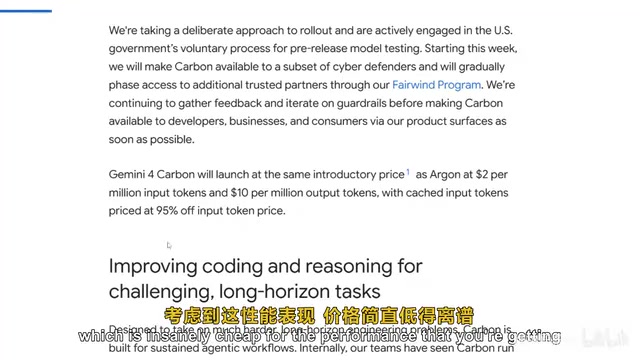
Gemini 4 Carbon Hands-On: The Strongest AI Model? Compared with Claude Opus 5.5
Google's Gemini 4 Carbon tops the Artificial Analysis leaderboard with 71% on CW Bench and leads Vending Bench. Hands-on comparison with Claude Opus 5.5: stunning front-end design but slightly behind in web development, with a clear price advantage.

Gemini 4 Carbon Tops Global Rankings as AI Productivity and Open-Source Ecosystems Surge
Google DeepMind's Gemini 4 Carbon tops global benchmarks, built for complex agents and system security. ByteDance launches Doubao Work integrated with Feishu, Anthropic's AI autonomously breaches 5 system-level attack chains, and ModelBest and Fudan open-source on-device multimodal and image generation models.

Overseas Creator Breaks Down N8n AI Agent Business Playbook: From Tooling to Monetization
An overseas creator breaks down the N8n AI agent business playbook: comparing Zapier, Make, and N8n, detailing four monetizable automation categories—lead capture, WhatsApp follow-up, booking, and content pipelines—plus agency pricing and a sales playbook.