Gemini 4 Carbon Tops AI Intelligence Leaderboard; DeepSeek V5 and Fable 5.5 Leaked

Gemini 4 Carbon tops the intelligence index at 59; DeepSeek V5 and Fable 5.5 leaks near; toolchains and open-source ecosystem see dense updates.
This week the top-tier AI race keeps accelerating: Google's Gemini 4 Carbon set a record on the Artificial Analysis Intelligence Index V5.0 with 59 points, setting bests on cybersecurity and long-horizon tasks and hitting 0.0% on the indirect injection benchmark. On the leak front, DeepSeek V5, V5 Open, and V5 Next have been written into the codebase, while Anthropic's unreleased Fable 5.5 is signaled as imminent via the anonymous model Obsidian 3's benchmark scores—but both are single-source and should be treated with caution. On toolchains, GitHub launched Copilot Fusion, which can schedule between Anthropic and OpenAI models, trading a small performance loss for roughly half the cost; GitHub Agentic Workflows supports defining workflows in natural-language Markdown. The open-source ecosystem has produced the diffusion language model Clover and the memory-native model MEMT 1.0, and there have also been dense moves in multimodal and world models from NVIDIA, DeepMind, Alibaba, and others. The leaderboard shows the gap between open-source and top closed-source models remains clear.
Model Arena Reshuffled Again: Gemini 4 Carbon Sets New Intelligence Index Record
According to the Bilibili AI Daily program, Google has officially released its frontier model Gemini 4 Carbon, which topped the Artificial Analysis Intelligence Index V5.0 with a score of 59, setting a new record. The model set new bests on cybersecurity and long-horizon tasks, achieving 0.0% on the Grace 1 indirect injection benchmark. Starting this week, it is being rolled out to cyber defenders through the Fairwind program, with access set to expand gradually.
This result means the intelligence race among top models is still accelerating. Carbon's top ranking is not just about the overall score—its performance on security-related benchmarks is also noteworthy: a 0.0% indirect injection rate means the model's resistance to prompt injection attacks has reached a new level, which is especially important for enterprise deployments.
The Artificial Analysis Intelligence Index is a composite capability scoring system for models launched by the third-party independent evaluation firm Artificial Analysis. It aggregates multiple public benchmarks (covering reasoning, coding, math, knowledge Q&A, and other dimensions) into a single weighted score, used to compare the overall intelligence level of models from different vendors. The index is versioned and iterated (e.g., V4.3.2, V5.0); each version upgrade typically adjusts the question set and weights, so scores across versions cannot be directly compared.
Indirect prompt injection refers to attackers hiding malicious instructions in external content that the model reads (web pages, documents, emails, code repositories) rather than inputting them directly to the model, hijacking the model while it performs normal tasks. For enterprise agents, this is one of the most dangerous attack surfaces, because models often automatically fetch and trust external data. A 0.0% injection success rate in the benchmark means the model fully resisted such attacks under that test set, but note that the test set's coverage is limited—this does not equal absolute security.
DeepSeek V5 Series Roadmap Leaked
According to a leak, the DeepSeekAd V5 series has been spoiled in advance: the latest code shows three names—V5, V5 Open, and V5 Next—have been written into Harness. V5 Open has no version restrictions, while V5 Next requires a higher client version. The leak also mentions that founder Liang Wenfeng, despite being worth 280 billion, has long rented in Beijing; the team is professionalizing and recruiting at a large scale, so an official release should not be far off.
Judging from the naming strategy, the V5 series is clearly taking a tiered approach: the Open version lowers the barrier to use, while the Next version may target higher-capability needs or enterprise scenarios. This three-tier structure of "base + open + advanced" aligns closely with the distribution logic of the current open-source model community, and also suggests DeepSeek is seeking a new balance between commercialization and open source.
Fable 5.5 Release Countdown Begins
In Cognition's new benchmark Frontier Code 2.0, an anonymous model Obsidian 3 appeared, scoring 46.8%, surpassing Opus 5.5's 45.5%. The model runs on the Cloud Code toolchain, and combined with two signals—early access for enterprise customers and a GitHub attribution—it points to Anthropic's unreleased model Fable 5.5. Accordingly, the official release of Fable 5.5 is in countdown, and Anthropic has not yet made an official announcement.
Another leak comes from the AI intelligence account Lyraxna, which disclosed that Google's Gemini Omni 1.2 Flash model has completed deployment and is about to be officially released. This news currently has only a single leak source, Google has not confirmed it officially, and details such as the model's capability specifications and launch time have not been announced.
Multi-source cross-validation: The release of Gemini 4 Carbon is supported by an official blog and benchmark data; the information on DeepSeek V5 and Fable 5.5 comes from code leaks and anonymous model signals, which are single-source leaks, and readers should remain cautious.
Anonymous model testing is a common practice before the release of large models today: vendors deploy unreleased new models under random codenames onto public evaluation platforms such as LMArena and Cognition Frontier Code, both to collect real user preference data and to use the codenames to generate buzz and preheat interest. Observers usually infer the model's true identity from side signals such as model ID naming patterns, response style, toolchain characteristics, and rate-limiting strategies. Such inference is essentially an indirect chain of evidence; a single signal is prone to misjudgment, and only cross-verification by multiple independent clues gives it credibility—this is also why the article treats Gemini 4 Carbon (supported by official data) and Fable 5.5 (inferred from anonymous signals) differently.
Coding and Agent Toolchains See Dense Updates
Mistral launched DigSit V4.1 Flash in public preview, suitable for long-context coding and agent tasks; the GLM5.3 Flash released in the same batch is now fully available, suitable for sub-agent tool calling and coding tasks, with both emphasizing speed and cost advantages. Mistral also launched a public preview of the Responses API, applicable to all its hosted chat models including Large4.
GitHub launched Copilot Fusion in Copilot, which can orchestrate and schedule between Anthropic and OpenAI models. This runtime system selects and coordinates models by task, optimizing three metrics: performance, cost, and latency. On the coding agent index, its score is 2 points lower than Cloud Code's Opus 5.5, but its cost per task is only $5.59, about half of the other's $11.42—trading a small amount of performance for a significant cost advantage, a positioning that is quite attractive for high-frequency invocation scenarios.
GitHub Next also open-sourced GitHub Agentic Workflows, allowing developers to define workflows in natural-language Markdown that are automatically compiled into standard Actions YAML files. Official data shows that one supervisor saves about 29 hours per week, and 91% of the team's code commits are contributed by AI. A typical run includes four stages: Activations, Agent Detection, and Safe Outputs.
Open-Source Ecosystem: Diffusion Language Models and Memory-Native Architectures
DiffuseBase, founded by HKU professor Kong Lingpeng, released and open-sourced Clover 35BA 3B Preview, which the company calls the first open-weight production-grade diffusion language model, using a fast diffusion mechanism. Clover achieved the highest score among open-source models on 6 agent benchmarks; in terms of speed, in BF16 precision a single card can generate 680 tokens per second, 41% faster than a same-scale model accelerated by fine D-Flash2.
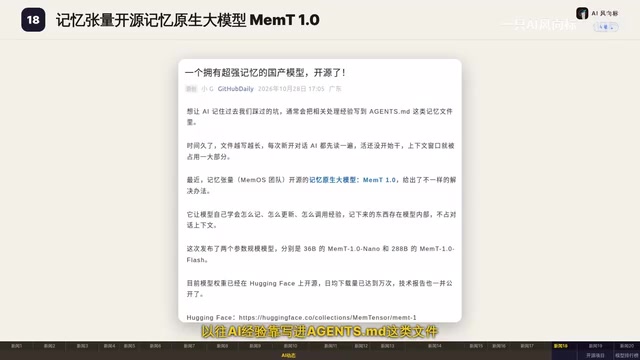
Memory Tensor open-sourced the memory-native large model MEMT 1.0. In the past, AI experience was written into files like agents.md, which grew longer and longer; MEMT lets the model learn how to remember, how to update, and how to invoke experience itself, using a memory-native MoDE architecture to store memory inside the model without occupying context. Two scale versions have been open-sourced on Hugging Face, with average daily downloads reaching ten thousand, and the technical report is also public.
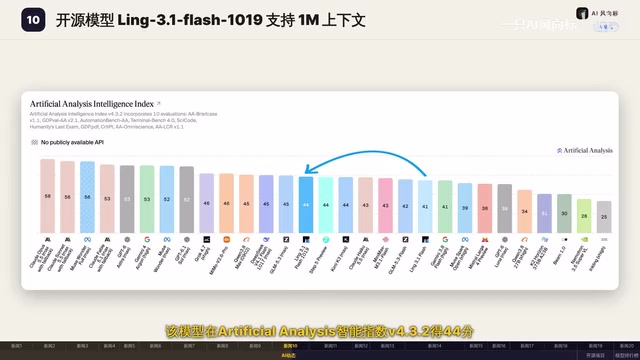
Other noteworthy open-source moves include: Lin 3.1 Flash 1019 released, a 560B-parameter open-weight MoE model activating 25B per token, scoring 44 on the Artificial Analysis Intelligence Index V4.3.2, higher than the previous generation's 41; Alibaba released Oviso CR3, a unified document model with only 0.8B parameters, scoring 96.74 on OmniDocBench and ranking first on both the Chinese and English OCRBench VR leaderboards, open-sourced under Apache 2.0; Minimax open-sourced M-Code Stack, containing the workflows and skills the team actually uses when building products daily, rather than demo examples.
Diffusion language models, unlike traditional autoregressive models that generate token by token from left to right, borrow the idea of image diffusion models: starting from noise, they denoise the entire text in parallel, converging to a complete sequence after multiple iterations. The advantages are parallel decoding, fast generation speed, and natural support for filling and rewriting at arbitrary positions; the difficulties lie in denoising modeling for discrete text and quality stability. Clover in this article uses a "fast diffusion" mechanism, i.e., reducing denoising steps in exchange for throughput—the single-card speed of 680 tokens/s is the core selling point of this approach.
MoDE (Mixture of Decoupled Experts) is an architectural idea that further separates "memory/knowledge storage" from "computation" on top of MoE: some expert parameters specifically carry long-term experience, while others handle current reasoning, allowing the model to store experience inside parameters rather than cramming it into the context window. This contrasts with traditional RAG or agents.md external memory, at the cost that memory updates require dedicated training or editing mechanisms.
Multimodal and World Model Progress
NVIDIA officially announced the release of Numitron 3.5 Transcribe, an open-weight, prompt-controllable 30B MoE transcription model activating about 4B parameters per inference, supporting transcription in 40 languages and offering speaker attribution, translation, and contextual prompting capabilities.
Google DeepMind announced that the Genie 4 world model has begun rolling out to trusted testers, with broader opening coming soon, and the official blog has opened a waitlist simultaneously.
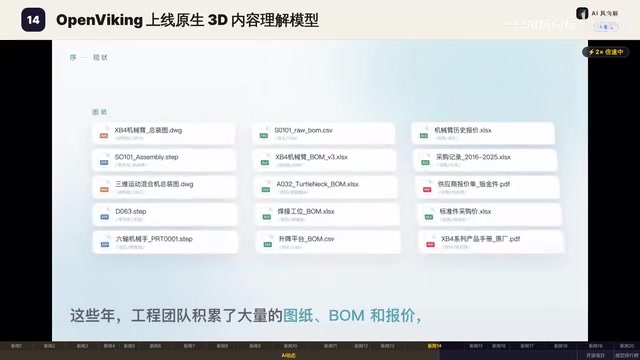
OpenViking released a content understanding model with native support for 3D data import and parsing, originating from Volcano Engine's Agent context database; this upgrade supports STEP file parsing with 100% information restoration rate. Users describe the target structure in agents such as Doubao, Codex, and Cloud, and AI can find candidate parts, organize the BOM, and check the impact of supply changes—a key step for agent deployment in engineering and manufacturing scenarios.
Audio and speech directions are equally active: Alibaba launched the Quan Audio 3.1 audio foundation model series, covering three capabilities: ASR, TTS, and real-time voice interaction; RAM launched PRISM, a speech-to-speech model for AI voice agents, which first generates text for each reply and then reads it aloud, allowing enterprises to edit the text and block content that should not be said while keeping the call uninterrupted, with a response time of only 300 milliseconds.
A world model refers to a generative model that can learn the dynamic laws of an environment and internally simulate "how the world will change after taking a certain action," usually trained on video or interaction trajectories. It is infrastructure for embodied intelligence, game generation, and robot planning: agents can first "imagine" multiple action paths inside the model and then choose the best to execute, reducing the cost of trial and error in the real environment. The Genie series is Google DeepMind's representative work in this direction, and the trusted tester program is its routine risk-control measure before opening up.
Model Leaderboard: Gap Between Open and Closed Source Remains
The top of the intelligence leaderboard is topped by Gemini 4 Carbon High with 59 points. Among open-source and domestic camps, Kimi K3.1 Pro leads at 9th place with 46 points, while Quan 3.8 Max with 34 points and DeepSeek V4.1 Flash with 32 points both make the list. There is still a clear gap between top closed-source models and the open-source camp, but the speed at which open-source models are catching up on specific tasks (such as document parsing and agent benchmarks) cannot be ignored.
Note: The subscription promotion information appearing in the original text is unrelated to AI technical content and has not been adopted in this article.
One-line Summary
Gemini 4 Carbon tops the intelligence index with 59 points; leaks about DeepSeek V5 and Fable 5.5 are imminent; toolchains and the open-source ecosystem see dense updates.
Paragraph Summary
This week, the top-tier competition in AI continues to accelerate: Google's Gemini 4 Carbon set a new record on the Artificial Analysis Intelligence Index V5.0 with 59 points, setting bests on cybersecurity and long-horizon tasks, and reaching 0.0% on the indirect injection benchmark. On the leak front, the three names DeepSeek V5, V5 Open, and V5 Next have been written into the codebase, while Anthropic's unreleased Fable 5.5 is pointed to as imminent release through the benchmark signals of the anonymous model Obsidian 3—but both are single-source and should be viewed with caution. On the toolchain side, GitHub launched Copilot Fusion, which can schedule between Anthropic and OpenAI models, trading a small performance loss for about half the cost; GitHub Agentic Workflows supports defining workflows in natural-language Markdown. The open-source ecosystem has produced the diffusion language model Clover and the memory-native model MEMT 1.0, and there have also been dense moves in multimodal and world models from NVIDIA, DeepMind, Alibaba, and others. The leaderboard shows that the gap between open-source and top closed-source models remains clear.
Related articles
 Tech Frontiers
MuJoCo: An Analysis of DeepMind's Open-Source General-Purpose Physics Simulator
An in-depth analysis of Google DeepMind's open-source physics simulator MuJoCo: high-performance C++ kernel, MJCF modeling format, contact solving principles, MJX GPU acceleration, and robot reinforcement learning use cases.
 Tech Frontiers
Claude API Quick Start: The Official Quickstarts Project Collection
Anthropic's official claude-quickstarts project collection helps developers quickly build deployable apps with the Claude API. Nearly 20k stars, Python-based, great for beginners and prototyping.
 Tech Frontiers
AI Agents Connecting Directly to APIs: Which Calls Can Be Safely Allowed?
AI agents can call any API, but the real challenge is deciding which calls can be safely allowed. This article analyzes allowance decisions from three dimensions—intent matching, least privilege, and controllable impact—and argues that the control layer should sit outside the agent, combined with audit traceability to build a trustworthy API call governance mechanism.