Gemini 4 Carbon Tops Intelligence Index, Google Opens Offensive/Defensive Model for the First Time

Google's Gemini 4 Carbon tops the intelligence index and opens offensive/defensive capabilities, while OpenAI and the open-source camp counterattack across the board.
The article reviews a week of intense AI industry developments. Google surprise-launched Gemini 4 Carbon, topping the Artificial Analysis Intelligence Index V5 with 59 points and taking first place in 4 of 9 benchmarks, while opening cybersecurity capabilities to defenders for the first time through the Fairwind program with an 88.2% vulnerability discovery rate and 71.0% remediation rate, and leveraging a 50% developer discount. OpenAI counterattacked with up to $500 monthly API credit rebates and ChatGPT agent integration with iMessage and RCS texting. On the open-source side, NVIDIA Nemotron 3.5 Transcribe, Tencent Hunyuan Hi4, and Alibaba Ovis OC23 were released intensively, while DeepSeek and MiniMax advanced agent engineering. Coding agents and mathematical formal verification achieved productivity breakthroughs, and the compute and antitrust battles intensified simultaneously.
Google Surprise-Launches Gemini 4 Carbon: Tops Intelligence Index, Offensive and Defensive Capabilities Made Public for the First Time
Just two weeks after the previous flagship release, Google CEO Pichai surprise-launched Gemini 4 Carbon. According to Artificial Analysis Intelligence Index V5 data, Carbon scored 59 points to claim the global number one spot. Even more notable is its cybersecurity capability: an 88.2% vulnerability discovery rate and a 71.0% vulnerability remediation rate. Through the Fairwind Pioneer Security Program, Google is first opening this capability to trusted defenders before gradually opening it to developers worldwide. The official Twitter account also confirmed that Carbon reaches frontier-level performance in cybersecurity and long-horizon tasks.
This move marks large-model competition entering a stage of real-world offense and defense—models are no longer just generating content, but directly participating in vulnerability identification and remediation for critical infrastructure.
Dominating Benchmarks and Extreme Cost-Effectiveness: Carbon's Comprehensive Sweep
In Artificial Analysis's in-depth cross-comparison, Carbon took first place in 4 of 9 core benchmarks, covering diamond-level scientific problems and automated testing. In coding agent capability, only Claude Opus 5.5 can rival it. Google simultaneously launched a 50% launch discount for developers to leverage cost-effectiveness in building its model ecosystem.
Data from the large-model arena Marina shows that Carbon has reshaped the rankings on the cost-effectiveness dimension. Renowned coding assistant Klein commented that Carbon is the industry's first frontier model to comprehensively surpass Claude and GPT, defeating Opus 5.5 on almost all benchmarks while costing only half as much per call. It achieved an 18% improvement over its predecessor Argon within two weeks, showing that the iteration cycle for top models has been compressed to the half-month level.
Real-world performance is equally impressive: in the Grace 1 indirect prompt injection test, the attacker made 15 attempts and Carbon maintained a 0% attack success rate, far better than GPT's 8.5% and Grok's 51.8%; in the Vending Bench vending machine operation simulation, it earned $16,484 in one year starting from $500, beating Astra and Opus to take the top spot.
However, a reply on social media from a DeepMind training engineer is intriguing: the next-generation Gemini model with its codename redacted has not actually debuted yet. The community interprets this as Google still holding a hidden trump card with larger parameters and a more aggressive architecture.
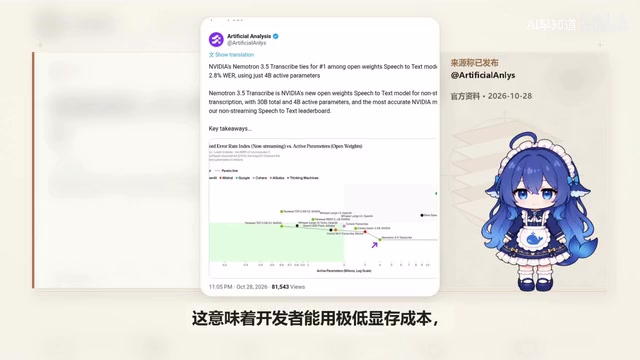
MoE (Mixture of Experts) architecture is the key technical background for understanding this model competition. Unlike traditional dense models that activate all parameters on every inference, MoE splits the model into multiple "expert" subnetworks and routes each forward pass to only a few experts via a gating mechanism. As a result, a model can have a very large total parameter count (which determines knowledge capacity) while actually activating only a small portion during inference (which determines computational cost and latency). The NVIDIA Nemotron 3.5 Transcribe's "30B total parameters, only 4B activated" mentioned in the article is a typical formulation—total parameters measure model scale, while activated parameters truly correspond to memory and compute overhead. This also explains why vendors cite both numbers in marketing: it is both a capability metric and a cost-effectiveness metric.
Indirect Prompt Injection refers to attackers not directly instructing the model, but hiding malicious instructions in external content that the model will read—web pages, emails, documents, search results, or even text messages. When an agent with tool permissions processes such content, it may be "hijacked" into executing the attacker's intent, such as leaking data or initiating unauthorized operations. Tests like Grace 1 let attackers seek a breakthrough across multiple rounds of attempts and measure the attack success rate. In the article, Carbon's success rate is 0% across 15 attempts, while Grok's is as high as 51.8%; the gap reflects the model's ability to isolate untrusted content and judge instruction priority, which is especially critical once agents are connected to real systems at scale.
OpenAI's Counterattack: API Credit Rebates and SMS Agent
Facing Google's offensive, OpenAI quickly threw a benefit to developers: eligible ChatGPT Pro and Business subscribers can receive up to $500 in API credits per month. Pro users receive $100–500 depending on usage tier, and enterprise workspaces also total up to $500. This is OpenAI's first large-scale API compute rebate, directly countering Google's price war.
On the product side, the ChatGPT agent is integrated with iMessage and RCS text messaging. Users can send text, photos, or voice memos directly to Dot, and Dot not only executes tasks but also proactively texts progress updates. OpenAI core member Tibo demonstrated a minimalist interaction: call Siri to send ED a text message to dispatch a complex research task. This seamless integration shows that personal agents are replacing the traditional standalone client form factor. Regarding rumors of a ChatGPT and Word workspace merger, Tibo denied it, saying some pop-ups were sent by mistake, but confirmed the team plans to connect the two capabilities within this year.
RCS (Rich Communication Services) is an upgrade standard for traditional SMS, supporting read receipts, typing indicators, high-definition image and file transfer, group chat, and card-based interaction. Its capabilities are close to instant messaging apps, but it relies on carriers' native channels rather than a standalone app. Like iMessage, RCS allows agents to reach users through "texting" with zero learning cost—users do not need to install a new client and can converse with the agent, send voice memos, or photos directly in the system SMS interface. For platforms, this means the agent's entry point shifts from a standalone app down to the operating-system-level communication layer, which is precisely the technical basis for "personal agents are replacing the traditional standalone client form factor" mentioned in the article.
Open-Source Camp: Voice, Small Models, and Agent Engineering Bloom in Multiple Areas
NVIDIA released the Nemotron 3.5 Transcribe model, using a 30B total-parameter MoE architecture with only 4B parameters activated at runtime. A single model covers high-accuracy transcription in 40 languages with a role-distinction error rate as low as 1.8%—a top performance—while activating only one-sixth of the parameters of competitors, meaning developers can deploy top-tier multilingual voice capabilities at extremely low memory cost.
Domestically, Tencent announced at the Digital Ecosystem Conference that the Hunyuan Hi4 official version is about to launch, followed by the lightweight Hi4 Flash, focusing on strengthening long-horizon complex tasks and chain-of-thought reasoning, and incorporating visual understanding for the first time. Alibaba's ATH team released the unified document model Ovis OC23 with only 0.8B parameters, reaching 96.74 on OmniDocBench, taking first place on PureDocBench with 82.31, and winning gold on both OCRBench leaderboards, redefining the performance ceiling for edge document processing.
The open-source community is equally active: DeepSeekAd Harness launched an experimental component that supports dynamically decomposing complex tasks and dispatching them to Codex or Claude as sub-agents; the MiniMax Code team open-sourced McodeStack engineering assets, packaging internal skills and workflows as standard documents that any AI agent supporting the skill protocol can load. An even wilder experiment comes from the geek community—developers compiled the complete RISC-V CPU architecture into the model weights of Qwen 3.5 4B, using the Gated DeltaNet layer as an exact memory model, running programs error-free solely through forward propagation, raising the arithmetic benchmark from 48% to a perfect 100%, opening a new dimension of neural networks as deterministic virtual machines.
Coding Agents and Mathematical Proofs: Dual Validation of the Productivity Revolution
At GitHub Universe, Microsoft released the Copilot Fusion model: 40% faster, up to 77% lower cost, and multi-agent orchestration across code repositories via the Projects platform. Tests show that the gap between Fusion and the top-tier combination of Copilot plus Opus 5.5 on the coding agent index has narrowed to less than 2 points, while API call cost per task is only half, with a 30% launch discount.
Anthropic's terminal agent achieved a breakthrough in government scenarios: a pilot opened to 34 developers across 10 state government agencies, with up to 80% of personnel setting up the environment within 30 minutes, and by the end of the four-week pilot, 71% of developers confirmed saving more than 20 hours of work per month.

In mathematics, Xeon's open-source results show that dozens of AI agents spent only 24 days converting the 15,000-page classification of finite simple groups proof into about 43 million lines of Lean code, and the scale of AI-written mathematical code is doubling every 37 days. SenseTime open-sourced the video generation model Sense Nova 6.8 Code 2 Video, which produces short videos by generating executable code and fully open-sources the weights; Kuaishou's Kling AI became the exclusive technology partner for the Hollywood animated feature MiniBots, scheduled for supply in 2027.

Lean is an interactive theorem prover and programming language that requires every mathematical proposition to be written as strictly formalized code and mechanically verified line by line by its kernel, so there are no proofs that "look correct but actually have gaps." Translating the 15,000-page classification of finite simple groups proof into Lean code is essentially reconstructing human natural-language mathematics into machine-checkable formal objects. The significance of this work is that once a proof is formalized, it becomes a reliable asset that machines can retrieve, reuse, and automatically combine, and AI agents can batch-attempt lemmas and proof strategies on top of it. The article's statement that "the scale of AI-written mathematical code doubles every 37 days" uses this verifiable formalized output as its unit of measurement.
Business Landscape and Compute Competition: AI Monetization Fully Realized
Pichai disclosed that Alphabet's third-quarter annualized revenue reached $500 billion, Google Cloud revenue surged 103% year over year, its proprietary model API throughput is nearly 32 billion tokens per minute, and explicitly stated that recursive self-improvement is accelerating R&D. Microsoft's cloud business exceeded $63 billion, with year-over-year growth accelerating against the trend to 30%. In the primary market, Cognition was reported to have received investment offers at a $70–80 billion valuation, a sharp jump from its $48 billion valuation just one month earlier in September.
At the bottom of the compute supply chain, Anthropic raised its 2028 AMD GPU orders threefold to 3,000 megawatts, and OpenAI's AMD deployment plan was increased to 8,000–9,000 megawatts. The U.S. Department of Justice has opened an antitrust investigation into NVIDIA's investment partnership with Hugging Face. Artificial Analysis estimates that the comprehensive performance gap between top Chinese and U.S. models has narrowed to 3.3 months, but APAC AI data shows that the U.S. monopolizes 78% of the world's effective compute, while China accounts for 18% of global chip count but only 10% of effective compute. The model arms race is evolving into an extreme contest between technology iteration speed and physical compute reserves.
Effective compute and chip count are two different concepts. Total chip count only counts hardware inventory, while effective compute also considers engineering factors such as per-card performance, interconnect bandwidth, cluster scale, power and cooling conditions, actual utilization, and whether stable scheduling is possible. With the same number of accelerator cards, if high-speed interconnect or power supply is lacking, the actual usable training throughput will shrink significantly. Therefore, the gap in the article—"China accounts for 18% of global chip count but only 10% of effective compute"—reflects system-level and supply-chain constraints beyond hardware. Similarly, vendors disclosing AMD GPU orders in "megawatts" is also a way to measure real deployment scale by power capacity rather than card count, because power budgets are often the hard boundary for data center expansion.
One-line Summary
Google's Gemini 4 Carbon tops the intelligence index and opens offensive/defensive capabilities, while OpenAI and the open-source camp counterattack across the board.
Paragraph Summary
The article reviews a week of intense developments in the AI industry. Google surprise-launched Gemini 4 Carbon, topping the Artificial Analysis Intelligence Index V5 with 59 points, taking first place in 4 of 9 benchmarks, and for the first time opening cybersecurity capabilities to defenders through the Fairwind program with an 88.2% vulnerability discovery rate and 71.0% remediation rate, while leveraging a 50% developer discount to build its ecosystem. OpenAI counterattacked with up to $500 monthly API credit rebates and ChatGPT agent integration with iMessage and RCS texting. On the open-source side, NVIDIA Nemotron 3.5 Transcribe, Tencent Hunyuan Hi4, and Alibaba Ovis OC23 were released intensively, while DeepSeek and MiniMax advanced agent engineering. Coding agents and mathematical formal verification achieved productivity breakthroughs, and the compute and antitrust battles intensified simultaneously.
Related articles

Only 40% of Statistics Cited by AI Are Traceable: A Credibility Crisis Emerges
A Hacker News discussion notes that only 40% of statistics cited by AI can be traced to specific studies. This article analyzes the causes, the impact on content creators and users, and practical ways to reduce risk.

Simantic: A Firmware Emulation Platform Built for AI Agents
Simantic, a YC F26 project launched on Hacker News, provides firmware emulation for AI agents, letting them interact with low-level hardware software in virtual environments and lowering the barrier to embedded testing.

Why Do Excellent Developers Remain Wary of Agentic Development?
Hacker News discussion reveals why excellent developers are wary of agentic development: surrender of control, demo-production gap, and blurred responsibility boundaries.