Gemini 4 Carbon Tops the Intelligence Leaderboard, But Coding Agents Still Trail Claude Opus 5.5

Google releases Gemini 4 Carbon within two weeks, topping the overall leaderboard but still trailing Claude Opus 5.5 in coding agents.
Google launched its new flagship Gemini 4 Carbon just two weeks after Gemini Argon, taking first place on the fifth comprehensive intelligence leaderboard with 59 points and ranking first in four individual categories: high-difficulty reasoning, scientific terminal, encyclopedic knowledge, and automated workflow. Security attack and defense form a complete closed loop, with vulnerability discovery, exploitability verification, and automatic remediation scoring 88.2%, 54.8%, and 71%, respectively, and an indirect prompt injection attack success rate of 0. All 17 internal benchmarks comprehensively surpass the previous generation, with terminal capability rising from 57.1% to 65.2%. However, in coding agent and computer operation tests, Carbon still lags behind Claude Opus 5.5. Launch pricing is $2 per million input tokens and $10 for output, with a 95% discount on cached input, but the discount deadline has not been announced, nor has the opening time for ordinary developers.
Just two weeks after the release of its previous flagship Gemini Argon, Google launched a new model, Gemini 4 Carbon, without any warning. This pace of iteration has led many in the industry to wonder: has Google already gotten its "AI training AI" self-evolution flywheel spinning?
Topping the Overall Leaderboard, But Not a Sweeping Victory
On the fifth edition of the comprehensive intelligence leaderboard updated by an independent overseas organization, Carbon scored 59 points, overtaking the previously top-ranked Claude Opus 5.5 and coming in 9 points above Argon from two weeks ago. The leaderboard includes nine highly difficult tests, and Carbon took first place in four individual categories: high-difficulty complex reasoning (HLE Diamond), scientific terminal evaluation, an all-subject encyclopedia knowledge base, and an automated workflow benchmark.
According to an analysis by Bilibili creator "Evolutionary Ah Chen," these four first-place finishes do demonstrate Carbon's high intelligence in deep mathematical logic and interdisciplinary reasoning. But the overall first place measures a composite average score, and does not mean it wins every individual category.
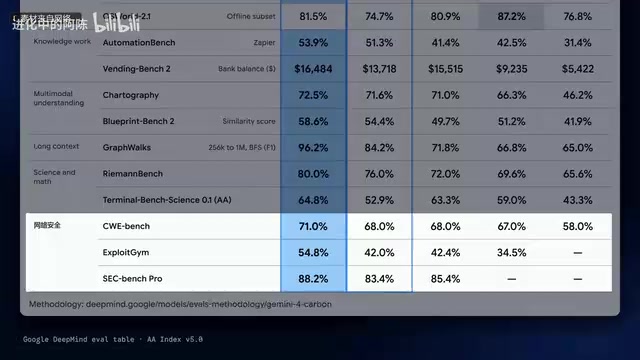
HLE Diamond is a high-difficulty subset of the "Humanity's Last Exam" (HLE) benchmark. HLE is jointly created by scholars worldwide and covers dozens of disciplines including mathematics, physics, history, and law. The questions are designed to be extremely challenging for current large models, aiming to test the upper limits of model reasoning on expert-level knowledge. The Diamond version further filters out the hardest questions and applies stricter scoring standards, so topping this individual category is usually seen as an important signal of a model's deep mathematical logic and interdisciplinary reasoning capabilities.
Security Attack and Defense Is the Biggest Highlight, With a Promise of Long-Running Autonomous Operation
What Google is most proud of this time is the complete closed loop of cybersecurity attack and defense. Official data shows: the first step, vulnerability discovery, scored 88.2%; the second step, verifying vulnerability exploitability, scored 54.8%; and the third step, automatically patching and fixing, scored 71%. From discovering risks and verifying threats to taking action to fix them, the entire security chain is basically operational.
In the indirect prompt injection evaluation, under a strict test of 15 attempts per attack, the attack success rate against Carbon was shown as 0. The official internal team also revealed that Carbon can run continuously in the background for several days, focusing on extremely complex long-term engineering tasks. This combination of "ironclad defense" and "sustained operation" is the direction Google focused on this time.
Indirect prompt injection refers to attackers hiding malicious instructions in external content that the model may read (such as web pages, documents, emails, or tool return results) rather than directly inputting them to the model. When the model processes such content, it may be induced to perform unintended actions, such as leaking sensitive information or invoking dangerous tools. This evaluation requires the model to avoid being compromised across multiple attempts for each attack, so a "success rate of 0" means the model has strong robustness against this type of covert attack.
Internal Benchmarks Comprehensively Surpass the Previous Generation, With Clear Terminal Capability Gains
In the officially released internal comparison table, Carbon surpasses Argon from two weeks ago on all 17 benchmark tests. Terminal capability testing rose from 57.1% to 65.2%, an increase of more than 8 percentage points; the software engineering cleanup test more than doubled from 4.3% to 9.6%. Such an improvement in just 14 days shows that Google has indeed put effort into the model's reasoning capabilities.
Coding Agent Track: Claude Opus 5.5 Remains the More Reliable Choice
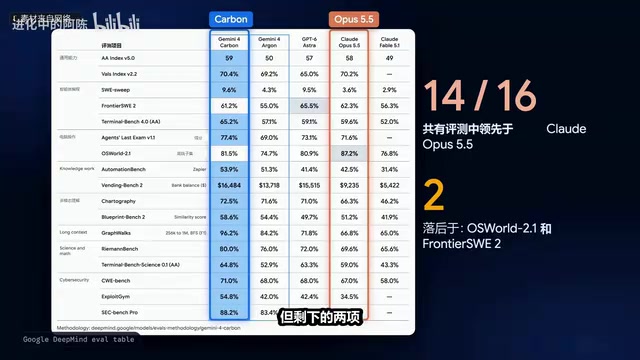
However, when looking at the individual subcategories, the picture is less optimistic. Among the 16 adversarial tests listed officially by Google, Carbon won 14, but the two it lost are precisely the most core productivity battlegrounds for current large models.
In the system test simulating human computer operation, Claude Opus 5.5 scored 87.2%, while Carbon scored only 81.5%; on the more advanced code test Frontier SWE-2, Opus 5.5 was likewise slightly ahead. On the leaderboard specifically evaluating models combined with coding tools, Opus 5.5 paired with a dedicated coding tool ranked first with 62 points, while Carbon paired with its own coding tool scored 59 and placed second — although this is already substantial progress from the previous generation's 53 points.
Carbon also did not gain an advantage on knowledge tasks involving daily office work and long-chain business analysis. In the complex business and knowledge work benchmark leaderboard, Carbon scored 1609 points, up more than 120 points from Argon's 1483, but it still did not reach the top; ahead of it are the domestic model Kimi and Musk's Grok, among others.
The conclusion is clear: if daily work relies heavily on deep coding agents and long-chain code engineering, Claude Opus 5.5 is still the more reassuring mainstay at this stage. Where Carbon truly pulls ahead of its competitors is in macro complex long-horizon reasoning, interdisciplinary science problems, and general encyclopedic knowledge.
Frontier SWE-2 is a frontier benchmark for software engineering that typically simulates multi-step tasks in real code repositories, requiring the model to understand the codebase, locate defects, modify code, and pass tests. Unlike traditional single-function code generation, it emphasizes long-chain engineering capability, tool invocation, and autonomous debugging, so it is often used to measure the actual performance of coding agents in near-production environments.
Pricing Strategy: Attractive Launch Discount, But the Window Is Unclear
Carbon's launch price is quite attractive: $2 per million tokens for input, $10 for output, with an additional 95% discount on cached input. Processing 1 million regular input tokens and generating 1 million output tokens costs $12 in total at launch; if all input hits the cache, the cache cost drops to $0.1, bringing the total with output to $10.1. Compared with the standard unit prices after the discount ends ($4 for input and $20 for output), the launch price is directly cut in half.
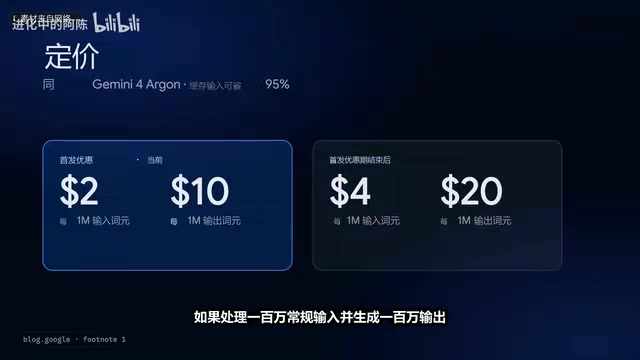
But the fine print in the official announcement shows that this discount has an expiration date, after which the total price will rise to $24, and the official deadline has not been clearly stated.
Cached input discount is a common billing optimization in current large model APIs: when the prefix content in a request (such as system prompts, long documents, or conversation history) repeats previous requests, the provider can reuse already cached computation results and charge a lower fee for that portion of input tokens. Carbon's 95% discount means that input cost on cache hits is only 5% of the original price, which has a significant impact on applications that need to repeatedly carry long contexts.
When Can Ordinary People Use It?
Currently, Carbon is only open to trusted cybersecurity personnel, and the next batch will be distributed to some enterprise partners through a partnership program. Ordinary developers and individual users have only received an official reply of "as soon as possible." The announcement mentions that it is undergoing pre-release safety testing with the U.S. government, which is a voluntary safety assessment process participated in by major companies and not a case of being blocked by regulators. Some overseas analysts speculate that it may not be until mid-to-late November, but that is a grassroots prediction, and no official date has been set.
Undercurrents: The Mysterious Model Obsidian-3 and an Unreleased Big Move
Just as Carbon was sparking discussion, a core Google engineer meaningfully hinted online that "an unreleased mysterious big move has not yet been deployed." Meanwhile, in the backend of the evaluation organization Cognition, someone discovered a hidden model codenamed Obsidian-3: when high compute is enabled for specific tasks, it scores 46.8%, with an average cost of $8.62 per task; by contrast, Opus 5.5 in full-power mode scores 45.5%, with a task cost of $12.82. Interestingly, when Obsidian-3 is pushed to its highest full-power mode, the score actually drops to 45.5%, while the cost per task soars to $47 — indicating that in complex coding tasks, greater thinking investment does not necessarily yield better results.

Although some speculate that Obsidian-3 may be Claude Fable 5.5, its ownership has not been officially confirmed. This wave of rumors is enough to show that major vendors are all quietly accelerating preparations for the next round of moves.
Google has once again delivered a new flagship that tops the leaderboard in just two weeks, proving its hard strength in ultra-long complex engineering and security attack and defense. But no matter how impressive the benchmark scores are, only when it is truly fully opened to everyone can we know whether it is smooth to use in real development. In the face of this increasingly brutal arms race, are you more optimistic about Google's high-frequency refreshes, or more accustomed to using Claude for work?
Related articles

14 Core Concepts of Reasoning Models: From Chain of Thought to GRPO Explained
A systematic breakdown of 14 core concepts of reasoning models: chain of thought, test-time compute, verifiers, RLVR and GRPO, distillation, and reward hacking, plus rules for controlling thinking-token costs to help you decide when reasoning is worth paying for.
OpenAI's Claimed Refutation of ETH Sparks Debate, Meta Bets Big on AI Infrastructure
OpenAI claims an AI-assisted discovery that challenges the Exponential Time Hypothesis (ETH) and launches the mid-tier GPT-6.1 Tera. Cloudflare discloses a cross-customer data leak postmortem, and Meta plans $95B in AI infrastructure financing.
Data Scraping, AI Proofs, and Open Source Contracts: This Week's Deep Dive into the Tech World
From the 3D model crawler controversy and OpenAI's Lean formal proofs to AI agents challenging Brooks' Law and Debian rejecting LLM review, this week's tech discussions center on openness and verifiability.