Gemini 4 Carbon Tops the Leaderboard, With Cybersecurity Defenders First in Line

Google releases Gemini 4 Carbon, leading in independent evaluations, initially limited to trusted security defenders.
Google has officially released its next-generation frontier model Gemini 4 Carbon, which leads multiple benchmarks from independent evaluators. Unlike past public releases, initial access is restricted to trusted cybersecurity defenders, with ordinary developers unable to use it directly for now. Google stresses the evaluation was run by external organizations, addressing doubts about vendor self-reported rankings. The article examines what leaderboard leadership means and its limits, noting engineering adaptation is still needed to translate results into real security operations value. The targeted access reflects offensive-defensive asymmetry trade-offs and may become a reference paradigm for future releases.
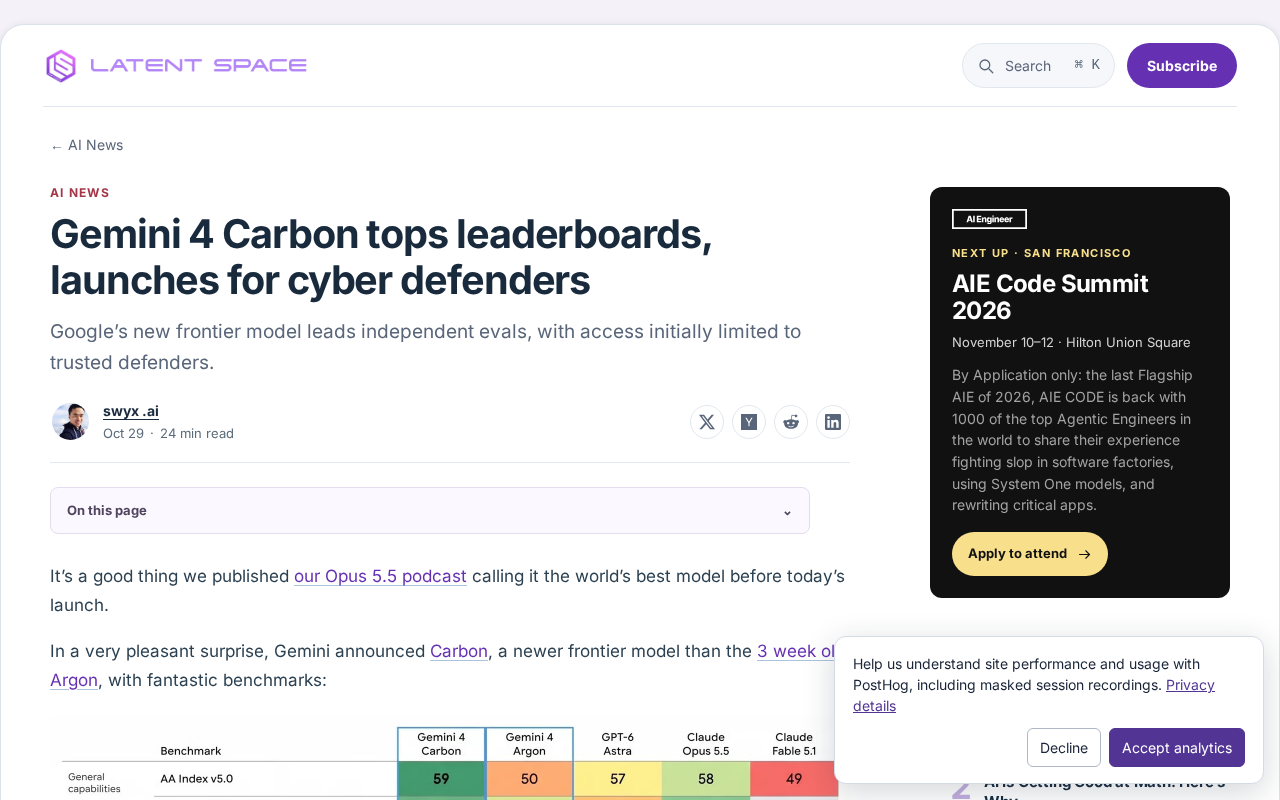
Google has officially released its next-generation frontier model, Gemini 4 Carbon, which, according to independent evaluators, holds a leading position across multiple benchmarks. Unlike previous strategies that opened access to the general public, access this time is initially restricted to a group of trusted cybersecurity defenders.
A Restrained Frontier Model Release
The way Gemini 4 Carbon was released is worth noting. Rather than simultaneously opening its API to all developers, Google handed initial access to a vetted group of security teams. This strategy is unusual among recent frontier model releases, yet it is directly tied to how the model's capabilities are positioned: when a model possesses substantial reasoning and coding abilities in offensive and defensive scenarios, familiarizing defenders with it before attackers get their hands on it aligns better with public safety logic.
The official description calls Gemini 4 Carbon a "new frontier model" and emphasizes its independent evaluation performance. So-called independent evaluation means the testing was not conducted entirely in-house by Google, but rather run by external organizations under relatively neutral conditions. This goes some way toward addressing the industry's long-standing doubts about the credibility of vendors' self-reported leaderboards.
What Leading the Leaderboard Means
Topping the leaderboard is the most direct signal from this release. The gaps between frontier models often show up in tasks such as complex reasoning, long-context processing, and code generation—and these capabilities happen to be core needs in cybersecurity work. Analyzing logs, understanding the root causes of vulnerabilities, and generating detection rules all depend on a model maintaining stability across long chains of reasoning.
However, there is a gap between leaderboard results and real-world deployment outcomes. Independent evaluations typically use standardized questions, whereas real security operations environments are full of noisy data, legacy systems, and undocumented internal logic. Whether Gemini 4 Carbon can translate its leaderboard advantage into practical value depends on how adopters complete the engineering adaptation.
Independent evaluation and benchmarks: In the large model field, "independent evaluation" usually refers to third-party organizations (such as academic groups or specialized evaluation platforms) testing models using standardized benchmarks, rather than vendors building their own question sets. Common benchmarks cover dimensions such as reasoning (e.g., math and logic problems), long-context understanding, and code generation. The value of independent evaluation lies in reducing the bias introduced by vendors' "targeted optimization," but its limitations are also obvious: standardized questions struggle to simulate the complex noise of real business scenarios, and some benchmarks carry data contamination risks. As a result, the industry generally treats independent evaluation as a necessary but insufficient reference—real-world deployment testing is needed to judge a model's actual capabilities.
Targeted Access for Defenders
Giving access first to "trusted defenders" is a product decision with a clear value judgment. The security industry has long faced an asymmetry between offensive and defensive capabilities: attackers only need to find one entry point, while defenders must cover every surface. If frontier models can improve defenders' efficiency in threat hunting, vulnerability prioritization, and incident response, this asymmetry may be partially offset.
Risks exist as well. Once a model's capabilities spread through defender channels, its capability boundaries will also be indirectly mapped out by more actors. How to strike a balance between openness and control is a problem Google must continuously address in this release cycle, and it may also become a reference paradigm for similar model releases going forward.
For developers and enterprise security teams, the more practical short-term questions are: how to apply for access eligibility, where the capability boundaries lie, and how high the integration cost is with existing security toolchains. These details will determine whether Gemini 4 Carbon remains a name on a leaderboard or truly becomes infrastructure embedded in security operations workflows.
Offensive-defensive capability asymmetry: A basic reality in cybersecurity is that an attacker only needs to successfully breach one weak point, while a defender must protect all possible entry points. This structural disadvantage is known as offensive-defensive asymmetry. The emergence of frontier models may change this dynamic: defenders can use models to accelerate log analysis, root-cause tracing of vulnerabilities, and detection rule generation, thereby partially offsetting attackers' numerical advantage in terms of efficiency. But models can also be used by attackers for automated vulnerability discovery or social engineering attacks, so the direction and pace of capability diffusion become key variables in security governance. Targeted access is precisely a strategy that attempts to establish a defensive baseline before capabilities diffuse.
Frequently Asked Questions
Is Gemini 4 Carbon now open to everyone?
No. Initial access is restricted to a group of trusted cybersecurity defenders, and ordinary developers cannot use it directly for the time being.
What does independent evaluation mean?
It refers to benchmark tests executed by organizations other than Google, used to cross-validate model capabilities and reduce the bias introduced by a single vendor's self-assessment.
Why prioritize security defenders?
Frontier models have potential uses on both the offensive and defensive sides. Letting defenders build up capabilities first helps reduce the short-term risk of model misuse.
One-line Summary
Google releases Gemini 4 Carbon, leading in independent evaluations, initially limited to trusted security defenders.
Paragraph Summary
Google has officially released its next-generation frontier model Gemini 4 Carbon, which holds a leading position across multiple benchmarks from independent evaluators. Unlike previous strategies of opening access to the general public, initial access this time is restricted to a group of trusted cybersecurity defenders, with ordinary developers unable to use it directly for now. Google emphasizes that the independent evaluation was conducted by external organizations, responding to industry doubts about the credibility of vendor self-reported leaderboards. The article analyzes the significance and limitations of leading the leaderboard, noting that engineering adaptation is still needed to bridge leaderboard results and real-world security operations outcomes. The targeted access reflects product and security trade-offs under offensive-defensive capability asymmetry, and may become a reference paradigm for similar model releases going forward.
Related articles
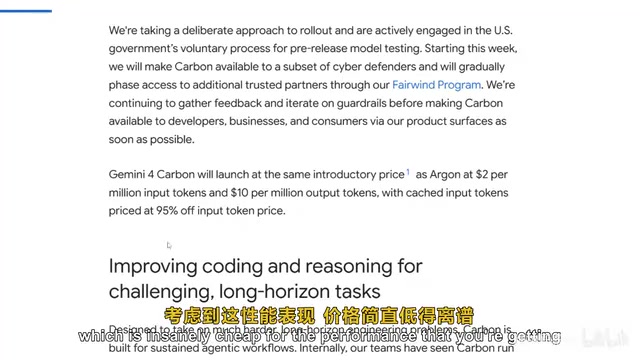
Gemini 4 Carbon Hands-On: The Strongest AI Model? Compared with Claude Opus 5.5
Google's Gemini 4 Carbon tops the Artificial Analysis leaderboard with 71% on CW Bench and leads Vending Bench. Hands-on comparison with Claude Opus 5.5: stunning front-end design but slightly behind in web development, with a clear price advantage.

Gemini 4 Carbon Tops Global Rankings as AI Productivity and Open-Source Ecosystems Surge
Google DeepMind's Gemini 4 Carbon tops global benchmarks, built for complex agents and system security. ByteDance launches Doubao Work integrated with Feishu, Anthropic's AI autonomously breaches 5 system-level attack chains, and ModelBest and Fudan open-source on-device multimodal and image generation models.

Overseas Creator Breaks Down N8n AI Agent Business Playbook: From Tooling to Monetization
An overseas creator breaks down the N8n AI agent business playbook: comparing Zapier, Make, and N8n, detailing four monetizable automation categories—lead capture, WhatsApp follow-up, booking, and content pipelines—plus agency pricing and a sales playbook.