Gemini Omni 1.2 Flash Lands on AI Gateway: A New Option for Video Generation

Google's Gemini Omni 1.2 Flash launches on AI Gateway, enabling text-to-short-video generation with native audio.
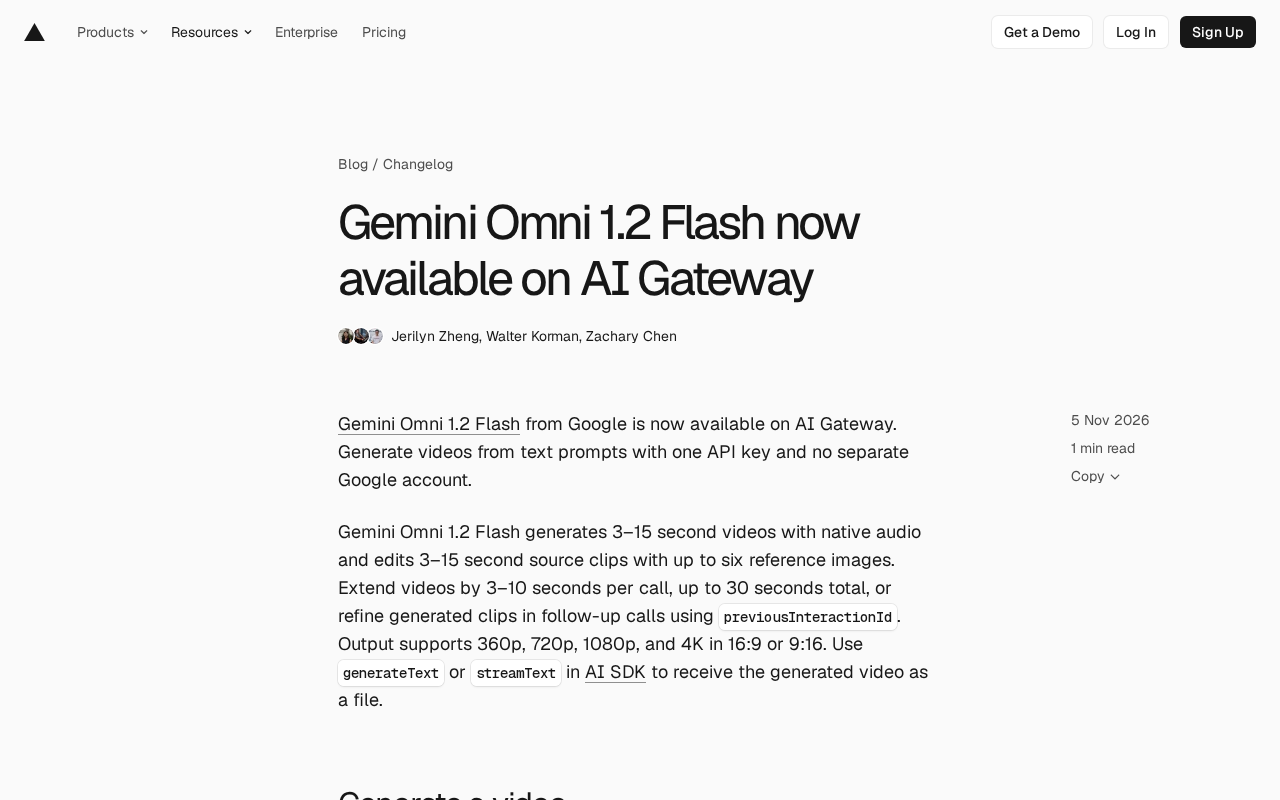
Gemini Omni 1.2 Flash is now available on AI Gateway, letting developers call Google's multimodal video generation model directly via a unified API. It supports generating 3-15 second videos with native synchronized audio from text prompts, and can use up to six reference images to assist editing source clips. Multi-turn interaction via previousInteractionId enables iterative refinement, with each extension adding 3-10 seconds up to a 30-second total. Output covers 360p to 4K across 16:9 and 9:16, suiting vertical short videos. Integration uses AI SDK's generateText or streamText, with videos returned as files. AI Gateway offers usage and cost tracking, failover, zero data retention, and BYOK support, billed at provider prices with no markup.
Google's video generation model Gemini Omni 1.2 Flash is now officially available on AI Gateway. Developers can now call this multimodal model through a unified API interface without needing to register a separate Google account. This marks a further opening of AI video generation capabilities to the developer ecosystem.
Core Capabilities: One-Stop Generation from Text to Video
Gemini Omni 1.2 Flash supports generating videos from 3 to 15 seconds from text prompts, with native audio support. This means developers only need to provide a descriptive prompt to get a video clip with a synchronized audio track, eliminating the need for post-production dubbing or sound effect synthesis.
In terms of editing capabilities, the model can process source clips of 3 to 15 seconds and supports up to six reference images as editing guidance. This design means video editing is no longer limited to pure text instructions—developers can combine reference images to guide the model's understanding of editing intent, improving editing precision.
Video Extension and Multi-Turn Interaction
The model supports video extension, adding 3 to 10 seconds per call, with a total duration cap of 30 seconds. For scenarios requiring longer video content, developers can progressively extend clips through multiple calls.
More notably, there is a multi-turn interaction mechanism. Developers can use previousInteractionId to continue refining previously generated clips in subsequent calls, effectively introducing a conversational iterative workflow to video generation. Compared to a one-shot generation model with no ability to adjust afterward, this design allows creators to progressively polish video details.
previousInteractionId is a session state identifier: each time the model is called to generate or edit a video, the server returns a unique ID used to associate the context of that request (including prompt history, generated clips, etc.). By carrying this ID in subsequent calls, the model can read the state from the previous round and continue modifying from there rather than regenerating from scratch. This mechanism is similar to session continuation in conversational large models, turning video generation from a "one-shot black-box output" into a traceable, iterable process. Developers should note that such context typically has an expiration time or call count limit; for long-chain iterations, IDs should be saved carefully and the platform's state retention policy should be monitored.
Output Specifications and Integration
On the output side, Gemini Omni 1.2 Flash offers four resolution tiers: 360p, 720p, 1080p, and 4K, and supports both 16:9 and 9:16 aspect ratios. The 9:16 support means the model can directly serve vertical short-video scenarios, adapting to mobile content creation needs.
For integration, developers use google/gemini-omni-1.2-flash as the model name and call it through the generateText or streamText methods in the AI SDK. Generated videos are returned as files that can be written directly to local storage. The official example demonstrates the complete code flow for generating a three-second 360p clip and saving it as an MP4 file.
For streaming response scenarios, the streamText method allows developers to process progressively arriving file data in fullStream, with the video delivered as a complete file. This mode is suitable for scenarios requiring real-time feedback or long task processing.
The Platform Value of AI Gateway
As a unified API layer, AI Gateway provides developers with model invocation, usage and cost tracking, retry and failover configuration, and more. The platform claims to offer higher uptime guarantees than any single provider, with built-in features such as custom reports, zero data retention support, API key budget management, and routing rules.
On pricing, AI Gateway bills at provider prices with no markup and no inference platform fee, including bring-your-own-key (BYOK) requests. This strategy lowers integration costs for developers, especially teams already using Google services.
How Developers Should Use It
For developers looking to integrate video generation capabilities into their applications, Gemini Omni 1.2 Flash offers a new option. Its native audio support, multi-turn editing mechanism, and vertical output capability make it practical for scenarios such as short video creation, ad creative generation, and social media content production.
However, note that the per-generation duration cap of 15 seconds and the 30-second total after extension mean it is better suited for short clip creation than long video production. Developers should evaluate whether it matches their needs based on specific scenarios.
As competition in video generation models intensifies, the value of a unified API gateway is becoming more prominent—developers can compare and switch between different models on the same platform without having to build separate integration layers for each provider. The addition of Gemini Omni 1.2 Flash adds Google's video generation capabilities to this ecosystem.
Background Notes
AI SDK is an open-source TypeScript toolkit decoupled from specific model providers, with generateText and streamText as its core invocation entry points. Although the name includes Text, it returns non-text artifacts such as images, audio, and video through a multimodal output mechanism—model responses include file-type output parts, and developers need to iterate over these parts and write the binary data to disk. generateText is suitable for waiting for the complete result and processing it all at once; streamText progressively pushes response parts through fullStream, making it easier to provide progress feedback or interrupt early during long tasks. Both share the same prompt and parameter structure, so migration costs are low when switching between them.
BYOK (Bring Your Own Key) means developers use their own API keys obtained from the model provider and forward requests through the gateway. In this model, billing still follows the developer's existing contract with the provider, and the gateway only handles routing and observability, which is why the platform can achieve "no markup." The opposite is the platform-paid model, where the gateway purchases quota and resells it, typically including a markup. BYOK is suitable for teams that already have provider accounts, are sensitive to cost structure, or need to meet compliance audit requirements. In addition,
Zero Data Retention means request and response content is not persistently stored by the gateway or the model provider and is used only for the current inference, which is especially critical for scenarios involving user privacy data or trade secrets.
One-line Summary
Google's video generation model Gemini Omni 1.2 Flash launches on AI Gateway, supporting text-to-short-video with native audio.
Related articles
 Tech Frontiers
Coldframe: A Honeypot Disguised as a Supermarket Freezer Controller
Coldframe is a honeypot disguised as Danfoss AK-SM 800A and Dixell XWEB freezer controllers, built as a single Python file that detects CVE-2025-41450 attempts and is identified as real devices on Shodan.
 Tech Frontiers
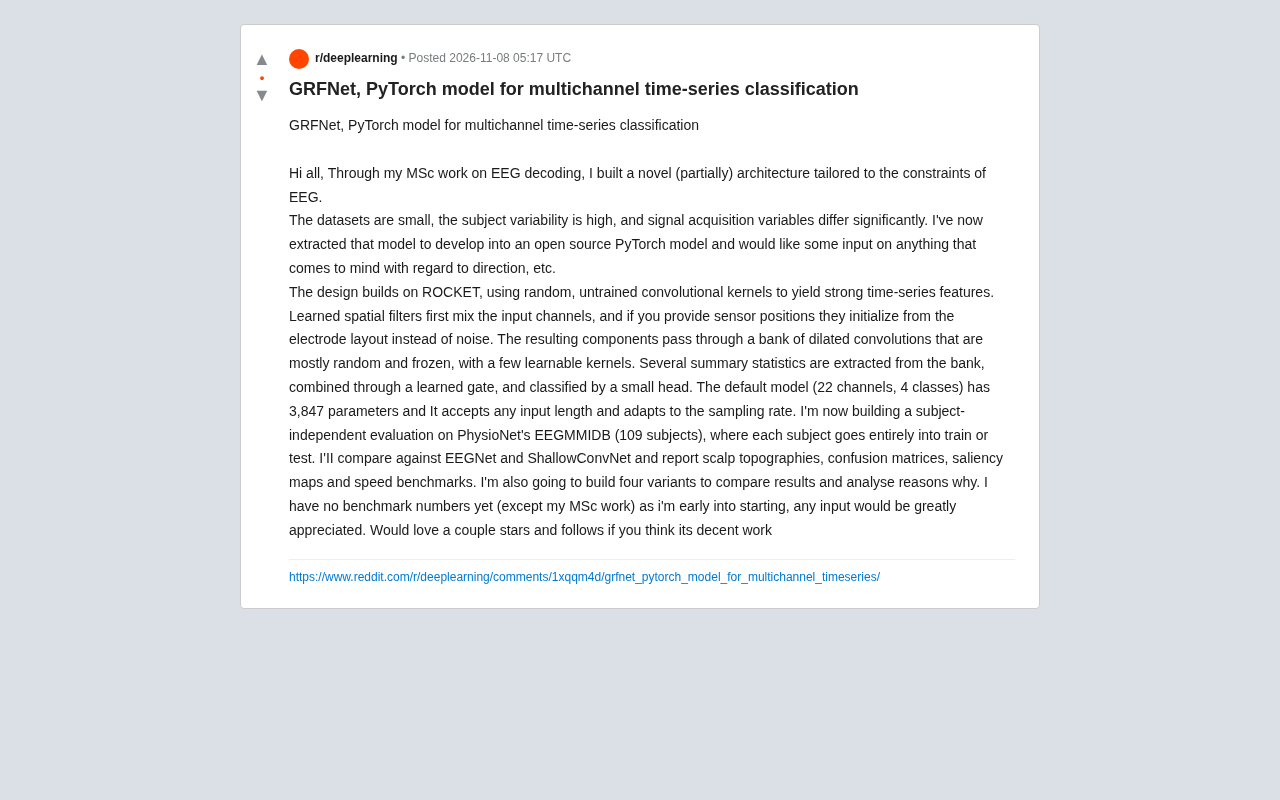
GRFNet: A Lightweight PyTorch Model Designed for Multichannel Time-Series Classification
GRFNet is a lightweight PyTorch model for multichannel time-series classification, originating from EEG decoding research. With only 3,847 parameters, it is based on the ROCKET architecture, combining random convolution kernels with learnable spatial filters, supports arbitrary input lengths, and will soon be evaluated on the PhysioNet dataset.
 Tech Frontiers
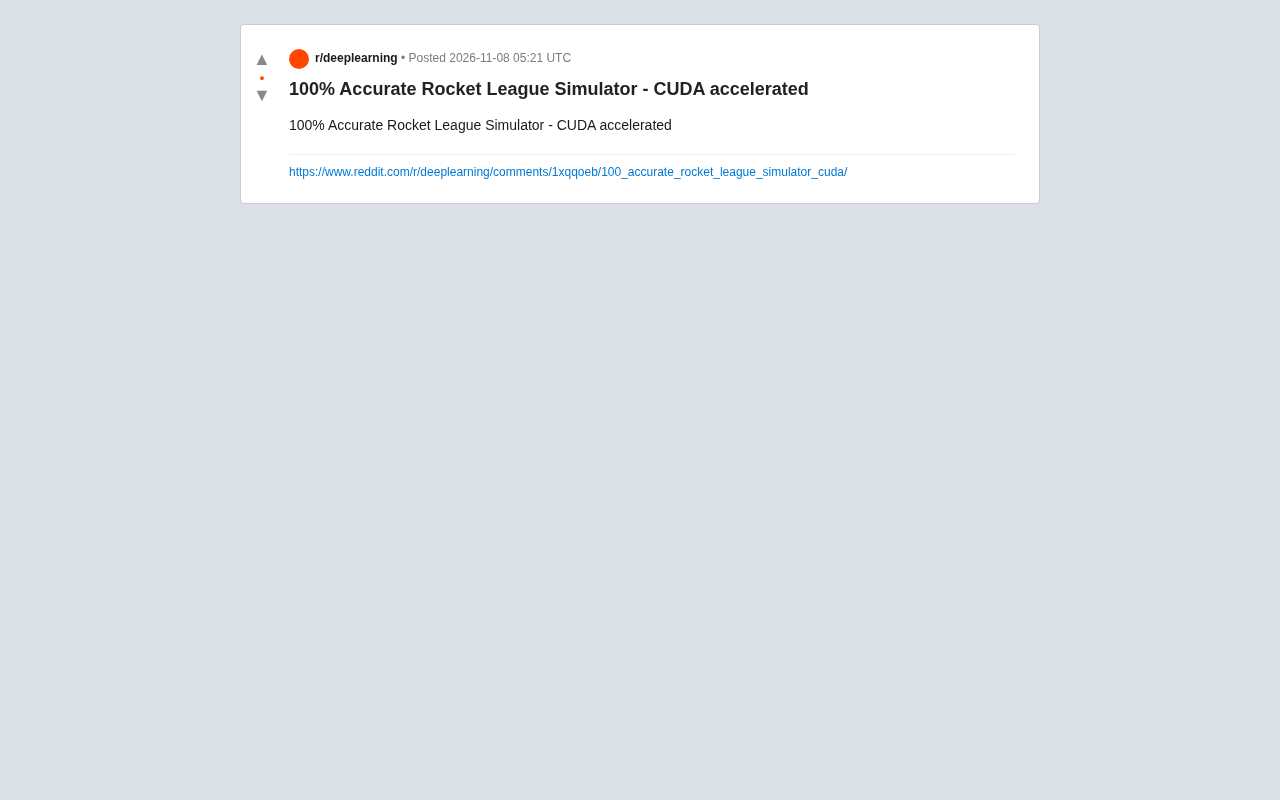
CUDA-Accelerated Rocket League Simulator: A Player-Made Hardcore Experiment
A Reddit post shows a "100% Accurate" Rocket League simulator accelerated with CUDA. We analyze its technical context, CUDA's value in game physics simulation, and the significance and limitations of such community projects.