Gemini Omni 1.2 Flash Released: 15-Second Video Generation at 30% Lower Price
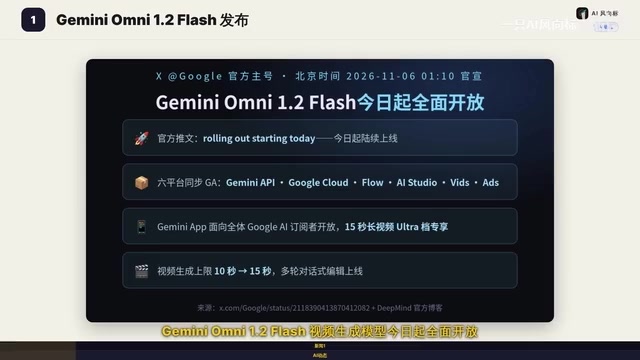
Google releases Gemini Omni 1.2 Flash, 30% cheaper and extended to 15 seconds, targeting scaled video production.
Google DeepMind released the video generation model Gemini Omni 1.2 Flash, positioned as fast, economical, and built for scaled video production, launched simultaneously across six platforms. Core upgrades include: generation duration increased from 10 seconds to 15 seconds, prices cut by 30%, 720p at $0.07 per second (under $1.10 per 15-second video), and finished videos can be upscaled to 4K. On quality, multi-shot narrative and scene consistency are improved, reference image adherence is stronger and closer to brand visual guidelines. The editing approach changes to multi-turn dialogue incremental modification, supporting second-level precise duration specification without full regeneration. Channels cover Gemini API, Google Cloud, Flow, AI Studio, Vids, and Ads—with the Ads integration pointing to bulk production of advertising assets, and 15-second long video exclusive to the Ultra tier. The overall strategy is trading price for scale and controllability for production adoption.
Google dropped a bombshell in the video generation space in the early hours of the morning. The official DeepMind blog announced Gemini Omni 1.2 Flash, with a clear positioning—fast, economical, and built for scaled video production. Six platforms launched simultaneously, prices cut by 30%, and video length extended from 10 seconds to 15 seconds. This isn't a routine iteration; it's a re-pricing of the commercialization path for video generation.
Four Core Upgrades: Duration, Price, Quality, Platforms
The official upgrade list is restrained—just four data points. Video generation duration increased from 10 seconds to 15 seconds, prices cut by 30%, 720p video costs only $0.07 per second, and finished videos can be upscaled to 4K. This combination punches with clear intent: to move video generation from "something to play with" to "something you can afford to use."
At $0.07 per second for 720p, this sits in a clearly low-price range in the current video generation market. At the full 15-second duration, a single video costs less than $1.10. For marketing, e-commerce, and education scenarios that need to produce short video assets in bulk, this price threshold is low enough to be incorporated into regular production workflows.
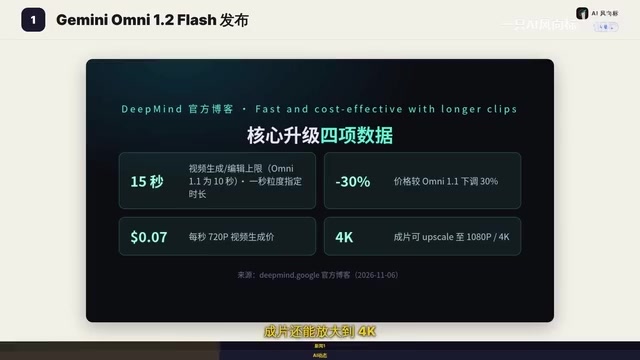
The DeepMind official blog release page states the product positioning plainly—built for scaled video production scenarios. In other words, the target users aren't early adopters generating an occasional demo, but teams that need to produce dozens or hundreds of assets every day. The 30% price cut combined with 4K upscaling capability solves two key procurement decision bottlenecks at once: "cost" and "delivery quality."
The product logic behind the Flash suffix: In the Gemini naming system, "Flash" represents a lightweight tier prioritizing low latency and low cost, complementing the Pro/Ultra tiers that focus on maximum capability. Google previously adopted this tiering strategy for text models, where Flash versions typically sacrifice some peak capability in exchange for faster response times and lower unit costs. Bringing Flash to video generation means Google believes the competitive focus in video generation has partially shifted from "single-item quality ceiling" to "unit cost and throughput"—consistent with the development path text models have already traveled.
Billing units for video generation: Video generation models are generally billed by output duration or resolution rather than per request. Per-second pricing has the advantage of cost predictability—bulk production teams can directly factor generation costs into the per-asset production cost. At $0.07/second for 720p, a single 15-second video costs less than $1.10, a level already approaching the lower bound of outsourced asset procurement—the key reason it's emphasized as a prerequisite for "scaling."
Multi-Shot Narrative and Improved Reference Adherence
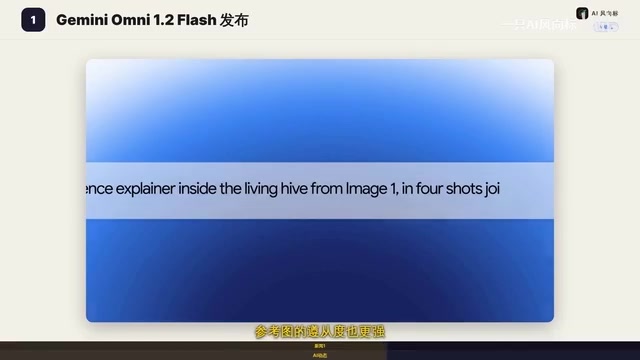
The official demo is a beehive biology explainer video, with noticeable improvements in multi-shot narrative and scene consistency. These two metrics are exactly where previous video generation models most often failed: change the shot and the subject deforms; change the scene and the style drifts.
Reference image adherence is also stronger. For enterprise users with brand visual guidelines, this means videos generated after uploading reference images stay closer to the established style, reducing the cost of repeated generation attempts. Improved scene consistency and reference adherence essentially push video generation from "random blind box" toward "controllable production tool."
Reference adherence: Refers to how faithfully the model reproduces the subject appearance, color scheme, style, and other dimensions of user-uploaded reference images during generation. It's a prerequisite for implementing brand visual guidelines—enterprises require that product appearance, logo colors, and character images remain consistent in generated videos. If the model deviates from the reference image, the output can't be used directly. When adherence is insufficient, users can only regenerate repeatedly and manually select (known in the industry as "gacha"), with hidden costs far exceeding the nominal unit price.
Scene consistency: The ability to maintain coherence in subject, lighting, and spatial relationships across different shots in multi-shot videos. A common failure mode in video generation models is subject deformation or style drift after shot changes, rooted in the fact that shots are typically sampled independently without cross-shot state constraints. Improving consistency requires maintaining latent variable continuity across the time dimension—which is why multi-shot narrative has long been considered one of the difficulties in video generation.
Editing Refactored: Multi-Turn Dialogue for Detail Changes, Second-Level Duration Specification
The change in editing logic may be more noteworthy than the parameter upgrades. The new model no longer requires full regeneration—multi-turn dialogue can modify details, and duration can be specified with one-second precision.
This change directly addresses a pain point in video generation workflows. The old approach required regenerating the entire video to change one detail, potentially invalidating all the parts you were previously satisfied with. Multi-turn dialogue editing makes modifications incremental—creators can iterate on existing footage rather than starting over each time. Second-level duration specification gives greater certainty to the editing process, eliminating the need to trim to fit duration.
The technical barrier of multi-turn dialogue editing: Having a model make incremental modifications to an existing video is harder than generating from scratch. Full regeneration only requires ensuring reasonable output; incremental editing requires the model to locate the specified segment, modify only the target region, and keep the remaining frames unchanged—otherwise flickering or jumps occur. This typically relies on local manipulation of the video's spatiotemporal representation and maintaining consistency before and after editing. For users, the real value isn't in "being able to edit," but in the fact that parts you were previously satisfied with don't get invalidated after editing—transforming video production from one-time generation into an iterable engineering workflow.
Six Platforms Fully Open, 15-Second Long Video Exclusive to Ultra Tier
The launch channels are broadly spread: Gemini API, Google Cloud, Flow, AI Studio, Vids, and Ads—six platforms launched simultaneously. All AI subscribers of the Gemini App can use it starting today.
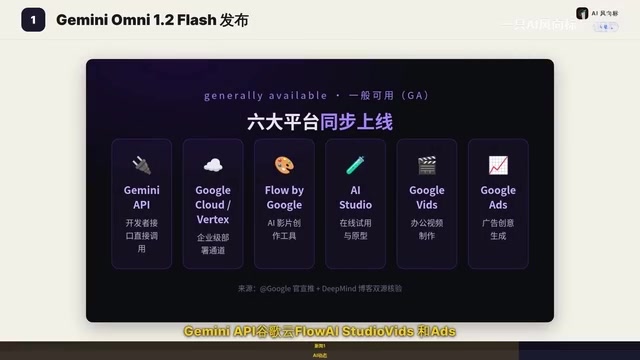
Worth noting is the tier differentiation—15-second long video is exclusive to the Ultra tier. This means the maximum duration and full capabilities are placed in the higher-tier subscription; regular subscribers can use the model but don't get the longest generation duration. This tiering strategy is increasingly common in AI products: basic capabilities for everyone, top-tier capabilities for paying customers.
Looking at platform coverage, the Ads integration deserves separate mention. Video generation going directly into the ad placement toolchain shows Google's clear expectation for this model's commercial scenario—bulk production of advertising assets. Flow and Vids target creation and office scenarios, AI Studio targets developers, Gemini API and Google Cloud target enterprise integration—six channels each serving their own purpose.
What This Release Changes
Looking at the four upgrades together, the strategic outline of Gemini Omni 1.2 Flash is clear: trade price for scale, trade controllability for production adoption. The 30% price cut and $0.07/second pricing lower the cost of trying, multi-turn dialogue editing and reference adherence improve usability, and 15-second duration and 4K upscaling support delivery standards.
The competitive focus in the video generation race is shifting from "can it generate" to "can it generate stably, cheaply, and controllably at scale." This model's release is Google's clear statement on this shift. Whether the actual generation quality and multi-turn editing stability match the official demo still needs verification from more user testing.
The above is the core information of this news brief; deeper analysis will be expanded in a follow-up daily report.
One-line Summary
Google releases Gemini Omni 1.2 Flash, 30% cheaper and extended to 15 seconds, targeting scaled video production.
Paragraph Summary
Google DeepMind released the video generation model Gemini Omni 1.2 Flash, positioned as fast, economical, and built for scaled video production, launched simultaneously across six platforms. Core upgrades include: generation duration increased from 10 seconds to 15 seconds, prices cut by 30%, 720p at $0.07 per second (under $1.10 per 15-second video), and finished videos can be upscaled to 4K. On quality, multi-shot narrative and scene consistency are improved, reference image adherence is stronger and closer to brand visual guidelines. The editing approach changes to multi-turn dialogue incremental modification, supporting second-level precise duration specification without full regeneration. Channels cover Gemini API, Google Cloud, Flow, AI Studio, Vids, and Ads—with the Ads integration pointing to bulk production of advertising assets, and 15-second long video exclusive to the Ultra tier. The overall strategy is trading price for scale and controllability for production adoption.
Related articles
 Tech Frontiers
MuJoCo: An Analysis of DeepMind's Open-Source General-Purpose Physics Simulator
An in-depth analysis of Google DeepMind's open-source physics simulator MuJoCo: high-performance C++ kernel, MJCF modeling format, contact solving principles, MJX GPU acceleration, and robot reinforcement learning use cases.
 Tech Frontiers
Claude API Quick Start: The Official Quickstarts Project Collection
Anthropic's official claude-quickstarts project collection helps developers quickly build deployable apps with the Claude API. Nearly 20k stars, Python-based, great for beginners and prototyping.
 Tech Frontiers
AI Agents Connecting Directly to APIs: Which Calls Can Be Safely Allowed?
AI agents can call any API, but the real challenge is deciding which calls can be safely allowed. This article analyzes allowance decisions from three dimensions—intent matching, least privilege, and controllable impact—and argues that the control layer should sit outside the agent, combined with audit traceability to build a trustworthy API call governance mechanism.