General Compute Raises $100M Series A, Inference Chips Challenge Nvidia
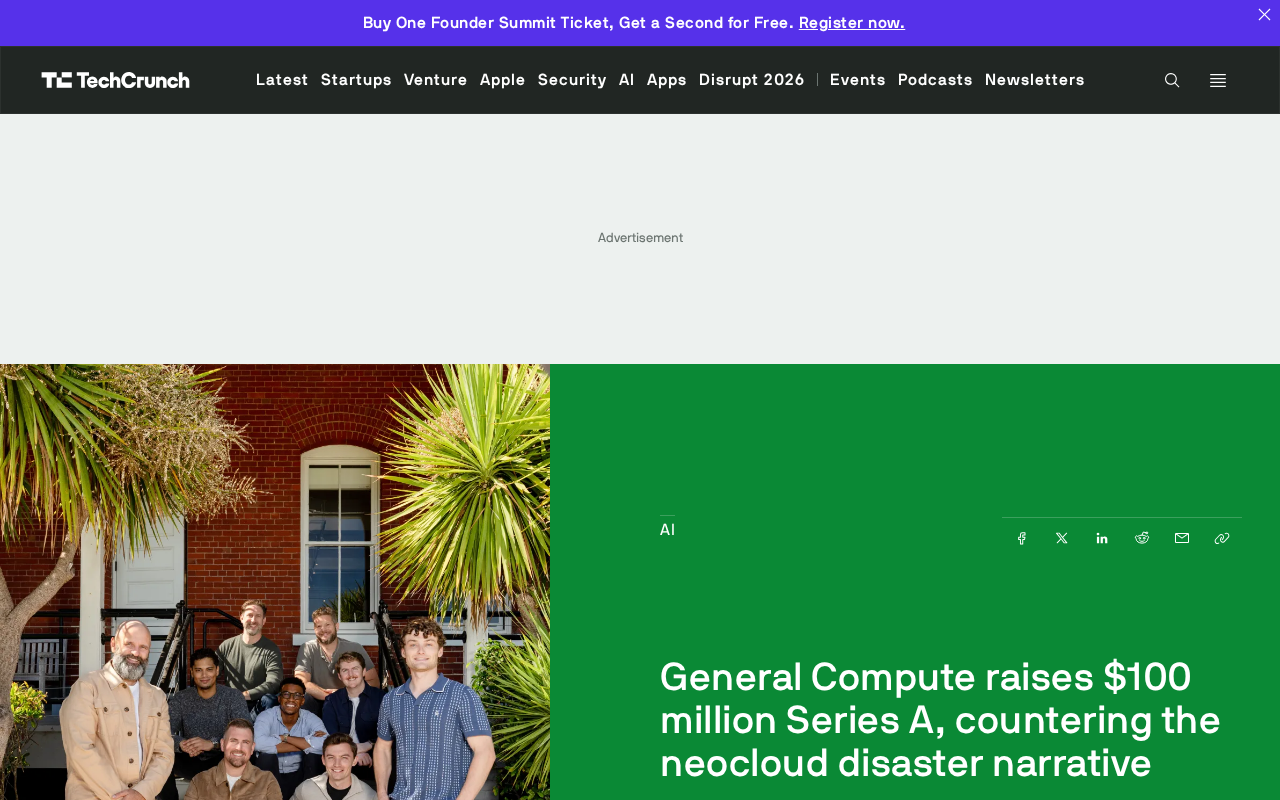
General Compute raises $100M Series A, betting on inference chip compute services beyond Nvidia.
Amid widespread pessimism about the neocloud sector, General Compute has closed a $100M Series A, choosing a path opposite to stockpiling cards for rental: building compute services around inference scenarios while deliberately avoiding Nvidia chips. Its core thesis is that as large models move from training to scaled application, inference costs will replace training costs as the main expense for AI companies, and inference is more sensitive to unit cost and energy efficiency than ecosystem lock-in, leaving room for non-Nvidia chips. The article analyzes the opportunities and challenges of this model: software stack engineering capability determines whether cost advantages can be realized, multi-chip supply chains bring flexibility but also complexity, and competitors include not only Nvidia but also traditional cloud providers and well-funded neocloud peers. The signal significance of this funding is that capital's judgment on AI compute is diverging.
At a time when funding news in the AI infrastructure space is frequently tied to "bursting bubbles" and "inverted valuations," a startup called General Compute has secured a $100 million Series A round. The direction this funding is betting on is quite clear: using inference chips outside the Nvidia ecosystem to capture the expanding slice of the AI compute market.
A Bet Against the "Neocloud Disaster Narrative"
For some time now, discussions around neoclouds (new cloud service providers) have been steeped in pessimism. A large number of players have rushed into the GPU cloud rental space, with high hardware procurement costs, enormous depreciation pressure, and relentless price wars leading many observers to question the sustainability of this business model.
General Compute's funding stands out particularly against this backdrop. It has not joined the arms race of stockpiling cards for rental, but instead chosen a more focused path—building compute services around inference scenarios, and deliberately avoiding Nvidia in chip selection.
The logic behind this contrarian move is that the structure of inference demand differs from training. Training pursues extreme performance and interconnect bandwidth, with strong ecosystem lock-in; inference places more emphasis on unit cost, energy efficiency, and deployment flexibility. As model invocation volume continues to climb, inference costs will replace training costs as the biggest line item on AI companies' bills, leaving room for non-Nvidia chips.
Neocloud (new cloud service provider) refers to a category of emerging compute rental companies relative to traditional hyperscale cloud providers (AWS, Azure, GCP), with typical representatives including CoreWeave and Lambda Labs. Their business model centers on GPU cluster rental, primarily serving AI training and inference customers. Their structural risk lies in: requiring massive upfront capital investment to purchase GPUs (a single H100 can cost tens of thousands of dollars), while the hardware depreciation cycle is typically only 3-5 years. If rental prices fall due to oversupply, the investment payback period gets stretched or even inverted. Additionally, such companies often rely heavily on a single supplier (Nvidia), have weak bargaining power, and limited customer stickiness. This is precisely the root of the market's "disaster narrative" around the neocloud sector, and important context for understanding General Compute's choice of a differentiated path.
Why Inference Chips, Why Now
General Compute's core thesis can be broken down into two layers.
The first layer is demand migration. As large models move from the lab to products, training is a one-time capital expenditure, while inference is an ongoing operational expense. For application-layer companies, whoever can drive down the cost per invocation gains pricing power. This creates genuine demand for "good enough and cheap" inference compute, rather than blind pursuit of top-tier training clusters.
The second layer is supply diversification. Nvidia's dominance in the training market is difficult to shake in the short term, but the competitive landscape in inference is far from settled. A batch of specialized inference chips has demonstrated cost advantages on specific workloads, and hardware-level substitutability is increasing. General Compute's business model is essentially about integrating these fragmented chip supplies into usable compute services.
A complete inference compute solution doesn't depend on the chip alone. Scheduling systems, model compilation optimization, batching strategies, memory management—these software-layer engineering capabilities determine how much effective throughput the same chip can deliver. This is exactly the value that players like General Compute need to prove—not simply reselling hardware, but making non-mainstream chips deliver cost-effectiveness under real business workloads.
The difference in computational characteristics between inference and training is key to understanding chip selection logic. The training phase involves repeated forward and backward propagation, with extremely high requirements for floating-point compute (FP16/BF16 or even FP8), memory bandwidth, and inter-card interconnect (such as NVLink), often requiring thousands of cards to work together, resulting in strong ecosystem lock-in and high migration costs. The inference phase is the forward computation after model deployment, typically more sensitive to latency, throughput, and cost per token, with relatively lower requirements for interconnect bandwidth. Many specialized inference chips (such as Groq's LPU, Cerebras's wafer-scale chips, and various ASICs) trade generality for higher energy efficiency and lower per-invocation costs. When model invocation volume grows from millions to billions, inference costs as a share of AI companies' total spending will rise significantly, creating a real market window for "good enough and cheap" non-Nvidia chips.
What $100 Million Can Buy
The size of the Series A round indicates that capital markets are willing to give this path a chance to prove itself. Funds typically flow to several key areas: chip procurement and cluster deployment, software stack R&D, and customer acquisition.
For inference service providers, the core early challenge is not on the demand side but on the engineering side. How to create a unified abstraction across chips of different architectures, how to make customer model migration costs low enough, how to raise resource utilization while ensuring stability—if these problems aren't solved well, cost advantages will be eaten up by operational overhead.
Another hidden test is the supply chain. Choosing non-Nvidia chips means building relationships with multiple chip suppliers, with uncertainty around production capacity, delivery cycles, and driver maturity. Compared to cloud service providers with a single supplier, this multi-source strategy has advantages in flexibility but is a burden in complexity.
The engineering challenges of a multi-chip software stack deserve further elaboration. Inference chips from different vendors differ enormously in instruction sets, memory hierarchies, parallelization approaches, and programming models—for example, GPUs rely on the CUDA ecosystem, while ASICs often require dedicated compilers and runtimes. To enable customers' models to run efficiently on multiple chips, service providers need to build a unified compute abstraction layer (similar to compiler infrastructure like MLIR and TVM) and implement operator fusion, continuous batching, KV Cache management, and other optimizations. These software efforts directly determine effective hardware utilization—the same chip can see multiple-fold throughput differences depending on software optimization quality. This also explains why such companies' core competitiveness lies not in hardware procurement but in the engineering team's ability to master heterogeneous computing.
The Competition Isn't Just Nvidia
If General Compute is placed in a broader competitive landscape, it faces more than just Nvidia's ecosystem barriers.
Traditional cloud providers are turning inference services into standardized products, squeezing independent players' space through economies of scale and existing customer relationships. Peers in the neocloud sector, while under profitability pressure, are also extending into inference scenarios—especially those with deep pockets.
General Compute's differentiation may lie in focus. Big cloud providers' inference services are often one part of their sprawling product lines, with pricing and resource allocation subject to overall strategy; inference-focused players can pursue more aggressive cost optimization and finer service granularity in specific scenarios. Whether this focus can translate into sustainable customer stickiness is the question this funding needs to answer.
Signal Significance for the Industry
What's most noteworthy about this funding may not be the amount itself, but the timing. In an atmosphere of widespread pessimism around the neocloud narrative, capital is still willing to bet on a clear technology path—indicating that the market's judgment on AI compute is diverging. The generic "compute rental" story is losing appeal, but solutions targeting specific links and specific cost structures still have room.
Whether inference chips can truly support an independent compute business depends on whether the software layer can smooth out hardware differences to the point where customers don't notice. General Compute has obtained a ticket to entry, not the answer.
Related articles

Gemini 4 Carbon Tops Global Rankings as AI Productivity and Open-Source Ecosystems Surge
Google DeepMind's Gemini 4 Carbon tops global benchmarks, built for complex agents and system security. ByteDance launches Doubao Work integrated with Feishu, Anthropic's AI autonomously breaches 5 system-level attack chains, and ModelBest and Fudan open-source on-device multimodal and image generation models.

Overseas Creator Breaks Down N8n AI Agent Business Playbook: From Tooling to Monetization
An overseas creator breaks down the N8n AI agent business playbook: comparing Zapier, Make, and N8n, detailing four monetizable automation categories—lead capture, WhatsApp follow-up, booking, and content pipelines—plus agency pricing and a sales playbook.

Empacer: The Voice-First AI Assistant for Small Business Owners That Topped Product Hunt
Empacer is a voice-first AI assistant for small business owners: three-question setup, voice requests turned into customer replies, social posts, and invoices—all owner-approved. It won #1 Product of the Day on Product Hunt with 231 upvotes and 47 comments.