Genie 4: Generate a Steerable Living World from a Single Prompt

Google DeepMind releases Genie 4 real-time world model with keyboard control and text editing, moving world models toward developer tools.
Google DeepMind released Genie 4 on Product Hunt, positioned as "turn a prompt into a living world you can steer." Unlike video generation models, Genie 4 builds an interactive environment you can enter and edit in real time: move with the keyboard and use text to change weather, add characters, or trigger events. It generates native audio, real-time conversation, simulates physics and human motion, and uses Gemini for scene consistency. Currently in research preview with an open waitlist, it received 81 votes and ranked 11th on launch day. The article argues it targets creators, game developers, and AI researchers, signaling world models moving from papers to developer tools, though key parameters remain undisclosed.
From Video Generation to World Generation: Positioning Genie 4
Google DeepMind released Genie 4 on Product Hunt, with the official tagline "Turn a prompt into a living world you can steer." It targets creators, game developers, and AI researchers, and is fundamentally different from typical video generation models: a video generator hands you a finished clip, whereas Genie 4 builds a world you can step into — move around with the keyboard and change it in real time with text.
According to the Product Hunt page, Genie 4 is currently in research preview, with a waitlist now open. On launch day it received 81 votes and 2 comments, ranking 11th. That's not blockbuster-level traction, but given its audience is professional developers and researchers, the discussion threshold is inherently higher.
The Key Divide from Video Generation
A video model's output is a "result"; Genie 4's output is an "environment." The former suits content production pipelines; the latter suits prototyping interactive experiences. You can change the weather, add characters, and trigger events while the world is running — this real-time editability is its real selling point.
World Model is the key background for understanding Genie 4's positioning. It refers to AI systems that can learn and simulate the dynamic laws of an environment, predicting the world's next state given actions or instructions, rather than merely generating pixels. Unlike video generation models (such as Sora), world models emphasize causality and interactivity: user behavior changes subsequent generated content. The Genie series was introduced by Google DeepMind, with the first Genie released in 2024, capable of generating playable 2D platform games from a single image; subsequent versions gradually improved resolution, duration, and controllability. Genie 4 is a continuation of this line, with the goal upgraded from "generating playable clips" to "real-time steerable persistent worlds."
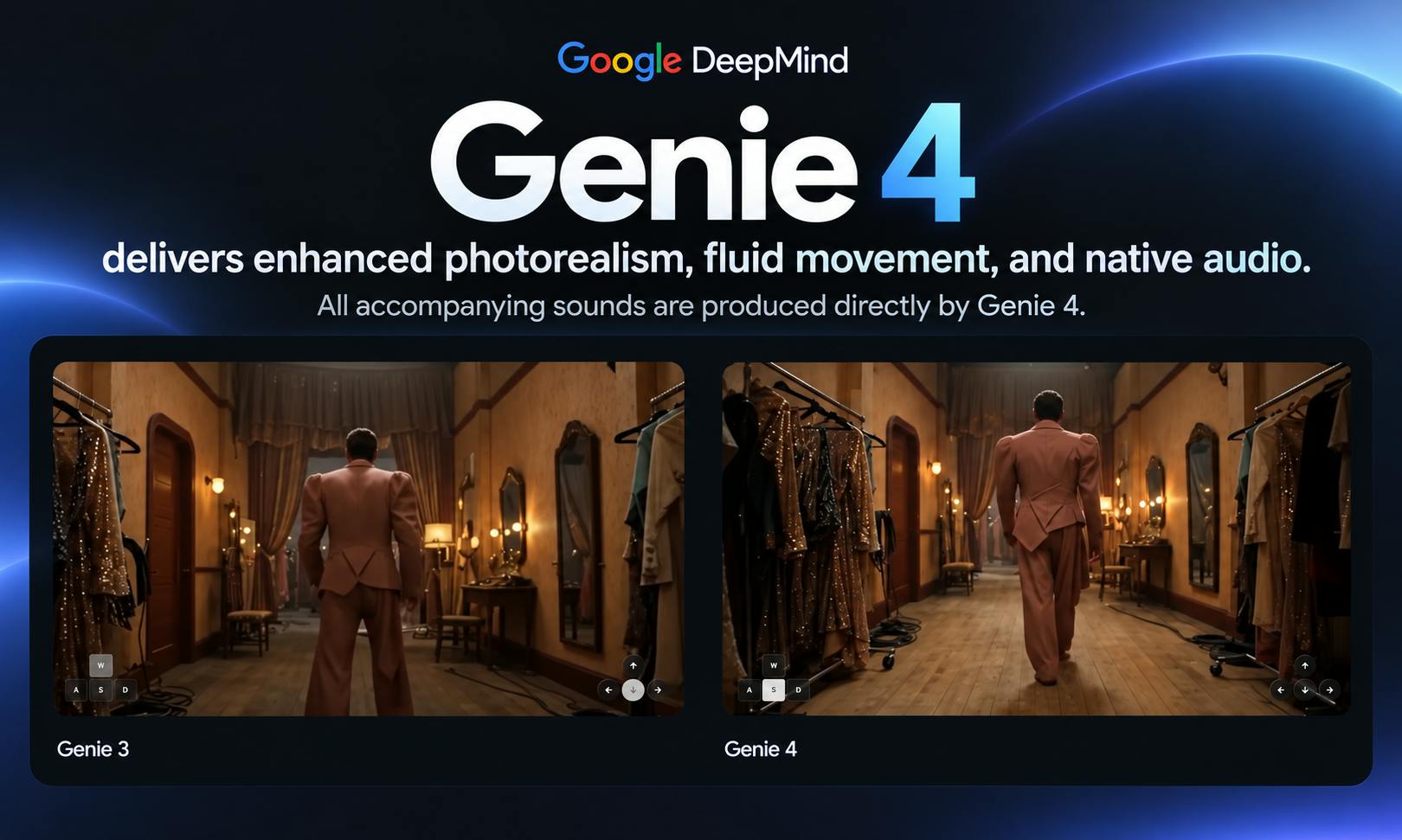
Real-Time Control: Walk with the Keyboard, Change the World with Text
Genie 4's core capability is real-time responsiveness. The world is not a pre-rendered static scene but is continuously generated as you operate. Control movement with the keyboard and change world state with text instructions — switch weather, add characters, trigger an event — these operations take effect while running.
This interaction mode places higher demands on the model: it must maintain temporal consistency of the scene, otherwise every time you turn around you see a new world. Genie 4 uses Gemini to maintain scene coherence, which is the technical key distinguishing it from ordinary video generation models.
Native Audio and Real-Time Conversation
Beyond visuals, Genie 4 also generates native audio and real-time conversation. This means characters in the world can speak, with sound produced in sync with the environment rather than dubbed in post. For game prototypes and immersive storytelling, this step advances from "watchable" to "listenable and conversational."
Native Audio Generation refers to the model directly synthesizing sound synchronized with the visuals while generating visual content, rather than producing visuals first and dubbing later. In interactive world models, this means ambient sounds (footsteps, wind) and character speech must change in real time with user actions, placing higher demands on the model's multimodal joint modeling capability. Real-time conversation further requires a low-latency speech recognition and synthesis loop so NPCs can respond instantly to user instructions. These two capabilities push world models from "watchable scenes" to "listenable, conversational immersive environments," an important watershed for game prototyping and storytelling tools.
Physics and Human Motion Simulation
Genie 4 simulates physics and natural human motion. The official description presents these two together, indicating it doesn't just generate plausible-looking images but attempts to make the world operate according to physical rules and character movements conform to real human biomechanics.
This is clearly meaningful for game developers: a world that can simulate physics can be used directly for gameplay validation, not just concept demonstration. If basic behaviors like character walking, object falling, and environmental interaction can be stably generated by the model, the cost of prototype iteration drops dramatically.
Gemini as the Consistency Engine
Scene coherence is the hardest part of world models. Genie 4 uses Gemini to maintain scene consistency, indicating a model-collaboration architecture: one model generates, another constrains. This design approach is not uncommon in recent world model research, but applying it to real-time interactive scenarios raises the engineering difficulty significantly.
Scene Consistency is the core challenge of world models. In real-time generation, the model must remember prior scene layout and object states after user movement, viewpoint changes, and instruction modifications, otherwise flaws appear such as "the wall disappears after turning around" or "the same character's appearance suddenly changes." A common solution is to introduce memory mechanisms or external constraint models: the generation model handles frame-by-frame output, while another model (such as Gemini) maintains a world state representation and corrects deviations. This "generation + constraint" dual-model architecture is gradually gaining popularity in recent world model research, but running it under the low-latency requirements of real-time interaction poses significant engineering challenges for inference efficiency and state synchronization.
Significance for Creators and Researchers
Genie 4's audience is clearly stated: creators, game developers, AI researchers. The three groups use it differently — creators use it to quickly build narrative spaces, game developers use it to validate gameplay and interaction, and researchers use it to observe world models' real-time generation capabilities.
The research preview positioning also means it's not yet a finished tool. The open waitlist indicates restricted access, with capability boundaries and stability still being validated. For teams wanting early access, joining the waitlist early is the most practical action right now.
Questions Worth Watching
The official page does not disclose key parameters such as the maximum scale of generated worlds, single-session duration, or hardware requirements. Real-time world generation inevitably consumes significant compute, an unavoidable limitation at the research preview stage. Additionally, how fine-grained text instructions can be and whether physics simulation accuracy can support real gameplay both require hands-on testing to judge.
Signals from the World Model Track
Genie 4 appearing on Product Hunt rather than purely academic channels is itself a signal: world models are moving from papers to developer tools. It shares a technical foundation with video generation, but the product form is completely different — one sells finished products, the other sells environments.
For AI application developers, the value of such tools lies in shortening the distance from "idea to interactive prototype." If Genie 4's real-time control is stable enough, prototyping workflows in gaming, education, simulation training, and other scenarios could all be rewritten. The research preview is just the starting point; the actual capabilities behind the waitlist are what to watch next.
One-line Summary
Google DeepMind releases Genie 4 real-time world model with keyboard control and text-based world editing, signaling world models moving toward developer tools.
Paragraph Summary
Google DeepMind released Genie 4 on Product Hunt, positioned as "turn a prompt into a living world you can steer." Unlike video generation models that output finished videos, Genie 4 builds an interactive environment you can enter and edit in real time: move with the keyboard and use text instructions to change weather, add characters, or trigger events. It generates native audio and real-time conversation, simulates physics and natural human motion, and uses Gemini to maintain temporal scene consistency. Currently in research preview with an open waitlist, it received 81 votes and ranked 11th on launch day. The article argues Genie 4 targets creators, game developers, and AI researchers, and its emergence signals world models moving from papers to developer tools, though key parameters like generation scale, session duration, and hardware requirements remain undisclosed and actual capabilities still need testing.
Related articles

T3 Code: The Open-Source AI Coding Assistant's Comeback Story
T3 Code is an open-source AI coding assistant that unifies subscriptions like Codex and Claude, with powerful remote control and parallel task management.

Never Elected, Yet Ruled New York for 30 Years: The Ultimate Case Study in the Mechanics of Power
Robert Caro's biographies reveal how unelected Robert Moses ruled New York for 30 years through legal drafting and public authorities, and how Lyndon Johnson built leverage as a "powerless" Senate Majority Leader. Unpacking the underlying logic of accumulating and sustaining power.

The CPython 3.10 Recursion Trap and Synthetic Recovery in TokenGuard, an LLM Circuit Breaker
TokenGuard's author recounts a recursion crash caused by OrderedDict.pop in CPython 3.10 and introduces v0.3.0's Loop Nudge synthetic recovery, inline DLP scanning, and other new LLM agent circuit-breaker capabilities.