Getting Started with Agent Application Development: From Concepts to Practice, Understanding AI Agents

An Agent is a system form with a large model as its brain and a dynamic decision-making loop, not a new model.
The article systematically explains the essential definition, core components, and engineering deployment points of AI Agents. An Agent is not a new model but a system form: with a large model as the reasoning brain, externally attached memory, tools, and planning modules, forming a "perception—reasoning—action—feedback" loop around a goal. Its fundamental difference from traditional AI and Workflows lies in runtime dynamic decision-making authority—the execution path is judged by the system itself, not hard-coded by programmers. The article breaks down the six core components and clarifies boundary relationships through four high-frequency interview follow-ups. At the production level, it emphasizes human-in-the-loop mechanisms, safety boundaries, and observability as the most critical engineering risks. Finally, it gives three quick judgment criteria: open goal, dynamic path, and a feedback loop that handles failures on its own.
A large model is essentially a function: given an input, it returns an output—either a classification label or a piece of text. It has no state, doesn't proactively do work, and doesn't remember anything. But an Agent is something entirely different.
An Agent operates around a clear goal, perceives the environment, thinks about the next step, calls tools to execute, and then adjusts its direction based on the results. This loop continues until the task is complete, or until it realizes it can't handle it and proactively comes to ask a human for help.
In one sentence: Goal + Perception + Reasoning + Action + Feedback Loop = Agent.
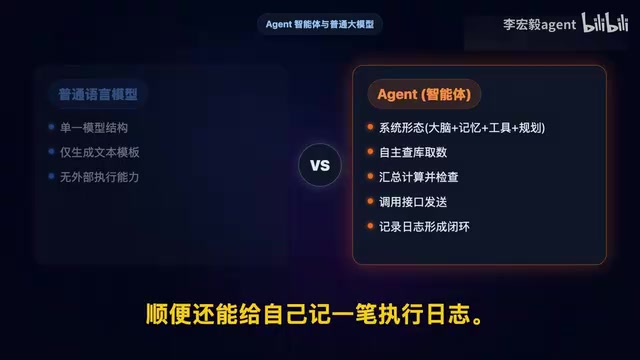
One common misconception to avoid here: an Agent is not a new model with some specific structure, but a system form. What the industry calls an Agent today by default uses a large model as the brain, with memory, tools, and planning modules attached externally.
What Can an Agent Actually Do? An Intuitive Example
Suppose you tell the system: "Go compile this week's sales report and send it to the supervisor."
An ordinary language model would at best generate a text template for the report. But an Agent will query the company database itself, extract data, aggregate and compute, write the report, check for anomalous data, call the email API to send it out, and incidentally log its own execution records.
From receiving the goal to completing a series of actions, this closed loop is the essence of an Agent.
Breaking Down the Six Core Components of an Agent
A complete Agent typically consists of six parts, none of which can be missing:
- Goal: Receive and maintain the task you want it to complete.
- Perception: Acquire external input, such as assembling context and pulling API data.
- Reasoning and Planning: The most central brain component—figuring out how to do it.
- Memory: Remember state across steps, including short-term context and long-term vector stores.
- Action and Tool Calling: Actually affect the external world.
- Feedback Loop: Evaluate results and decide the next step.
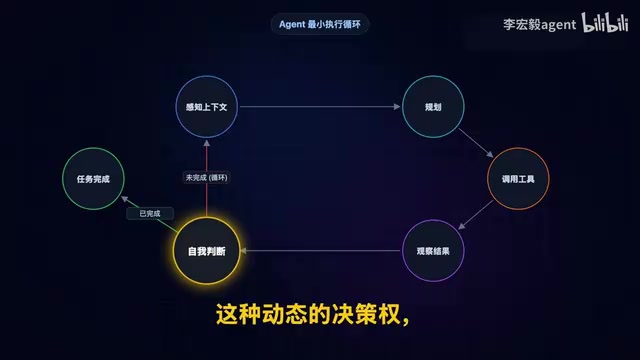
Abstracting these six components gives a classic minimal execution loop: perceive context with a goal → plan → select actions and call tools → observe the results → judge whether it's complete. If not complete, return to the loop and continue.
The key point: "Is this done or not" is judged by the Agent itself, not hard-coded by the programmer in the code. This dynamic decision-making authority is what fundamentally distinguishes an Agent from an ordinary workflow.
The Essential Difference Between Agents and Traditional AI
The "traditional AI" mentioned in interviews generally refers to symbolic AI such as rule engines and expert systems, or traditional machine learning for classification, regression, recommendation ranking, and risk scoring. Their common trait: clear task boundaries, fixed inputs and outputs, and pre-designed behavior paths.
They are strong at single-point capabilities—recognizing faces, calculating conversion rates—but asking them to decompose complex goals and execute them on their own is beyond their reach.
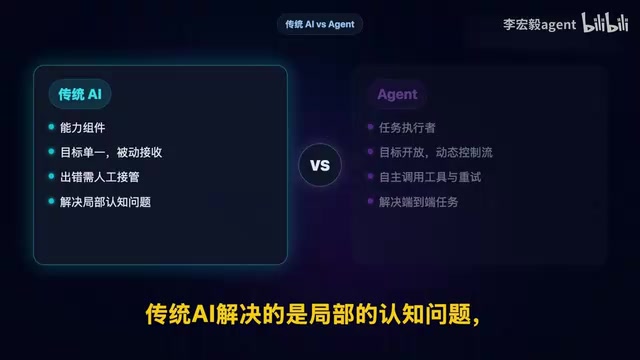
| Dimension | Traditional AI | Agent |
|---|---|---|
| Role | Capability component | Task executor |
| Goal | Single output (label/score/text) | Open, decomposable, iterable |
| Control flow | Statically designed | Dynamically decided at runtime |
| Output | Text or numeric value | Text + actions, changing environment state |
| Fault tolerance | Manual takeover | Self-retry, reflection, strategy switching |
Traditional AI solves local cognitive problems; Agents solve end-to-end tasks—stringing cognition, decision-making, and execution into one seamless chain.
Symbolic AI was the mainstream paradigm in the early days of artificial intelligence. Its core idea is to explicitly represent knowledge using symbols and logical rules and perform deduction through inference engines. Typical representatives include expert systems (such as MYCIN for blood infection diagnosis), logic programming (Prolog), and semantic networks. Its advantages lie in strong interpretability and clear rules, but its bottlenecks are also prominent: difficult knowledge acquisition (requiring domain experts to manually encode rules), inability to handle uncertainty, and difficulty coping with open environments. Traditional machine learning turns to learning statistical patterns from data, covering tasks such as classification, regression, and clustering, with typical algorithms including SVM, random forests, and gradient boosted trees. It far surpasses symbolic AI on perception and prediction tasks, but is likewise confined to well-defined single-step mappings and lacks autonomous planning and multi-step execution capabilities.
Understanding these two technical lineages helps clarify the positioning of Agents: they did not emerge out of thin air, but rather represent a system integration innovation that, after large models acquired general reasoning capabilities, unifies perception, planning, execution, and other links into a dynamic closed loop.
High-Frequency Interview Follow-Ups: Four Boundary Questions
What's the difference between an Agent and a Chatbot?
Chatbots lean toward "saying," with the core being generating natural language replies; Agents lean toward "doing," with the core being getting things done. Of course, if a chatbot comes with tools, memory, and a task loop, it is itself an Agent.
How do you distinguish an Agent from a Workflow?
There is only one criterion: whether the execution path is decided at runtime. Workflow paths are hard-coded, and the large model only works at fixed nodes; an Agent's next step is decided by the system itself based on current observations. Even if you chain multiple large models into a fixed execution chain, as long as there is no dynamic decision-making authority, it doesn't count as an Agent.
Must an Agent be based on a large language model?
Broadly speaking, no. Policy networks in reinforcement learning and robot controllers are broadly considered Agents too. But in the current large-model context, everyone by default refers to the kind where "the large model is the brain." Pointing out this contextual difference in an interview is a plus.

Will traditional AI be replaced by Agents?
No. More commonly, traditional AI gets "wrapped in": vertical capabilities like OCR recognition, recommendation ranking, and risk scoring become tools in the Agent's hands; the Agent is responsible for combining them to complete tasks, while traditional AI is responsible for pushing single-point capabilities to the extreme. The two are layered and complementary.
Agents in Production: Humans Must Be Involved
Many people think an Agent is fully automatic and unattended—that's also a misconception. An Agent that can truly run in production definitely has a human-in-the-loop mechanism: low-risk actions run on their own, high-risk actions require human confirmation, and when uncertain, it proactively asks for help. Being autonomous within appropriate boundaries is the real deployment form of an Agent.
Human-in-the-loop (HITL) refers to a design pattern that retains human intervention and decision-making in automated systems, widely used in high-risk domains such as autonomous driving, medical diagnosis, and financial risk control. In the Agent context, HITL is typically implemented in three forms: approval gating (human confirmation required before executing high-risk actions), exception reporting (the Agent proactively requests human intervention when it judges confidence is insufficient), and process auditing (recording key decision points for human post-hoc review). The core value of HITL lies in constraining the uncertainty risk of Agents within an acceptable range, while continuously optimizing the Agent's decision-making strategy through human feedback. Opposite to HITL are human-on-the-loop (humans monitor but don't approve each point) and fully automatic modes; which to choose depends on the risk level and reversibility of the task.
The Biggest Risk in Engineering Deployment: Safety Boundaries and Observability
When asked about the biggest engineering risk of Agents, the keywords big tech cares most about are safety boundaries and observability. High-frequency risk points include:
- Large model reasoning errors leading to goal drift
- Tool misuse falling into infinite loops, burning through resources
- Unauthorized execution
- Sensitive data entering prompts causing privacy leaks
The stronger the capability, the more the bottom line must be upheld.
Observability originates from cybernetics and in software engineering refers to the ability to infer a system's internal state from its external outputs, typically consisting of three pillars: logs, metrics, and traces. For Agents, observability faces unique challenges: an Agent's decision path is dynamically generated at runtime, unlike traditional services with fixed call chains, so it is necessary to additionally record each step's reasoning process, tool call parameters, intermediate observation results, and decision basis. Common practices include: structured execution logs, step-by-step reasoning traces, Token consumption and latency monitoring, tool call success rate statistics, and real-time alerting of anomalous behavior. An Agent lacking observability is like a black box in production—once goal drift or unauthorized behavior occurs, the troubleshooting cost is extremely high.
Three Criteria to Quickly Judge Whether a System Is an Agent
- Is the goal open—not fixed input/output, but a decomposable, iterable task.
- Is the path dynamically decided at runtime—not a hard-coded flowchart.
- Is there a feedback loop that can handle failures on its own—able to retry, reflect, and switch strategies.
If all three are satisfied, it's a true AI Agent.
The barrier to Agent application development is not the model itself, but how to design goals, tools, memory, and feedback mechanisms. Understanding this system form is more important than memorizing the API of a particular framework.
One-line Summary
An Agent is a system form with a large model as its brain and a dynamic decision-making loop, not a new model.
Paragraph Summary
The article systematically explains the essential definition, core components, and engineering deployment points of AI Agents. An Agent is not a new model but a system form: with a large model as the reasoning brain, externally attached memory, tools, and planning modules, forming a "perception—reasoning—action—feedback" loop around a goal. Its fundamental difference from traditional AI and Workflows lies in runtime dynamic decision-making authority—the execution path is judged by the system itself, not hard-coded by programmers. The article breaks down the six core components of goal, perception, reasoning and planning, memory, action tools, and feedback loop, and clarifies the boundary relationships between Agents and Chatbots, Workflows, and traditional AI through four high-frequency interview follow-ups. At the production deployment level, it emphasizes that human-in-the-loop mechanisms, safety boundaries, and observability are the most critical engineering risks. Finally, it gives three quick judgment criteria: open goal, dynamic path, and a feedback loop that handles failures on its own.
Related articles

T3 Code: The Open-Source AI Coding Assistant's Comeback Story
T3 Code is an open-source AI coding assistant that unifies subscriptions like Codex and Claude, with powerful remote control and parallel task management.

Never Elected, Yet Ruled New York for 30 Years: The Ultimate Case Study in the Mechanics of Power
Robert Caro's biographies reveal how unelected Robert Moses ruled New York for 30 years through legal drafting and public authorities, and how Lyndon Johnson built leverage as a "powerless" Senate Majority Leader. Unpacking the underlying logic of accumulating and sustaining power.

The CPython 3.10 Recursion Trap and Synthetic Recovery in TokenGuard, an LLM Circuit Breaker
TokenGuard's author recounts a recursion crash caused by OrderedDict.pop in CPython 3.10 and introduces v0.3.0's Loop Nudge synthetic recovery, inline DLP scanning, and other new LLM agent circuit-breaker capabilities.