GitHub Daily · Nov 15: The Interface Battle for AI Productivity and Agent Collaboration
Univer open-sources an office engine SDK for AI agents; AG-UI standardizes agent-frontend communication; Tencent's LoopForge orchestrates coding agents.
Today's GitHub Trending highlights the interface battle for AI agents: Univer open-sources an office document engine SDK with explicit AI agent support, gaining nearly 500 stars; AG-UI defines a standardized interaction protocol between agents and frontends; Tencent open-sources LoopForge, a Go-based self-hosted workflow orchestrating multiple coding agents with human approval gates.
GitHub Daily · Nov 15: The Interface Battle for AI Productivity and Agent Collaboration
Today's GitHub Trending list sends a clear signal. AI is stepping out of the chat box. Into documents, into spreadsheets, into the development pipeline. Of the four projects on the list, three revolve directly around the theme of "how humans and agents work together." One is an office suite SDK, one is a communication protocol between frontends and agents, and one is a self-hosted workflow that orchestrates multiple coding agents. The remaining WiFi security audit tool is a small consolation for the pure technologists.
Let's go through them one by one.
dream-num/univer: Handing Over the Foundation of an Office Suite
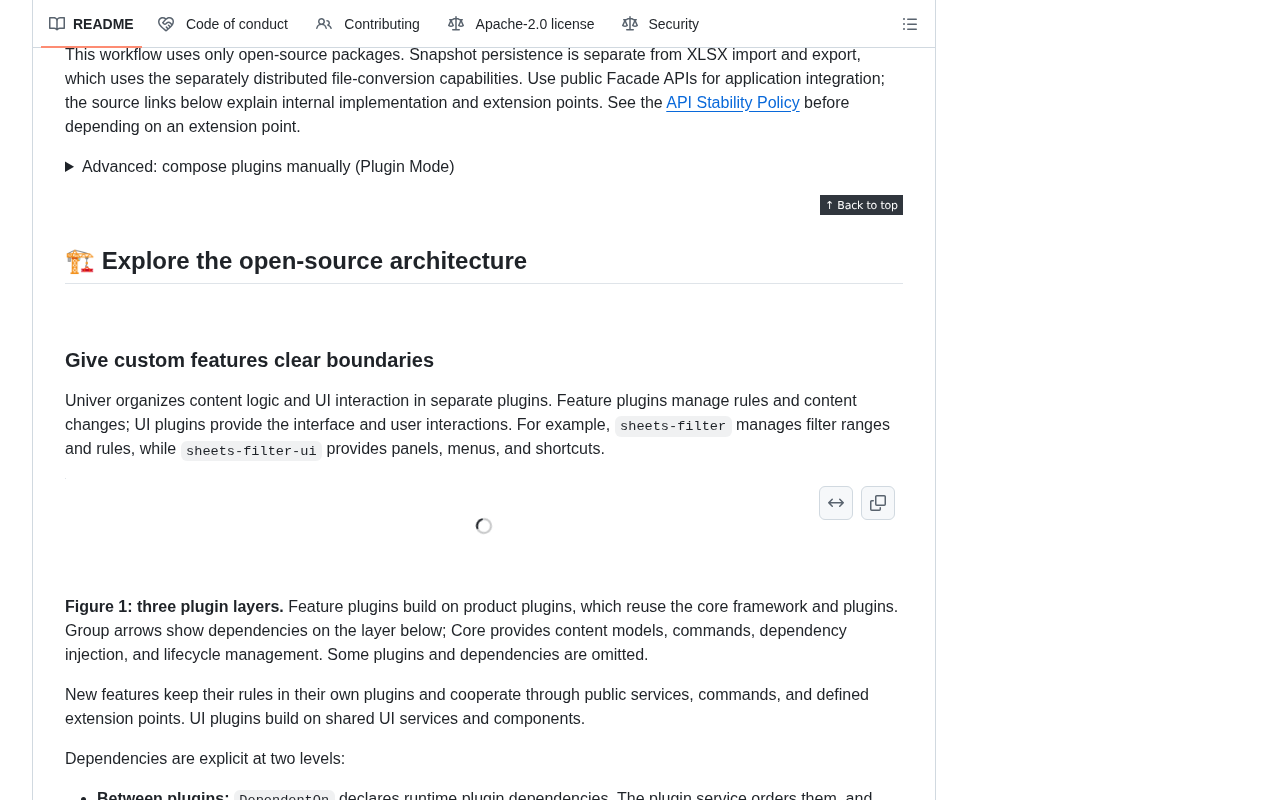
Project positioning: An open-source office document engine SDK. Supports spreadsheets, document editing, collaboration, and file processing.
Problem it solves: In the past, if you wanted to embed a spreadsheet that could calculate formulas into your own product, you either had to integrate a commercial component or grind through the spreadsheet rendering and calculation engine yourself from scratch. The former is expensive, the latter is hard. What Univer does is open-source this foundation layer. More importantly, its description explicitly says "for people and AI agents." That is, from the very beginning of its design, it considered letting agents read and write documents, not just letting humans click a mouse.
Core features: An extensible open-source kernel. The spreadsheet calculation engine, conflict handling for collaborative editing, file format parsing — it handles all the dirtiest, most laborious work. What you get is an embeddable office capability layer.
Use cases: SaaS teams that want to add online spreadsheets to their products. AI application teams that want agents to directly generate and modify a report with formulas. And those building education or financial tools can use it directly as well.
Tech stack: TypeScript. Friendly to the frontend ecosystem, runs in the browser, and is easy to integrate with existing web products. For people comfortable with frontend work, the integration cost is low.
Stars analysis: Over 25,000 stars, up more than 490 today. This scale is not that of a new project, but a daily gain approaching 500 shows it is being discovered by a new wave of users. Most likely, the AI productivity direction has pushed it back into the spotlight. With over 2,300 forks, it is clear that people really are modifying and using it, not just bookmarking it.
ag-ui-protocol/ag-ui: The Handshake Protocol Between Agents and Frontends
Project positioning: An interaction protocol between agents and user interfaces. The goal is to let agent capabilities plug smoothly into frontend applications.
Problem it solves: Right now every company building agents defines its own way of passing messages between frontend and backend. How streaming output is chunked, how tool calls are echoed, how state is synchronized — everyone writes their own. The result is that when you switch agent frameworks, the frontend has to be rewritten. What AG-UI wants to do is standardize this communication layer.
Core features: It defines a protocol, not a framework. That means it is not tied to any single agent implementation. Whichever backend your agent runs on, the frontend can connect to it in the same way. This positioning is somewhat like LSP back in the day, decoupling editors from language services.
Use cases: Teams building agent products, especially those where the frontend needs to display the agent's reasoning process and tool call results. Also platform providers that want to connect multiple agents into the same interface.
Tech stack: TypeScript. The protocol itself is language-agnostic, but the reference implementation and SDK are written in TS, which is friendliest to web frontends.
Stars analysis: Over 17,000 stars, up only nine today. This number is interesting. It shows it has passed its explosive phase and entered a stage of being recognized but growing slowly. Protocol-type projects are often like this: early on they attract a wave of attention through the concept, and later they penetrate the ecosystem gradually. Its value is not in daily growth, but in how many projects actually adopt it.
Tencent/LoopForge: Letting Multiple Coding Agents Queue Up to Work
Project positioning: A self-hosted coding agent workflow orchestration tool. Uses scripts and human approval gates to schedule CodeBuddy, Codex, and Claude Code.
Problem it solves: There are plenty of coding agents now, but getting them to work according to a process is a hassle. You have an agent modify code — who reviews it after the change? How do multiple agents hand off work to each other? The answer is often a human watching over it. LoopForge turns this into a process: automate what should be automated, and set approval gates where humans need to step in.
Core features: Self-hosted — this matters a lot for enterprises, since code never leaves the internal network. Supports orchestrating multiple mainstream coding agents, and comes with local workflows. Human approval gates are its key design, showing it has no intention of letting agents run completely wild.
Use cases: R&D teams with compliance requirements. Teams that want to connect agents into the CI process but dare not go fully automatic. And people using multiple coding assistants at once who want unified scheduling.
Tech stack: Go. Choosing Go for an orchestration service makes sense: simple deployment, strong concurrency handling, and it runs as a single binary.
Stars analysis: Over 1,100 stars, up 33 today. The absolute number is not large, but the relative growth rate is not low. This is a new project, and being from Tencent gives it a credibility boost. Worth watching its adoption going forward.
martin-olivier/airgorah: Doing Security Audits the Earnest Way
Project positioning: A WiFi security audit tool.
Problem it solves: Assessing wireless network security requires handy tools. This project makes the audit process more orderly, suitable for checking your own network within the scope of authorization.
Core features: Written in Rust, which means memory safety is guaranteed. For security tools, the tool itself must not become a vulnerability — this is crucial.
Use cases: Enterprises conducting internal wireless network security checks, and security researchers doing assessments in authorized environments.
Tech stack: Rust. In recent years, the migration of security tools to Rust has been a clear trend, wanting both performance and safety.
Stars analysis: Over 6,000 stars, up 270 today. This is the second-highest daily gain on today's list. It shows that the foundation for security tools is very stable, and the demand has always been there.
Today's Common Trend: The Interface Layer Is Becoming the Battleground
Looking at the first three projects together, a line emerges. Univer solves "what agents can operate on," AG-UI solves "how agents talk to the interface," and LoopForge solves "how multiple agents are scheduled." The three projects sit at the capability layer, the communication layer, and the orchestration layer, respectively.
This says one thing. Competition in model capabilities themselves has entered a plateau, and everyone's attention has turned to how to truly embed agents into workflows. Whoever can define the interface can secure a position in the ecosystem. The fact that a protocol-type project like AG-UI, with a daily gain of only nine, is still on the list precisely shows that the list looks not only at growth rate but also at long-term value.
Another small trend is Rust's presence in security tools. Airgorah's daily growth data shows that demand for this kind of tool is stable and real.
Today's Must-See TOP 3
First, dream-num/univer. If you want to add office capabilities to your product, or want agents to directly read and write documents, this is a rare mature open-source choice. A daily gain of over 490 shows it is being rediscovered.
Second, ag-ui-protocol/ag-ui. If you are building an agent product and your frontend has to be rewritten every time you switch frameworks, this protocol is worth studying. Its value lies not in today's popularity, but in the future ecosystem.
Third, Tencent/LoopForge. If you want to connect coding agents into your team's process but dare not go fully automatic, take a look at its approval gate design. Being self-hosted is very practical for enterprises.
Outlook
For some time to come, I expect to see more "agent workflow" projects emerge. A single agent is no longer enough to impress; how to get multiple agents to collaborate, and how to let humans step in at key nodes — these are the problems that really need to be solved for actual deployment. Today's list is, in a sense, a collective debut for this direction.
One-line Summary
Univer open-sources an office document engine as an SDK with explicit support for AI agents to read and write documents, gaining nearly 500 stars today; AG-UI defines an interaction protocol between agents and frontends, attempting to solve the coupling between agent frameworks and frontends; Tencent open-sources LoopForge, a Go-based self-hosted workflow that orchestrates multiple coding agents with human approval gates.
Related articles

No Coding Required: He Shipped an App Store App by 'Cutting Features' and Nitpicking with AI
A game designer with zero frontend/backend skills shipped a dual-platform App Store app with AI—not via one-click generation, but by cutting scope and nitpicking like a demanding client.

What Is Harness Engineering? From Concept Origins to Enterprise-Level Agent Implementation
What is Harness Engineering? This article traces the concept's origins and analyzes enterprise-level Agent requirements for tool call fault tolerance, data security, tenant isolation, and memory gaps.
Coze in Practice: A Three-Tier Agent Classification and a Multi-Agent Collaboration Guide
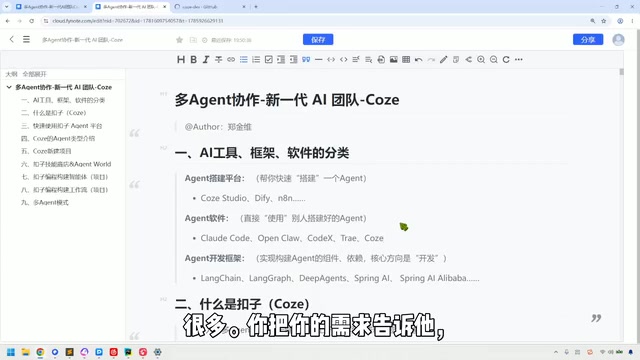
A Bilibili tutorial breaks down the multi-agent collaboration toolchain into three categories: building platforms like Coze Studio and Dify, Agent software like Claude Code, and development frameworks like LangChain—plus a Coze demo of industry templates, three-platform interoperability, local Agent integration, and the trade-offs of credit consumption.