GitHub Octoverse 2026: AI Agent Engineering Drives Explosive Growth in Commit Volume

All three core GitHub metrics hit record highs in 2026, with agentic engineering driving a structural shift in the development paradigm.
The 2026 Octoverse report announced at GitHub Universe shows 220M monthly merged PRs, 7.38B commits, and 30.3M new repositories, with all three metrics surging almost vertically in 2026—merged PRs and commits tripling in under a year. GitHub attributes this to "agentic engineering"—AI coding agents integrated into workflows at scale. The report also introduces LLM-based country classification, NAICS industry categorization via a fine-tuned embedding model, and new interoperability/reverse-engineering repo stats, while questions about code quality, misclassification risk, and developer skill shifts remain open.
Three Core Metrics Hit Record Highs, AI Agents Emerge as Key Driver
At this year's GitHub Universe conference, GitHub EVP Jay Parikh unveiled the core data from the 2026 Octoverse report. Three side-by-side line charts vividly illustrate the platform's surging activity: monthly merged PRs reached 220 million, monthly commits hit 7.38 billion, and monthly new repositories totaled 30.3 million.
All three trends move in remarkable lockstep—growing relatively steadily between 2023 and 2025 before surging almost vertically in 2026. According to Simon Willison, a well-known figure in the developer community and on-site observer, who documented the event on his personal blog, this growth pattern "clearly reflects the impact of agentic engineering on GitHub."
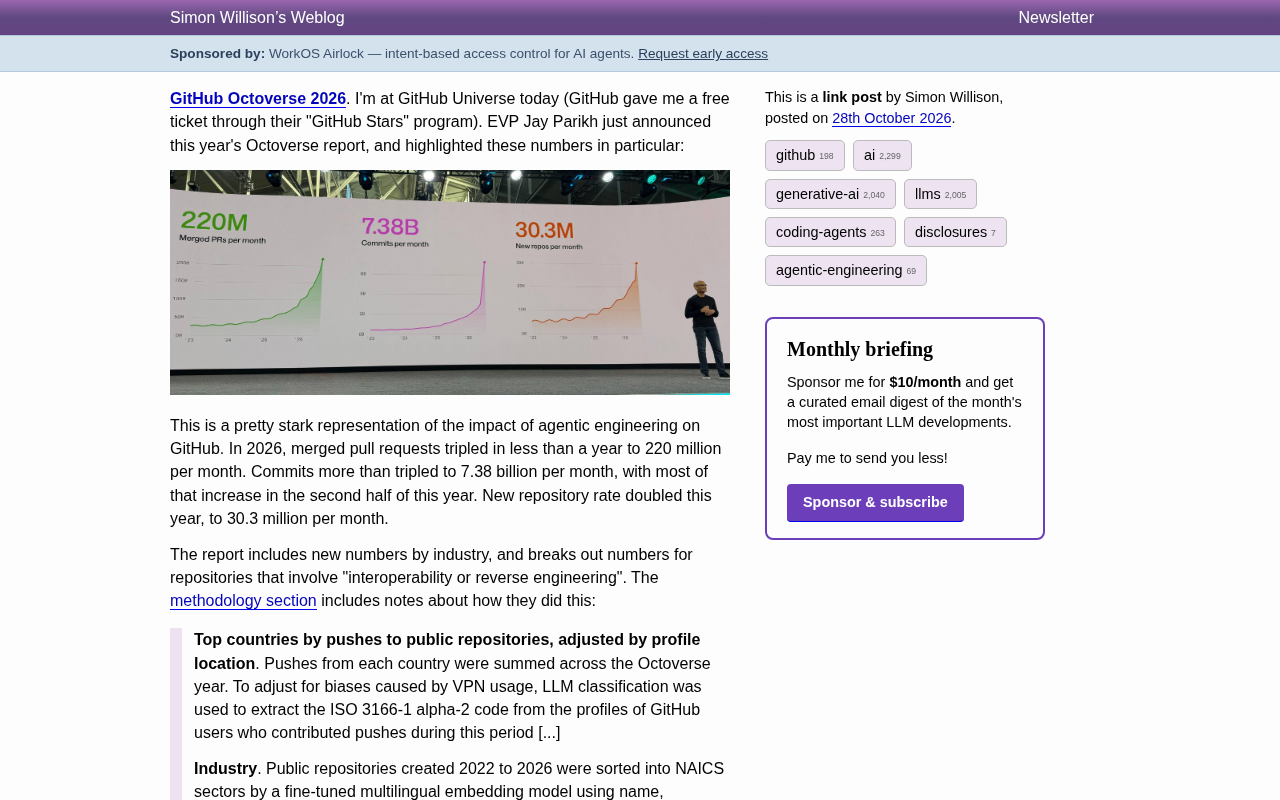
Specifically, the number of merged PRs tripled in less than a year, commit volume grew by more than threefold as well—with most of the increase concentrated in the second half of the year—and the rate of new repository creation doubled over the same period. This synchronized explosion is not attributable to any single factor but is a direct manifestation of AI coding agents being integrated into development workflows at scale.
The Methodology Behind the Numbers: LLM-Assisted Classification and Industry Breakdown
This year's Octoverse report introduces more granular analytical dimensions. In its methodology section, GitHub disclosed several data-processing details—adjustments that themselves reflect the platform's expanding data scale and growing complexity.
When tallying public repository pushes by country, the team used an LLM classification model to extract ISO 3166-1 alpha-2 country codes from user profiles to correct for VPN-related bias. The industry dimension relies on a fine-tuned multilingual embedding model that categorizes public repositories created between 2022 and 2026 into NAICS sectors based on name, description, topics, and README, with random samples drawn each year for analysis.
Another notable dimension is the tally of repositories related to "interoperability or reverse engineering." GitHub identifies such projects through keyword matching—including terms like clean room implementation, drop-in replacement, and protocol reimplementation. The emergence of this category hints that AI agents are being used for more complex system-level tasks beyond code generation.
NAICS (North American Industry Classification System) is a standard industry classification system jointly developed by the United States, Canada, and Mexico. It uses a 2- to 6-digit hierarchical code, refining from sectors (such as manufacturing and information) down to specific industries. GitHub maps public repositories to the NAICS sector level to obtain a coarse-grained industry distribution that can be compared against official economic statistics, in the absence of repository-level industry labels. It should be noted that this text-based classification—relying on repository name, description, topics, and README—is essentially a weak-supervision inference: a single repository may span multiple sectors, and an open-source project's use case does not necessarily equal its maintainer's industry. Conclusions drawn from this dimension are therefore better suited to observing trends than to precise measurement.
The Real Impact of Agentic Engineering: From Numbers to a Shift in the Development Paradigm
Behind the threefold growth curves lies a structural transformation of the development paradigm. Traditionally, growth in PRs and commits has an approximately linear relationship with the number of developers and project complexity. But the 2026 data shows this correlation is being broken.
AI agents can autonomously complete the entire loop from code generation and testing to submitting a PR, significantly raising the output ceiling of an individual developer. The concentrated surge in commits during the second half of the year aligns closely with the capability iteration cycles of mainstream AI coding tools. When agents can reliably handle multi-step tasks, developers tend to delegate repetitive, pattern-based work—producing more mergeable changes in the same amount of time.
The doubling of new repositories points to another phenomenon: the cost of trial and error has dropped sharply. Developers can more easily launch experimental projects because AI agents can handle the initial scaffolding and baseline code. This "low-friction startup" model may be changing the lifecycle of open-source projects—dramatically shortening the path from idea to a runnable prototype.
Agentic engineering is a paradigm upgrade relative to traditional "AI-assisted programming." In the assisted mode, LLMs intervene in the form of code completion and single-function generation, with human developers still the primary agents of task decomposition and workflow control; agentic engineering, by contrast, emphasizes AI agents with planning, tool-calling, and self-correction capabilities autonomously completing the multi-step loop from understanding requirements to submitting code. Its technical foundations typically include ReAct-style reasoning-action loops, tool interfaces such as function calling or MCP, sandboxed execution environments, and test-feedback-driven iteration mechanisms. This model pushes the developer's role from "writing line by line" toward "defining tasks and validating results," and it is the key backdrop for understanding the non-linear growth in GitHub commits and PRs in 2026.
The Boundaries of Data Interpretation and Open Questions
While the growth data is striking, several key questions remain unanswered. First, does the large volume of agent-generated commits deliver a proportionate amount of substantive value? A rise in merged PRs does not directly equate to improved code quality—the review burden may also grow accordingly.
Second, the statistical methods for industry classification and interoperability repositories themselves rely on AI models, carrying a risk of misclassification. GitHub candidly acknowledges these limitations in its methodology but does not provide quantitative estimates of the error range. For teams hoping to make decisions based on Octoverse data, understanding the boundaries of these statistical definitions is crucial.
Finally, the impact of agentic engineering on developers' skill structures is not yet reflected in the report. As the mechanical aspects of coding are absorbed by agents, the core value of human developers will shift more toward system design, requirement decomposition, and result validation—and the speed and depth of this shift may define the next stage of the development ecosystem more than the commit numbers do.
ISO 3166-1 alpha-2 is the two-letter country/region code defined by the International Organization for Standardization (e.g., US, CN, DE), widely used for geographic identification. GitHub previously tallied pushes based on users' self-reported locations, but VPNs and proxy tools cause large volumes of traffic to appear as originating from a handful of network-export countries, distorting the geographic distribution. Switching to LLMs to infer country codes from profile text amounts to replacing a single field with semantic cues, which can partially mitigate the problem; however, its accuracy depends on profile completeness and model judgment, and systematic bias remains for users with missing or deliberately obfuscated profiles—one reason the report does not quantify the error.
One-line Summary
All three core GitHub metrics hit record highs in 2026, with agentic engineering driving a structural shift in the development paradigm.
Paragraph Summary
The 2026 Octoverse report, announced at GitHub Universe, shows the platform reaching 220 million monthly merged PRs, 7.38 billion commits, and 30.3 million new repositories, with all three metrics surging almost vertically in 2026—merged PRs and commits tripling in less than a year. The report attributes this to the impact of "agentic engineering"—AI coding agents being integrated into development workflows at scale. On methodology, GitHub introduced LLM classification to correct national data bias, a fine-tuned embedding model for NAICS industry categorization, and new statistics on interoperability/reverse-engineering repositories. The article also notes that the link between commit growth and code quality, the misclassification risk of the classification models, and the shift in developers' skill structures remain open questions.
Related articles

Gemini 4 Carbon Tops Global Rankings as AI Productivity and Open-Source Ecosystems Surge
Google DeepMind's Gemini 4 Carbon tops global benchmarks, built for complex agents and system security. ByteDance launches Doubao Work integrated with Feishu, Anthropic's AI autonomously breaches 5 system-level attack chains, and ModelBest and Fudan open-source on-device multimodal and image generation models.

Overseas Creator Breaks Down N8n AI Agent Business Playbook: From Tooling to Monetization
An overseas creator breaks down the N8n AI agent business playbook: comparing Zapier, Make, and N8n, detailing four monetizable automation categories—lead capture, WhatsApp follow-up, booking, and content pipelines—plus agency pricing and a sales playbook.

Empacer: The Voice-First AI Assistant for Small Business Owners That Topped Product Hunt
Empacer is a voice-first AI assistant for small business owners: three-question setup, voice requests turned into customer replies, social posts, and invoices—all owner-approved. It won #1 Product of the Day on Product Hunt with 231 upvotes and 47 comments.