GitHub Trending: 7-Step Agent Skill Pack for AI Startups
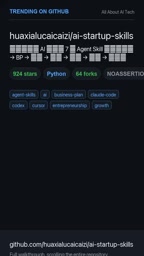
An open-source project uses 7 Agent Skills and a router to guide one-person AI companies from validation to registration.
The GitHub project huaxialucaicaizi/ai-startup-skills gained about 900 stars in 20 days, now at 924. It implements 7 Python Agent Skills for one-person AI startups, using a router to connect idea validation, pricing, and company registration with synchronized outputs—an orchestrated pipeline, not isolated tools. Growth signals rising demand for process tools, but trending attention isn't usability: code quality and real cases aren't shown, and registration involves regional compliance, so treat it as a checklist and starter template.
Can One Person Run an AI Company? This Open-Source Project Wants to Help You Through Seven Steps
A project called huaxialucaicaizi/ai-startup-skills has been gaining traction on GitHub recently. According to the daily trending repository broadcast on the YouTube channel "All About AI Tech," it picked up 900 stars in 20 days and currently shows 924 stars. The project's positioning is straightforward: it provides a set of Python-written Agent Skills for one-person AI startups, stringing together the process from idea validation to company registration.
This broadcast comes from a channel that recommends trending repositories daily. The information density isn't particularly high, but the point is clear—it solves the problem of "one person building an AI product with no one managing the process."
The Seven-Step Skill Pack: What's Actually Inside
According to the broadcast, the project offers 7 agent skills aimed at "one-person AI companies," implemented in Python. The core design is a router that guides the stages and synchronizes the output of each step from validation to pricing. In other words, it's not seven isolated tools but a pipeline with orchestration: whichever step you're on, the router directs you to the corresponding skill, and the output of the previous step becomes the input of the next.
The broadcast's original wording mentions "streamlines startup workflows from validation to registration"—from validation to registration, which basically covers the most trivial early-stage stretch of a micro startup. For indie developers, writing code isn't the hardest part; the hard part is validating demand, writing a business plan, pricing, and registering—all the non-engineering steps.
Agent Skill and Router Orchestration Mechanism
An Agent Skill refers to a reusable module that encapsulates specific task logic, usually existing as a function or class that receives structured input and returns structured output. What distinguishes it from an ordinary function library is that a Skill often carries explicit trigger conditions and context dependencies, making it easy for an upper-layer scheduler to select automatically. A Router, meanwhile, is a decision layer: based on the current stage, existing outputs, and user intent, it dispatches requests to the corresponding Skill. This "Router + multiple Skills" pattern has similar implementations in agent frameworks like LangChain and AutoGen. The benefit is that each step is decoupled and easy to replace individually; the cost is that once the Router's decision logic is off, the entire pipeline goes off track. The "output synchronization" mentioned in the article is precisely the key—the output of the previous step must conform to the input contract of the next, otherwise no matter how accurate the Router is, it can't connect them.
900 Stars in 20 Days: What This Growth Rate Says
A growth rate of 900 stars in 20 days isn't explosive by GitHub standards, but in the relatively cold "startup tools" category it stands out. According to the broadcast, the project currently has 924 stars.
A detail worth noting is the demand signal behind the star growth: solo founders plus AI agents is a combination that has clearly been heating up over the past two years. The more mature the toolchain, the more willing indie developers are to try going it alone—which in turn creates demand for "process-oriented skills." This project sits right at that intersection.
The Logic of Combining Solo Founders and AI Agents
A one-person company refers to a business entity operated independently by a single founder with no employees, commonly seen among indie developers, content creators, and micro-SaaS entrepreneurs. Traditionally, one-person companies are limited by an individual's time and breadth of skills, with marketing, legal, and finance all needing to be outsourced. The maturation of AI agents has changed this constraint: repetitive, process-oriented work can be handed off to agents, leaving the founder to make judgments and decisions. The backdrop for this combination heating up is the gradual standardization of the agent toolchain (model invocation, tool orchestration, memory management), which has greatly lowered the cost of building. A new pain point has emerged on the demand side—not a lack of individual tools, but a lack of an orchestration layer that strings tools into a process. That's exactly why "process-oriented skill" projects are getting attention.
A Sober View: Trending Doesn't Equal Productivity
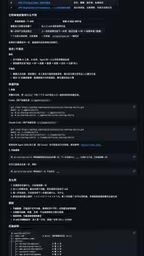
A little cold water is in order. The broadcast itself doesn't show code quality, the specific implementation details of the skills, or real-world use cases. 924 stars indicates attention, not usability. The biggest pitfall of projects like Agent Skills is that "the demo runs smoothly, but real operation is fragmented"—whether the input/output formats of each step are stable and whether the router's decision logic holds up in real scenarios both need to be verified hands-on.
Another observation: the seven steps include "registration," which involves compliance differences across regions. A generic skill can hardly cover all jurisdictions, so in practice you'll most likely need to add your own localized content.
For indie developers, a reasonable expectation is to treat it as a process checklist and a starting template rather than an out-of-the-box startup pipeline. Run your own idea through the router first, see which step gets stuck, and then decide whether to dig deeper into the corresponding skill—that may be a more pragmatic approach than simply forking it.
The Signal Value and Limits of GitHub Stars
GitHub Stars are users' bookmarking actions on a repository, reflecting "interest" rather than "usage." Trending is ranked by recent star growth rate, so it's easily amplified by external events like social media coverage and channel recommendations, forming short-term pulses. For startup-tool repositories, high stars with low usage is common: the concept is appealing, but actually running the process through requires time investment, and most bookmarkers stop at browsing the README. To evaluate such a project, more reliable signals include real issues in the issue tracker, PR merge activity, whether there are runnable examples and tests, and whether the release cadence is sustained. Judging usability by star count alone makes it easy to overestimate a project's maturity.
One-line Summary
An open-source project uses 7 Agent Skills and a router to help one-person AI companies walk through the process from validation to registration.
Paragraph Summary
The GitHub project huaxialucaicaizi/ai-startup-skills gained about 900 stars in 20 days and currently has 924 stars. It implements 7 Agent Skills in Python for one-person AI startups, using a router to connect the process from idea validation and pricing to company registration, synchronizing the outputs of each step to form an orchestrated pipeline rather than isolated tools. The article argues that its growth rate reflects rising demand among indie developers for process-oriented tools, but also cautions that trending attention doesn't equal usability: the project hasn't demonstrated code quality or real-world cases, and the registration step involves regional compliance differences. It recommends treating it as a process checklist and starting template rather than an out-of-the-box startup pipeline.
Related articles

Hands-On with Shopify AI Toolkit: Official Validation for AI-Generated Shopify Code
Hands-on with Shopify's official AI Toolkit: connect Shopify docs, API schemas, and code validation to Claude Code and other coding assistants to intercept AI-fabricated fields. Installation steps, offline validation, and telemetry-on-by-default warnings.
Claude Orchestrating an AI Coding Team: A Practical Analysis of Agent Orchestrator
The open-source Agent Orchestrator lets Claude Code dispatch Codex, Gemini, Cursor and more for parallel AI coding, with Git Worktree isolation, CI auto-correction, and mobile notifications for AI team collaboration. This article analyzes its core mechanisms, cost structure, and use cases.

Google's New AI Coding Model Beats Claude at One-Third the Cost
Google's Gemini 4 Carbon edges past Claude Fable 5.2 Max on CursorBench 4.0 at 60.4% vs 60%, costing just $9.22 per task versus $32.79—about one-third.