Give Your Product a 'Quirky-Cute Compendium': An Identity and Incentive System for Small-User Products

Small products can use "unique nickname + avatar" and dress-up blind boxes to boost activity and retention at low cost.
The article introduces a Bilibili creator's "identity + incentive" scheme for small-user products: assigning each user a unique nickname-and-avatar combination to replace meaningless UIDs, making leaderboards and user data more vivid; daily login dress-up blind boxes and free outfit switching give users a reason to return. Built on combinations of characters, colors, outfits, and mood accessories—about 20-30k assets cover under 10k users—it also supports generating pet avatars. Daily active users rose from 15 to 28 after launch (small sample, weekend factor). The author stresses blind boxes are only auxiliary for retention.
Why Small Products Need a Human-Feeling Identity System
According to a Bilibili creator, if your product has fewer than ten thousand users, it's highly recommended to add an "identity + incentive" combo feature. It essentially solves two problems: first, giving anonymous users a human-feeling identity marker; second, providing a dress-up and incentive system to boost activity and retention.
A traditional UID is a string of digits that users can't remember and you can't distinguish. The creator's design instead assigns each user a unique nickname and corresponding avatar—every avatar-and-nickname combination is unique. This identity can be used to store users' learning data, personal behavior tracking, and more.

In the creator's product there's a leaderboard. If it showed only garbled characters, the leaderboard would be meaningless; now every user has a vivid avatar, complete with a little feedback when clicked, and the nickname is assigned by the system rather than chosen by the user.
UID (User Identifier) is a unique numeric identifier assigned to users by the system, typically a string of incrementing or random digits like "10086." Its design goal is uniqueness and indexability, not readability. As a result, users can neither remember their own UID nor identify others by UID. In scenarios like leaderboards and comment sections, pure numeric UIDs make the interface feel mechanical and devoid of personality. The alternative proposed in the article is to assign each user a unique "nickname + avatar" combination—essentially shifting the identity marker from "machine-readable" to "human-readable," reducing the cost of recognition between users while providing a more emotionally attached carrier for subsequent dress-up, social interaction, and data ownership. This approach is highly feasible in small products because the combination space (nickname pool × avatar pool) is sufficient to cover a user base of under ten thousand without duplication.
Dress-Up Blind Boxes: Giving Users a Reason to Come Back Every Day
The second capability of this system is incentives and dress-up. Users can claim a dress-up blind box each day they log in—for example, drawing a color that lets them recolor their "little eagle." Users can also switch outfits according to their mood without the hassle of picking a name.
The creator expects this mechanism to enhance product activity and retention to some extent, but long-term retention clearly can't rely on this system alone—it's more of an extra reason to stay in the product and a memorable hook.
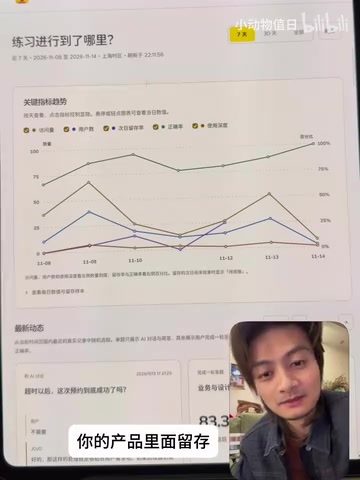
In terms of results, the creator mentioned that daily active users were 15 before the feature launched and rose to 28 after, though that day was a weekend and people not using it much is normal. The sample is small, but at least it suggests the direction is worth trying.
The blind box mechanism originates from the "random draw" consumption model of the designer toy industry, whose core psychological driver is variable reward. In behavioral design, intermittent, unpredictable positive feedback is more likely to form habit loops than fixed rewards—users don't know what color or accessory they'll draw tomorrow, and this sense of anticipation constitutes the motivation for daily login. Compared with check-in for fixed points, the randomness of blind boxes makes each claim feel fresh, while costs remain controllable because the prize pool is a pre-designed set of limited assets. It's worth noting that the effect of blind box mechanisms on retention is usually concentrated in short-term activity boosts; without follow-up collection goals, rarity tiers, or social display scenarios, users' novelty tends to fade quickly. The author also explicitly states that long-term retention cannot rely solely on blind boxes, which aligns with common industry understanding.
The Logic of Combinatorial Asset Volume and Pet Customization
Why is this recommended for products with under ten thousand users? The creator explains that the current number of asset combinations is roughly twenty to thirty thousand, composed of characters, colors, outfits, and mood accessories. The asset volume isn't large—a few dozen of each type.
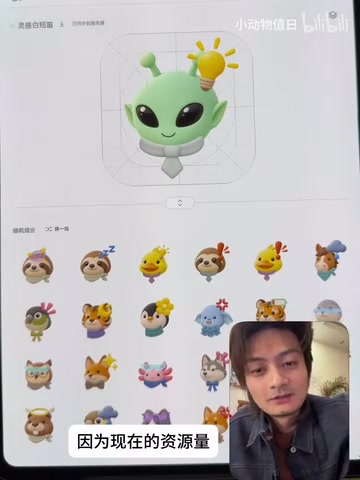
More importantly, you can generate your own assets based on this set or expand it further. Cats, dogs, and the two birds the creator keeps can be generated in various colors and breeds, basically covering the pet types people commonly keep. Users love putting their own pets up there—this really resonates—and the creator mentioned that two colleagues have already set their avatars to their own pets.
Combinatorial asset generation is a design method that produces a large number of differentiated avatars from a small set of base assets through combination rules. Suppose there are 20 characters, 30 colors, 40 outfits, and 10 mood accessories; the theoretical number of combinations reaches the 240,000 range. Even accounting for visual plausibility and deduplication, the actual usable combinations still number in the tens of thousands. The advantage of this method is that art cost and combination space relate multiplicatively rather than additively: adding 10 new colors creates new pairing possibilities for all existing characters and outfits. For small teams, this means a few dozen base assets can support the perception that "every user's avatar is different." The article mentions the current combination count is about twenty to thirty thousand, which恰好 covers a user base of under ten thousand with redundancy, while also supporting the generation of pet variants like cats, dogs, and birds from the same asset set, further amplifying the personalization space.
Extended Gameplay: From Virtual Pets to "Speaking on the User's Behalf"
The creator also proposed more gameplay ideas: users who stay in the leaderboard's top three each day can receive an extra dress-up blind box; loyal users who report bugs or offer suggestions get bonus dress-up blind boxes. The creator immediately added three dress-up blind boxes for themselves and saw new outfits after refreshing their profile page.

A more interesting idea is to give outfits personality traits. For example, a tie represents "old-school forward," black represents "cool and aloof," and paired with an animal avatar, the character can "speak on the user's behalf"—for instance, "Your meme game really puts me at ease," or be set as calm and opinionated. Users can even converse with it, asking things like "Can someone with assets at A3 level like me spend with ease?" and it will chat back. This avatar can serve as both a virtual pet and a way for users to express their attitude.
The system is called "Quirky-Cute Compendium" and can currently be found on GitHub.
Virtual pets are a digital avatar product form centered on nurturing and companionship, with early representatives like Tamagotchi, later evolving into desktop pets and in-app virtual avatars. Their retention logic lies in the sunk cost and attachment formed by the time and emotion users invest in the avatar, raising the psychological barrier to leaving the product. The advanced form envisioned in the article is to give outfits "personality tags" (e.g., tie = old-school forward, black = cool and aloof), enabling the avatar to express attitudes on the user's behalf and support conversational interaction. This effectively transforms the virtual pet from "an object to be cared for" into "the user's spokesperson," approaching the idea of an AI personified agent. The implementation barrier depends on whether the conversational capability is preset scripts or an integrated large model; if the latter, the avatar's personality settings can serve as part of the system prompt, so different outfits correspond to different tones and stances, creating a strong personalized experience at low cost.
Practical Advice for Small Product Teams
The core value of this approach isn't technical complexity but creating differentiated user perception at low asset cost. For products with a still-small user base, rather than pursuing a large and comprehensive user system, first making each user "seen"—with an exclusive avatar, a changeable outfit, and a bit of daily login anticipation—may be a more pragmatic starting point. The creator also admits that long-term retention can't rely on blind boxes, but as a memorable hook and auxiliary means of activity, it's worth trying in early-stage products.
One-line Summary
Small products can use "unique nickname + avatar" and dress-up blind boxes to boost activity and retention at low cost.
Paragraph Summary
The article introduces a Bilibili creator's "identity + incentive" scheme for small-user products: assigning each user a unique nickname-and-avatar combination to replace meaningless UIDs, making leaderboards and user data more vivid; meanwhile, daily login dress-up blind boxes and free outfit switching give users a reason to return. The scheme relies on combinations of characters, colors, outfits, and mood accessories—about twenty to thirty thousand assets suffice to cover under ten thousand users—and supports generating pet avatars like cats, dogs, and birds. After launch, daily active users rose from 15 to 28 (small sample, weekend factor included). The author emphasizes that blind boxes can only be an auxiliary retention tool and long-term retention needs other support, and envisions extended gameplay like leaderboard rewards, feedback gifts, outfit personification, and conversation. The system is called "Quirky-Cute Compendium" and is available on GitHub.
Related articles
Codex in Practice: From Installation and Configuration to Multi-Agent Collaboration
Based on a Bilibili Codex course overview, this guide maps the full path of AI coding assistants from installation and agents.md context design to CLI commands, MCP integration, and multi-agent collaboration.

Claude Code Installation and Model Switching Guide for Users in China
How can developers in China install Claude Code reliably? This article compiles a Bilibili creator's hands-on solution: install via NPM, skip official login, use CC Switch to configure API Keys and freely switch between DeepSeek, Kimi, and other models to avoid account bans.
AI Supply Chain Security: What Canary Tokens Reveal
Starting from a Hacker News discussion, this article analyzes the role of canary tokens in AI supply chain security: how they detect abnormal access to model weights, training data, and credentials, as well as coverage blind spots and cost constraints during implementation.