Glutra: A Multi-Agent Collaborative Desktop App for Building Your AI One-Person Company

Glutra is a multi-agent desktop app that lets individuals orchestrate AI employee teams to complete complex tasks.
Glutra is a cross-platform multi-agent desktop application that enables users to batch create AI employees and orchestrate them through visual organizational structures and workflows. It supports any CRI (such as Codex) and offers templated company architectures, real-time monitoring, node-level fine-tuning, and multi-project concurrent execution. By introducing human-in-the-loop checkpoints, it addresses loss-of-control issues in multi-agent systems, turning the "one-person company" vision into a practical, tool-based product.
What is Glutra: A Desktop App for Multi-Agent Collaboration
The concept of a "one-person company" is shifting from vision to reality. Glutra is a multi-agent desktop application that has recently been gaining attention. It allows users to create multiple AI employees and orchestrate them through organizational structures and workflows to collaboratively complete complex tasks.
Technical Background of Multi-Agent Systems: Multi-Agent Systems (MAS) represent an important research direction in artificial intelligence, referring to computational frameworks where multiple autonomous intelligent agents work together to accomplish complex tasks. Each Agent possesses independent perception, decision-making, and execution capabilities, achieving collaboration through communication protocols and task allocation mechanisms. In recent years, as Large Language Model (LLM) capabilities have advanced dramatically, LLM-based multi-agent systems have moved from academic concepts to engineering practice, with frameworks like AutoGen, CrewAI, and LangGraph emerging in succession—signaling that this field has entered a rapid deployment phase. What Glutra does is package this complex infrastructure, which previously required engineers to build, into a desktop product that ordinary users can use directly.
Glutra supports Windows, MacOS, and Linux, and can connect to any CRI (such as Codex), providing individual developers and small teams with a complete multi-agent collaborative solution.
About CRI: CRI (Coding Runtime Interface) is an interface specification that encapsulates AI model capabilities into callable execution environments, similar in concept to CRI (Container Runtime Interface) in the container domain. OpenAI Codex is a representative implementation—it's built on GPT-series models with specialized optimization for code understanding and generation, capable of interpreting natural language instructions and outputting executable code. By abstracting the CRI layer, Glutra makes the underlying AI capabilities swappable, avoiding vendor lock-in. This aligns with the "program to interfaces" design philosophy in cloud-native architecture.
Core Feature: Batch Creation of AI Employees
Glutra's most intuitive feature is the ability to create a large number of AI employees at once. In the demo, the developer directly created 20 AI employees, each capable of executing tasks independently. Users can choose different CRIs as the underlying capability layer—for example, selecting Codex to power these AI employees for programming-related work.
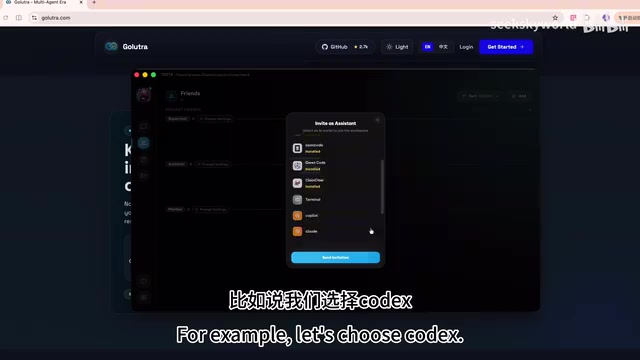
This batch creation capability means a single person can own a complete "digital team" covering development, testing, documentation, and other roles—truly realizing the operational model of an AI one-person company.
The Era of the "One-Person Company": The "Solo Company" concept has been frequently discussed by Silicon Valley investors like Sam Altman since around 2023. The core thesis is that the maturation of AI tools will enable individual entrepreneurs to accomplish workloads at extremely low cost that previously required teams of dozens. The technical pillars supporting this trend include: code generation tools (GitHub Copilot, etc.), automated testing, AI customer service, and multi-agent collaborative systems. The multi-agent desktop application that Glutra represents is a concrete attempt to turn this vision into a practical tool.
Organizational Structure and Workflow Orchestration
Templated Company Architecture
Glutra provides a template page where users can directly view preset company organizational workflow structures. These templates display the collaborative relationships and task flow paths between different roles. Beyond using ready-made templates, users can also customize workflows and organizational structures to flexibly adapt to different project requirements.
Technical Principles of Workflow Orchestration: Workflow Orchestration has a long history in software engineering—from early BPEL to modern tools like Apache Airflow and Temporal—with the core goal of decomposing complex business processes into nodes and edges within a Directed Acyclic Graph (DAG). In AI Agent scenarios, the orchestration layer must additionally handle the uncertainty of LLM calls, side effects of tool invocations, and state synchronization between multiple Agents. Glutra hides this complexity behind a visual organizational chart, essentially performing a semantic mapping between DAG orchestration paradigms and enterprise organizational structures, enabling non-technical users to intuitively understand task flow logic.
One-Click AI Team Deployment
After selecting a workflow template, Glutra immediately generates the corresponding AI employee team. Each employee has clearly defined responsibilities and begins collaborative work according to the preset process. In the demo, after clicking "Use Workflow," multiple AI employees quickly enter working status, with status lights turning yellow to indicate task execution.

Real-Time Monitoring and Node-Level Fine-Tuning
Transparent Execution Process
One of Glutra's most powerful features is its real-time monitoring capability. Users can click on any member's avatar to directly view the command-line content that AI employee is currently running. This transparency gives users a clear picture of the entire workflow's execution status, eliminating the frustration of "black box" operations.

Node-Level Fine-Tuning
More critically, users can fine-tune any sub-node, adjusting the workflow's execution direction in real time. You don't need to wait until the entire process finishes to discover problems—you can intervene, correct, and optimize at any point during execution. After closing the terminal window, tasks continue running in the background without interruption.
Why Controllability Matters So Much: The "loss of control" problem in multi-agent systems is one of the core challenges in current engineering practice. Because LLM outputs are inherently stochastic, errors amplify layer by layer when multiple Agents execute in sequence, causing final results to deviate severely from expectations—a phenomenon researchers call "Error Propagation." Mainstream strategies in the industry include: Human-in-the-loop Checkpoints, Structured Output constraints on Agent outputs, and Observability infrastructure for execution processes. Glutra's real-time monitoring and node fine-tuning mechanism essentially introduces fine-grained human-in-the-loop checkpoints into the multi-agent pipeline, adjusting from a "fully automatic" mode to "automation under human supervision," striking a pragmatic balance between efficiency and controllability.
This combination of "real-time monitoring + node-level fine-tuning" effectively addresses the common loss-of-control problems in multi-agent systems.
Concurrent Execution: Multiple Projects Running Simultaneously
Glutra supports creating multiple projects for concurrent execution. Users can run multiple workflows simultaneously, with each project progressing independently without interference. This concurrency capability multiplies production efficiency several times over.

Template replicability is another highlight—a mature workflow architecture can be quickly applied to new projects, saving the time cost of repetitive configuration. In the demo, the software development portion completed its tasks first, demonstrating the practical effectiveness of multi-agent collaboration.
Glutra's Technical Highlights and Design Philosophy
From a product design perspective, Glutra has several design decisions worth noting:
- CRI Agnosticism: Supports connection to any CRI without binding to a specific AI service provider, giving users maximum flexibility and choice. This design borrows the mature concept of "programming to interfaces rather than implementations" from the cloud-native domain, ensuring the product maintains long-term competitiveness in an environment where AI infrastructure is rapidly iterating.
- Visual Orchestration: Simplifies complex multi-agent collaboration into intuitive organizational charts, significantly lowering the barrier to entry. Behind this is the design decision to semantically align DAG workflows with enterprise organizational structures that users are already familiar with.
- Cross-Platform Support: Covers Windows, MacOS, and Linux—all three major desktop operating systems—for broad applicability.
- Process Controllability: The combination of real-time monitoring and node-level fine-tuning introduces Human-in-the-loop checkpoint mechanisms to keep multi-agent workflows in a controllable state at all times, effectively addressing error propagation risks caused by LLM output uncertainty.
As AI Agent capabilities continue to grow stronger, multi-agent orchestration tools like Glutra will become essential infrastructure for individual productivity. The "one-person company" is no longer just a concept—it's becoming an achievable reality.
Related articles
 Product Reviews
The Programmer's Desk Setup Guide: Building a Workspace That Feels Like Home
Discover how programmers build productive, comfortable workspaces. From multi-monitor setups to ergonomic design, explore the desk philosophy that drives focus and flow.
 Product Reviews
Qoder vs Cursor Real-World Comparison: Which $20/Month AI IDE Is Better?
Hands-on comparison of Qoder vs Cursor AI IDEs: Agent autonomy, human interaction count, and architecture decisions. Qoder needed only 2 interactions vs Cursor's 8.
 Product Reviews
Cursor Cloud Agent Demo: Eliminating Bottlenecks Across the Entire Software Development Lifecycle
Deep analysis of Cursor's Cloud Agent demo showing how cloud VMs, automated test artifacts, and a full-chain control plane systematically eliminate human bottlenecks across the software development lifecycle.