Gmail Connector Error Rate Rises: Search and Read Email Operations Affected

Gmail connector search and read email error rate elevated, official investigation ongoing, other connectors unaffected.
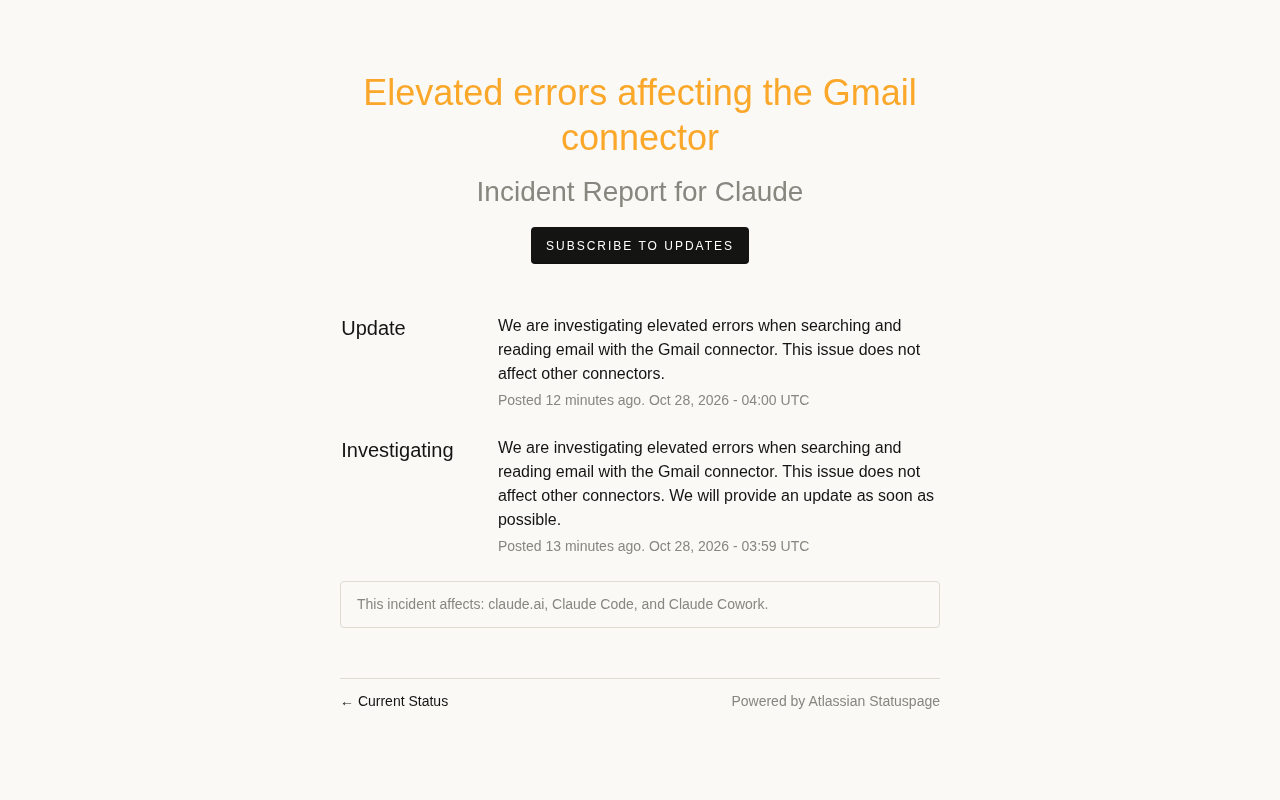
The official status page shows that the Gmail connector is experiencing an elevated error rate when searching and reading emails. The issue was marked as investigating at 03:59 UTC on October 28 and updated again one minute later, still in the investigation stage. The fault is confined to the Gmail connector itself; basic functions such as sending emails and account authentication, as well as other connectors, are unaffected, which provides clues for narrowing the troubleshooting scope. Since search and read are the highest-frequency operations in automation tools, customer service systems, and data pipelines, an elevated error rate will lead to increased task retries, message processing delays, and even trigger downstream alerts. The article recommends that developers design exponential backoff retries, local cache fallbacks, and error rate threshold alerts for connector failures, and continue to follow the official follow-up root cause analysis and fix progress.
Incident Overview
According to a status update from the RSS source, the Gmail connector is experiencing an elevated error rate when searching and reading emails. The official status page shows the issue was marked as "Investigating" at 03:59 UTC on October 28, then updated again at 04:00 to "Investigating" status, explicitly stating the issue does not affect other connectors. For users relying on the Gmail connector for email automation or data synchronization, this kind of connector-level anomaly can directly block workflows.
A connector is a core building block in iPaaS (Integration Platform as a Service) or automation platforms, responsible for establishing standardized data channels between the platform and external SaaS services. Taking the Gmail connector as an example, it encapsulates Google's OAuth authentication, Gmail API calls, pagination and rate-limiting handling, and other details, so that callers can complete search, read, send, and other operations without directly writing HTTP requests. Connectors typically divide capabilities by "action" granularity, such as search messages, get message, send message, with each action corresponding to a set of upstream API endpoints. Precisely because connectors are shared infrastructure, an anomaly in a single action will simultaneously affect all integrations that depend on that action, while other connectors in parallel (such as calendar, cloud drive) can remain independent because they call different upstream interfaces. Understanding this layering helps determine the fault boundary: whether the problem lies in the connector encapsulation layer or in the upstream Gmail API itself.
Scope and Impact
The official statement points out that errors are concentrated on the two operations "search and read emails," rather than the entire Gmail service being unavailable. This means basic functions such as sending emails or account authentication may still work normally, but any integration scenario that needs to pull email lists, search emails by keyword, or read email content may fail. Because the issue is confined to the Gmail connector itself, other connectors (such as calendar, cloud drive, etc.) are unaffected, which helps narrow down the troubleshooting scope.
For automation tools, customer service systems, or data pipelines using the Gmail connector, search and read are the highest-frequency operations. An elevated error rate may lead to increased task retries, message processing delays, and even trigger alerts in downstream systems. The fact that the official status was updated twice within a short period indicates the issue has been included in the priority handling process, but no root cause or fix timeline has yet been provided.
The Gmail API imposes quota limits on read-type operations based on project and user, measured in requests per minute and similar metrics, returning 429 or 403-type errors when exceeded. Searching and reading emails are precisely the endpoints that consume the most quota, so an "elevated error rate" may stem from temporary failures or rate limiting of the upstream API, or from the connector's own retry strategy amplifying traffic. In addition, Gmail's search relies on its indexing service, and returned results have eventual consistency delays; if the connector handles pagination and incremental synchronization improperly, it is easy to generate duplicate requests under high concurrency. These mechanisms explain why search and read are more likely to expose error rate issues before send, and also provide directions for troubleshooting: distinguishing whether it is quota exhaustion, upstream 5xx, or serialization and timeout configuration issues on the connector side.
Lessons for Connector Reliability
As the bridge between third-party services and platforms, a connector's stability often determines the success or failure of automation processes. This incident once again reminds developers that degradation or retry mechanisms should be reserved for connector failures in architecture design. For example, setting exponential backoff retries for email read operations, or falling back to local cache when search fails, are common mitigation measures. At the same time, monitoring connector error rate metrics and setting threshold alerts can help teams perceive anomalies before official status updates.
The official statement says updates will be provided as soon as possible, but does not disclose specific error counts or the proportion of affected users. In the absence of detailed data, users should pay attention to error logs in their own integrations, confirm whether they are related to the Gmail connector's search and read operations, and assess whether task scheduling strategies need to be temporarily adjusted.
Follow-up Points
At present, the incident is still in the investigation stage, and follow-up attention should be paid to whether the official side releases a root cause analysis and fix progress. For operations teams, promptly subscribing to status page updates and documenting connector failure emergency procedures in internal documentation are effective ways to reduce the impact of such incidents.
One-line Summary
Gmail connector search and read email error rate elevated, official investigation ongoing, other connectors unaffected.
Paragraph Summary
The official status page shows that the Gmail connector is experiencing an elevated error rate when searching and reading emails. The issue was marked as investigating at 03:59 UTC on October 28 and updated again one minute later, still in the investigation stage. The fault is confined to the Gmail connector itself; basic functions such as sending emails and account authentication, as well as other connectors, are unaffected, which provides clues for narrowing the troubleshooting scope. Since search and read are the highest-frequency operations in automation tools, customer service systems, and data pipelines, an elevated error rate will lead to increased task retries, message processing delays, and even trigger downstream alerts. The article recommends that developers design exponential backoff retries, local cache fallbacks, and error rate threshold alerts for connector failures, and continue to follow the official follow-up root cause analysis and fix progress.
Related articles

Gemini 4 Carbon Tops Global Rankings as AI Productivity and Open-Source Ecosystems Surge
Google DeepMind's Gemini 4 Carbon tops global benchmarks, built for complex agents and system security. ByteDance launches Doubao Work integrated with Feishu, Anthropic's AI autonomously breaches 5 system-level attack chains, and ModelBest and Fudan open-source on-device multimodal and image generation models.

Overseas Creator Breaks Down N8n AI Agent Business Playbook: From Tooling to Monetization
An overseas creator breaks down the N8n AI agent business playbook: comparing Zapier, Make, and N8n, detailing four monetizable automation categories—lead capture, WhatsApp follow-up, booking, and content pipelines—plus agency pricing and a sales playbook.

Empacer: The Voice-First AI Assistant for Small Business Owners That Topped Product Hunt
Empacer is a voice-first AI assistant for small business owners: three-question setup, voice requests turned into customer replies, social posts, and invoices—all owner-approved. It won #1 Product of the Day on Product Hunt with 231 upvotes and 47 comments.