Goodbye LLM Parsing Nightmares: How Decision 3.0 Handles Agent Routing
Decision 3.0 replaces text generation with probabilistic classification, revolutionizing Agent routing but lacking interpretability.
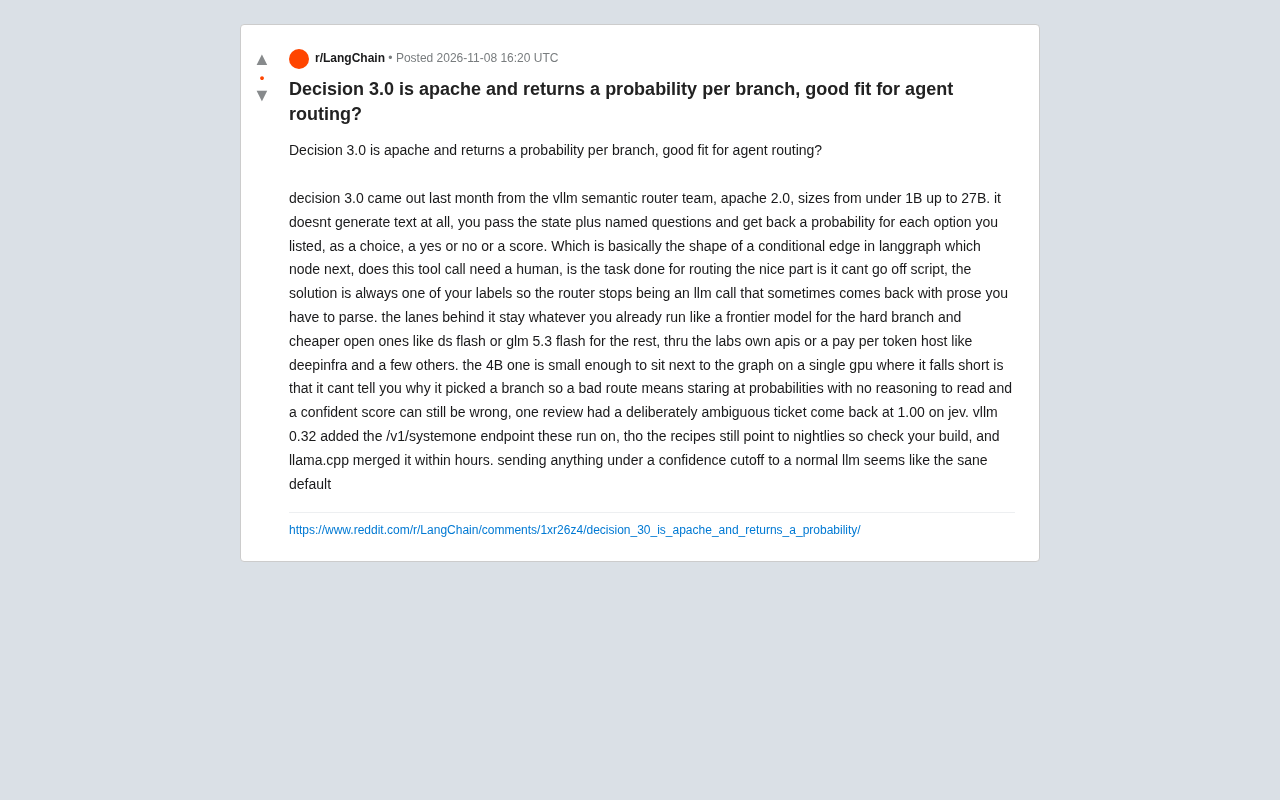
Decision 3.0 is an Agent routing model open-sourced by the vLLM semantic router team under Apache 2.0, with parameter sizes from under 1B to 27B. Its core design returns probability values for predefined labels rather than generating text, fundamentally solving the problem of unparseable traditional LLM routing outputs. Acting as a routing decision layer separate from the generation layer, its 4B version can be co-located with graph compute nodes on the same GPU to reduce latency. Its biggest weakness is the lack of interpretability—high confidence can still mean wrong decisions—so the community consensus is to set a confidence threshold and hand off low-confidence requests to a regular LLM as a fallback. vLLM and llama.cpp have added quick support, but deployment requires checking nightly build compatibility.
As Agent workflows become increasingly complex, a key question emerges: how should routing between nodes work? The traditional approach has an LLM output a piece of text, then uses regex or a JSON parser to extract the next step. This approach is not only fragile, but frequently produces unparseable output because the model goes off-script. Recently, the vLLM semantic router team released Decision 3.0, which attempts to fundamentally change this situation—according to Reddit community discussion, the model is open-sourced under the Apache 2.0 license, with parameter sizes ranging from under 1B to 27B.
Decision 3.0's Core Idea: No Text Generation, Only Probabilities
The most counterintuitive design of Decision 3.0 is that it generates no text at all. You pass in the current state and a set of named questions, and the model returns a probability value for each option. Options can be multiple-choice selections, yes/no judgments, or a score. This output format maps perfectly onto the typical needs of conditional edges in Agent frameworks—for example, deciding in LangGraph which node comes next, whether the current tool call requires human intervention, or whether the task is already complete.
This design brings a direct benefit: the model cannot "go off-topic." Because the solution space is always confined to your predefined label set, the routing step no longer requires parsing prose-style answers returned by the LLM. For developers long plagued by unstable output formats, this is almost a relief.
The difference between a probabilistic classifier and a generative model: Decision 3.0 is essentially a discriminative classifier, not a generative model. Generative models produce text token by token in an autoregressive manner, with the entire vocabulary as their output space; discriminative models directly model how well the input matches each candidate label, outputting a normalized probability distribution. This architectural difference determines that the former requires parsing and post-processing, while the latter naturally outputs structured results. Decision 3.0 turns the routing problem into a classification task of "given the context, which label is most likely," thereby sidestepping the inherent risk of generative models going off-script.
Architectural Positioning: Separation of the Routing Layer and the Generation Layer
Decision 3.0 does not replace your existing models. It is more of a routing decision layer, while the actual execution branches can still have frontier models handle difficult tasks and cheap open-source models (such as the ds flash or glm 5.3 flash mentioned by the community) handle the remaining paths. These downstream models can be called through official APIs, or through token-billed hosting platforms such as Deepinfra.
Interestingly, the smallest 4B version is small enough to be deployed on the same GPU as the graph compute nodes. This means routing decisions can achieve extremely low latency, without needing to make a remote LLM call for every routing decision.
LangGraph conditional edges: LangGraph is a graph framework for building stateful Agent workflows, where nodes represent computation steps and edges represent the direction of flow. A conditional edge is a dynamic routing mechanism that takes the current state and returns the name of the next node. In traditional implementations, a conditional edge typically calls an LLM and parses its text output to decide where to go. Decision 3.0's probability outputs can be directly mapped to the selection criterion for conditional edges—taking the highest-probability label as the next node, with no text parsing required. This integration turns routing logic from "prompt engineering" into "classification threshold configuration," significantly improving reliability.
Lack of Interpretability: High Probability Does Not Mean Correct Decision
Decision 3.0's biggest shortcoming is that it cannot explain the reason for its choice. When routing goes wrong, all you see is a set of probability values, with no reasoning process to investigate. What's trickier is that a high confidence score can also correspond to a wrong result—one evaluator mentioned that a deliberately ambiguous ticket returned a probability of 1.00 on the "jev" option. This means the model can make a wrong judgment with great confidence.
This leads to a practical consensus: set a confidence threshold, and hand off requests below the threshold to a regular LLM. Community members regard this as a reasonable default strategy—using the probabilistic model for clear-cut cases and leaving ambiguous scenarios to a model with reasoning capabilities as a fallback.
Confidence calibration: Whether a probabilistic model's output values are trustworthy depends on its calibration quality. A well-calibrated model, when it gives a probability of 0.9, means that among samples of that type, about 90% do indeed have the correct label. But neural network classifiers often exhibit overconfidence—still giving probabilities close to 1.0 for out-of-distribution or ambiguous inputs. The "jev option returning a 1.00 probability" mentioned in the article is a typical manifestation of overconfidence. In practice, this can be mitigated through temperature scaling or by introducing a reject option, but a fundamental solution still requires a threshold fallback strategy.
Ecosystem Support and Deployment Considerations
Decision 3.0 has been adopted remarkably quickly. vLLM version 0.32 added the /v1/systemone endpoint it requires, and llama.cpp merged support within hours. However, the community cautions that the relevant recipes currently still point to nightly builds, so you need to confirm that your build matches before deploying.
Overall Assessment: Good for Routing, but Not a Master Key
Based on discussion across multiple sources, the consensus value of Decision 3.0 lies in the paradigm shift from "LLM generation + parsing" to "probabilistic classification" for routing. For graph-structured workflows like LangGraph, it offers a routing solution with a closed output space and flexible deployment. But disagreements are equally clear: the lack of interpretability makes it unsuitable for scenarios that require auditing the basis of decisions, and the existence of high-confidence errors means a threshold fallback mechanism is almost mandatory.
If your Agent system is being tormented by routing parsing issues, Decision 3.0 is worth evaluating; but if your scenario requires understanding "why this path was chosen," it currently cannot provide an answer.
One-line Summary
Decision 3.0 replaces text generation with probabilistic classification, revolutionizing Agent routing but lacking interpretability.
Paragraph Summary
Decision 3.0 is an Agent routing model open-sourced by the vLLM semantic router team under the Apache 2.0 license, with parameter sizes ranging from under 1B to 27B. Its core design is not to generate text but to return probability values for predefined labels, fundamentally solving the problem of traditional LLM routing outputs being hard to parse. The model serves as a routing decision layer separate from the generation layer, and the 4B version can be deployed on the same GPU as graph compute nodes to reduce latency. Its biggest shortcoming is the lack of interpretability—high confidence can still correspond to wrong decisions—and the community consensus is to set a confidence threshold and hand off low-confidence requests to a regular LLM as a fallback. vLLM and llama.cpp have added rapid support, but deployment requires attention to nightly build compatibility.
Related articles

Microsoft WebIQ: Verifiable Real-Time Web Grounding for AI Agents
Microsoft WebIQ gives AI Agents real-time, citable web grounding across web, news, images, videos, and Places—164ms P95 latency, 50% fewer tokens, Scopes source control, and MCP integration.

Augmentable Gaussian Splatting: Building Photorealistic Simulation Environments for Robot Training
Team combines Gaussian Splatting with meshes to build photorealistic robot simulation environments, integrating MuJoCo Warp physics and Franka Panda for augmentable, relightable real-site simulation.

Gemini 4 Carbon Released: The Leap from Gemini 3 to Gemini 4 in Under a Year
Google releases Gemini 4 Carbon, less than a year after Gemini 3. In the official demo, Carbon reverse-engineered the Theme Park binary, added a new DeepMind-themed ride, and ported it to the web in one shot.