Google Calendar Connector Error Rates Spike: Troubleshooting Underway

Google Calendar Connector error rates have risen since October 26; official investigation is underway, and developers need to strengthen monitoring and degradation.
Google Calendar Connector has recently experienced elevated error rates, affecting requests to list or search calendar events, with the failure continuing since October 26. Google marked it as "Investigating" on its status page on October 28 and has not provided a fix timeline. This may cause intermittent failures in third-party applications and automation workflows that rely on calendar synchronization, leading to issues such as missed meetings and delayed reminders. The article recommends that developers strengthen failure monitoring, optimize retry logic, and enable cached or alternative data sources, while emphasizing the importance of designing circuit breaker and graceful degradation mechanisms for critical external dependencies. Users should follow the Google Workspace status page for further updates.
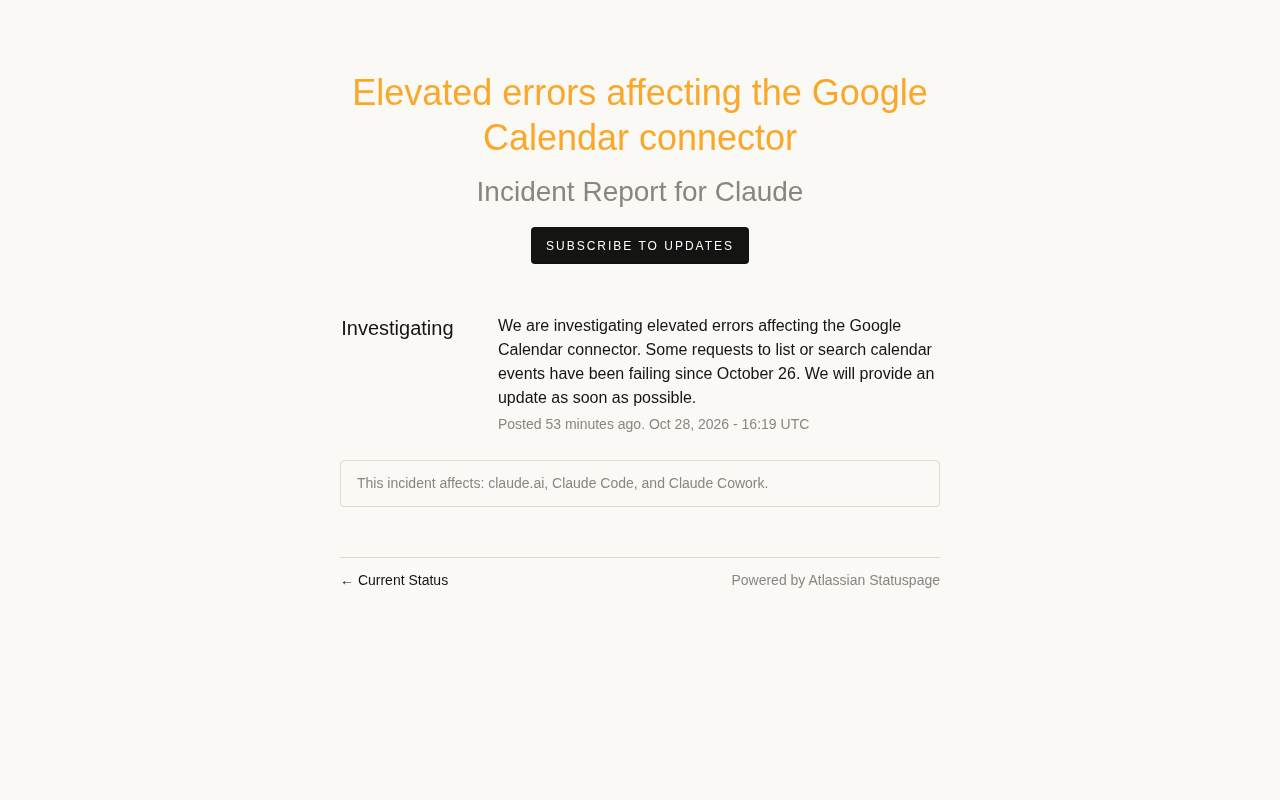
The Google Calendar Connector has recently experienced elevated error rates, affecting some users' normal access to calendar events. According to an official status page announcement, since October 26, some requests to list or search calendar events have been failing, and the team is currently investigating the cause.
Fault Symptoms and Scope of Impact
The announcement indicates that errors mainly occur in "listing or searching calendar events" operations. This means third-party applications or automation workflows that rely on the Google Calendar Connector for schedule synchronization and event retrieval may encounter intermittent failures.
Although the announcement does not specify the exact percentage of affected users, the phrase "elevated errors" indicates that the error rate is significantly higher than the normal baseline. For teams integrating calendar data into their workflows, such failures may lead to cascading issues such as missed meeting arrangements and delayed reminders.
Connector in this context refers to the integration component between third-party platforms (such as automation tools and calendar synchronization applications) and the Google Calendar service. It typically encapsulates OAuth authorization, API calls, data transformation, and other logic, enabling non-technical users to read and write calendar events in a no-code environment. Connector errors often mean that the underlying API requests fail or responses time out, but error messages may be simplified by the upper-layer platform. Therefore, troubleshooting requires combining Google's official status page with the connector's own logs.
Elevated errors is a common term in service status monitoring, referring to an error rate (such as the proportion of HTTP 5xx responses) that is significantly higher than the normal baseline but has not yet reached a full outage. It typically corresponds to a violation of the SLO (Service Level Objective), meaning some requests may succeed while others fail, manifesting as intermittent failures. For applications that depend on the service, this "partial degradation" state is more insidious than a complete outage because retries may occasionally succeed, masking systemic problems.
Official Response and Timeline
Google posted a status update at 16:19 UTC on October 28, marking the incident as "Investigating." The announcement mentioned that errors have occurred since October 26, and the team is analyzing the root cause and promises to provide further information as soon as possible.
This standard status page response process typically includes: confirming the problem, identifying the cause, implementing a fix, and monitoring recovery. It is currently still in the first stage, with no estimated time to resolution.
Potential Impact on Developers
For developers using the Google Calendar API or relying on the connector, elevated error rates may trigger retry logic or degradation strategies within their applications. It is recommended to increase monitoring of calendar request failures during the outage and consider temporarily enabling cached data or alternative data sources.
At the same time, this incident also reminds us that the availability of third-party services directly affects the stability of integrated applications. When designing systems, setting up circuit breaker mechanisms and graceful degradation solutions for critical external dependencies is an effective way to reduce the impact of such failures.
Circuit Breaker is a resilience design pattern for handling dependency service failures. When the failure rate of requests to an external service (such as the Google Calendar API) exceeds a threshold, the circuit breaker "trips" and directly rejects subsequent requests for a set period, avoiding resource exhaustion and cascading failures. It then enters a half-open state, allowing a small number of probe requests; if successful, it recovers. Combined with Graceful Degradation, the system can return cached data or a read-only view when the calendar service is unavailable, ensuring core functionality remains available.
Key Follow-up Points
Users can follow the Google Workspace status page for the latest updates. Once the official fix or mitigation measures are released, the affected functionality should gradually recover. For enterprise users, it is recommended to share this information with internal IT teams and assess the impact on business continuity.
The specific cause of this failure has not yet been announced, and whether it is related to recent infrastructure changes remains to be confirmed by official conclusions. We will continue to track the incident's progress.
One-line Summary
Google Calendar Connector error rates have risen since October 26; official investigation is underway, and developers need to strengthen monitoring and degradation.
Paragraph Summary
Google Calendar Connector has recently experienced elevated error rates, affecting requests to list or search calendar events, with the failure continuing since October 26. Google marked it as "Investigating" on its status page on October 28 and has not provided a fix timeline. This may cause intermittent failures in third-party applications and automation workflows that rely on calendar synchronization, leading to issues such as missed meetings and delayed reminders. The article recommends that developers strengthen failure monitoring, optimize retry logic, and enable cached or alternative data sources, while emphasizing the importance of designing circuit breaker and graceful degradation mechanisms for critical external dependencies. Users should follow the Google Workspace status page for further updates.
Related articles

Why Does Self-Play AI Always Get Crushed by Cheap Units? An RTS Developer's Account of the Dilemma
An independent developer trained an RTS commander AI with pure self-play, only to find it dominated historical versions but was crushed by human players using cheap tier-1 units. This article analyzes the causes of self-play strategy collapse, explores solutions such as exploiters, diversity rewards, and reward design, and introduces the open Bot Kit and AI league plan.
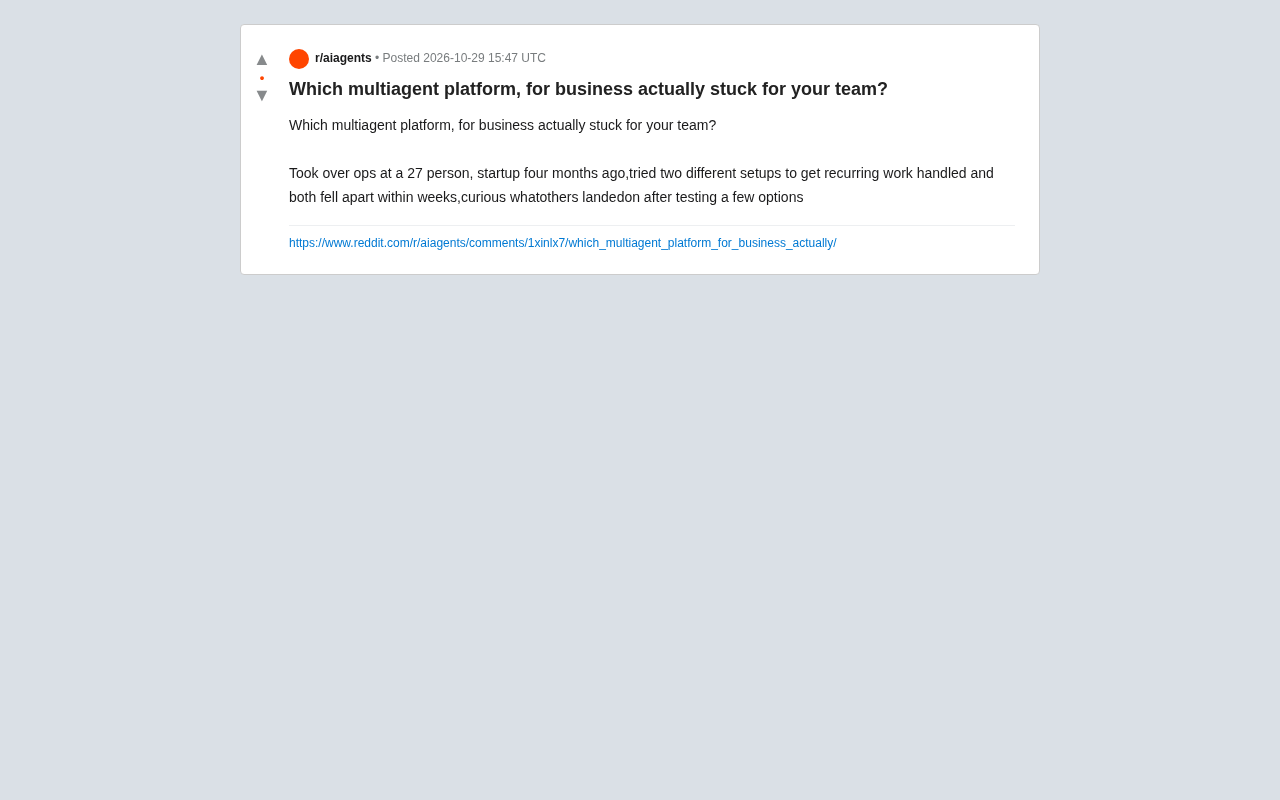
Which Multi-Agent Platform Wins? A Small Team's Battle Scars and Selection Considerations
A 27-person startup's ops lead tried two multi-agent platforms in four months and both failed. This article analyzes why small-team deployments break down, and offers selection guidance on integration depth, observability, and progressive rollout.

Thrive Holdings Takes ADT Private in $7.6 Billion Deal
Thrive Holdings acquires ADT for $7.6 billion in an all-cash take-private deal expected to close in Q1 2027. Analysis of the deal structure, ADT's asset value, and impact on the smart home security industry.