Google Gemini Omni 1.2 Flash and OpenAI GPT-6 Cyber Lead AI Morning Digest

Google, OpenAI, Ant Group and others release video, security, and multimodal models; METR warns AI R&D acceleration may be self-reinforcing.
This AI morning digest covers multiple developments: Google releases Gemini Omni 1.2 Flash video generation model with native support for up to 15-second videos, multi-turn conversational editing, and a 30% price cut to $0.07 per second at 720p; OpenAI launches GPT-6 Cyber, a security-specific model scoring 48.5% on Exploit Gym, reproducing 1,724 Linux kernel vulnerabilities and finding 81 unknown high-severity flaws in Firefox; DeepSickHarness reaches 1.54 million DAU with 34,900 third-party plugins; AntLyn releases the 560-billion-parameter Lyn 3.2 Flash multimodal model, leading on several benchmarks. METR assesses that Anthropic's model capability improvement is about twice as fast as before, though key evidence in the public report was redacted; OpenAI publishes a compute campus policy blueprint, and Anthropic tests personal finance features in the U.S.
Today's AI Brief: Video Generation, Cybersecurity, and Community Ecosystem Advance Together
This AI morning digest brings several major announcements: Google releases the video generation model Gemini Omni 1.2 Flash; OpenAI launches GPT-6 Cyber, a model purpose-built for cybersecurity; DeepSickHarness publishes the latest community data; Ant Group's AntLyn releases the multimodal model Lyn 3.2 Flash; METR provides an independent assessment of how quickly Anthropic's model capabilities are improving; and OpenAI unveils a policy blueprint for compute campuses.
Google Gemini Omni 1.2 Flash: Video Generation Evolves Again
Google has released the Gemini Omni 1.2 Flash video generation model. According to the company, the new version natively supports videos up to 15 seconds long and allows durations to be specified second by second from 3 to 15 seconds. It performs better on consistency of characters, products, and scenes, and supports multi-turn conversational editing—changing backgrounds, swapping products, or adjusting lighting without starting over from scratch.
On pricing, it is 30% cheaper than the previous generation, at $0.07 per second for 720p video. The model is now generally available in the Gemini API and Google Cloud.
What It Means for Developers
Lower pricing and conversational editing further lower the barrier to video generation, making it especially suitable for e-commerce, advertising, and other scenarios that require rapid iteration on visual content. Multi-turn editing also reduces the cost of repeated generation.
OpenAI GPT-6 Cyber: Built for Cybersecurity
OpenAI has released GPT-6 Cyber, a model purpose-built for cybersecurity. The company calls it a major leap in security research. The model can discover and verify exploitable vulnerabilities and adheres more reliably than the previous generation to the authorization scope set by researchers. It is initially available via API and Codex to a small number of approved Daybreak Red customers.
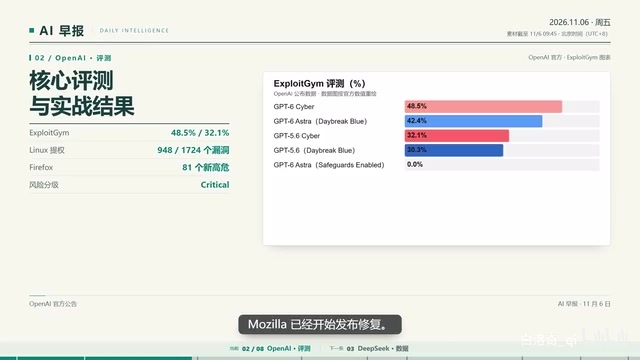
On Exploit Gym, which tests vulnerability exploitation capabilities, GPT-6 Cyber scored 48.5%, about 16 percentage points higher than the 32.1% of GPT-5 and GPT-6 Cyber. The company also says it reproduced 1,724 Linux kernel vulnerabilities, developed working privilege-escalation exploits for 948 of them, and discovered 81 previously unknown high-severity vulnerabilities in Firefox, for which Mozilla has already begun releasing fixes.
Balancing Security and Ethics
GPT-6 Cyber's scope-adherence mechanism is noteworthy: it shows that while OpenAI is improving offensive security capabilities, it is also trying to control the boundaries of model use. However, stronger exploitation capabilities are a double-edged sword, and ensuring such models are not misused will be a long-term challenge.
Exploit Gym and the Concept of Scope
Exploit Gym is a class of benchmarks specifically designed to evaluate the "offensive security capabilities" of large models. The core idea is to have a model attempt, in a controlled sandbox environment, to turn discovered security flaws into actual exploitable attack paths—such as privilege escalation or remote code execution. It measures not whether the model can name a vulnerability, but whether it can complete the end-to-end loop from discovery to verification, so scores are typically much lower than on conventional code benchmarks.
"Scope adherence" corresponds to the concept of scope in penetration testing: real red-team engagements explicitly define the assets that may be tested, the time window, and prohibited actions (such as not touching production databases). For a model, this requires it to stay within bounds across multi-turn tool calls—neither scanning unauthorized targets nor executing destructive commands. This capability is regarded as a prerequisite for security-specific models to enter enterprise environments, and it is a compliance selling point that vendors emphasize when releasing such models.
DeepSickHarness Community Data: 1.54 Million DAU, Plugin Ecosystem Expands
DeepSickHarness has published its latest community data. As of November 4, daily active users reached 1.54 million, up 545% from the desktop launch; monthly active users reached 5.48 million; and average daily token consumption was 92.1 trillion, up 306% from the desktop launch.
The plugin ecosystem is also expanding, with 34,900 public third-party plugins—29,400 on GitHub and 18,500 on NPM (note: the original figures may overlap). 58.94% of users have created or used a custom plugin. The company highlighted four community plugins: self-media creation, design, context insights, and paper reading, and said it will improve plugin API stability and security mechanisms.
Ant Group's AntLyn Releases Lyn 3.2 Flash Multimodal Model
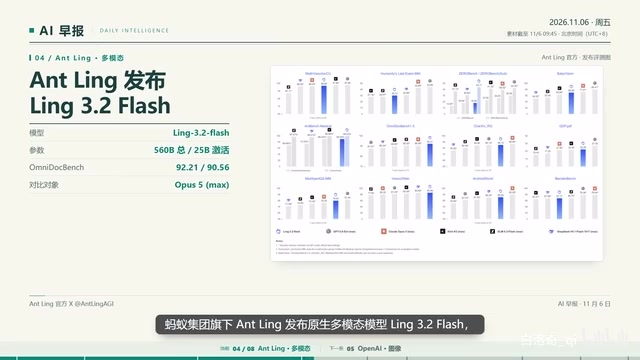
AntLyn, under Ant Group, has released the natively multimodal model Lyn 3.2 Flash, with 560 billion total parameters and 25 billion activated per token. The company says it is stronger in complex visual understanding, long-horizon multimodal agents, 3D understanding, and medical intelligence.
In the release evaluations, it scored 92.21 on Omnidog Bench 1-5, higher than Opus 5's 90.56; it also led on ZeroBench and Vision2Web.
Multimodal Competition Intensifies
The release of Lyn 3.2 Flash shows that domestic vendors continue to push in the multimodal large model space, and their differentiated capabilities in vertical scenarios such as healthcare and 3D understanding are worth watching.
Total Parameters and Activated Parameters (MoE Sparse Architecture)
"560 billion total parameters, 25 billion activated per token" describes typical metrics of a mixture-of-experts (MoE) architecture. An MoE model consists of many expert subnetworks plus a routing network; on each forward pass, the router selects only a few experts for each token, so "total parameters" represents model capacity and knowledge storage, while "activated parameters" represents the actual computation per inference.
The value of this design is that it decouples capacity from cost: the model can be scaled to a very large total parameter count to improve understanding and generalization, while inference overhead depends only on activated parameters, close to that of a 25-billion-parameter dense model. This is why recent multimodal models commonly adopt MoE—visual tokens far outnumber text tokens, and the inference cost of dense architectures becomes unsustainable. However, MoE places higher demands on memory usage, load balancing, and inference frameworks, so the deployment barrier is not low.
OpenAI Image Generation Surges; METR Assesses Anthropic's Rate of Progress
OpenAI's Teebo said that ChatGPT and the API now generate more than 32,000 plugins per week (note: as in the original text, likely a typo—possibly more than 320 million images per week? But the original explicitly says "32,000 plugins," so the original wording is retained here). Teebo also said that OpenAI now generates more than 4 billion images per week, up from more than 3 billion per week just 8 weeks earlier—equivalent to more than 500 million per day. The post cited the release of ChatGPT Images 2.6.
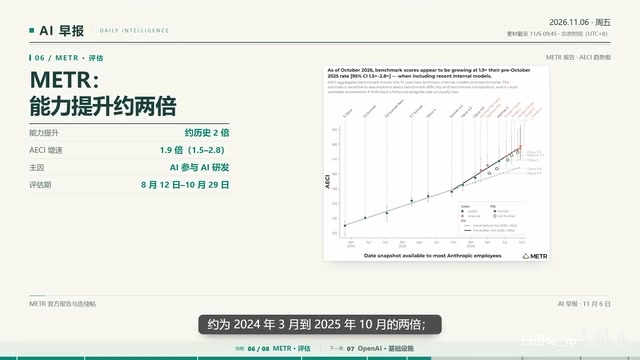
METR published an independent assessment of Anthropic, saying its models' capability on well-defined tasks is improving about twice as fast as from March 2024 to October 2025. The AECI benchmark score has grown since October 2025 at 1.9 times the previous rate. METR believes most of the current acceleration is likely driven by AI participating in AI R&D, and it sees no clear bottlenecks or obvious diminishing returns. METR also said it submitted a full report of about 100 pages to Anthropic, but most of the important evidence in the public version was redacted by Anthropic, leaving the public to rely more on METR's judgment. Community account Lumina said Anthropic's internal model Model 4 scored above 90 on multiple METR benchmarks.
What Are METR and the AECI Benchmark?
METR (Model Evaluation & Threat Research) is an independent nonprofit evaluation organization that externally measures large model capabilities as a "third-party assessor," with a methodology emphasizing reproducible task sets and public evaluation protocols. One of its best-known efforts is measuring how long a human task a model can complete independently (task-horizon), using this to judge capability progress.
AECI is a type of composite capability index benchmark used by METR that aggregates scores on multiple well-defined tasks into a single number, making it easier to observe the slope of change over time. Statements like "twice the rate of improvement" refer to changes in the slope of that score over time, not the absolute value of a single score. It is worth noting that such indices are sensitive to task selection, and when the evaluated party has the right to redact report content, external verifiability drops markedly; METR therefore emphasizes that redaction of evidence in the public version weakens the independent value of the assessment.
OpenAI Compute Campus Policy Blueprint and Anthropic Personal Finance Test
OpenAI released a national community compact and a policy blueprint for compute campuses, pledging that future self-built and self-operated compute campuses will fully bear electricity and infrastructure costs, publicly report water, electricity, and noise data, refrain from signing confidentiality agreements with public officials except for a few security and trade-secret exceptions, and publish local employment and training plans. OpenAI also recommends that states require large electricity customers to bear the cost of new grid capacity.
Anthropic launched a personal finance beta for Cloud in the U.S., available to Pro, Max, and Ultra subscribers. Users can connect bank and credit card accounts via Plaid, and Cloud answers questions about balances, spending, and bills in everyday language. Access is read-only; Cloud cannot transfer, manage, or invest funds, and does not provide investment advice.

The Grid Cost Allocation Debate Around Compute Campuses
A single large AI data center can draw hundreds of megawatts, and connecting to the grid often requires new transmission lines, substations, or even peaking power plants. Who bears these "new grid costs" is a central regulatory debate in U.S. states today. Traditionally, some costs are spread across all residential electricity rates, while OpenAI's recommendation that states require large electricity customers to bear new costs themselves essentially advocates an interconnection principle of "causer pays."
The accompanying public water, electricity, and noise reports correspond to the actual impact of data centers on local water resources (cooling water consumption) and community environments. The pledge not to sign confidentiality agreements with public officials responds to criticism that the approval process for compute projects lacks transparency. Such policy blueprints are not legally binding, but they influence state legislation and public utility commission rate design, and they are a common way for AI companies to engage early in the regulatory agenda.
Conclusion
From video generation to cybersecurity, from multimodal models to community ecosystems, competition in AI is shifting from single capabilities to comprehensive ecosystems and policy participation. Google and OpenAI have launched specialized models in their respective tracks, while DeepSickHarness and AntLyn demonstrate progress in community and multimodality. METR's assessment also reminds us that the acceleration of AI R&D may be forming a self-reinforcing loop.
Related articles
 Tech Frontiers
MuJoCo: An Analysis of DeepMind's Open-Source General-Purpose Physics Simulator
An in-depth analysis of Google DeepMind's open-source physics simulator MuJoCo: high-performance C++ kernel, MJCF modeling format, contact solving principles, MJX GPU acceleration, and robot reinforcement learning use cases.
 Tech Frontiers
Claude API Quick Start: The Official Quickstarts Project Collection
Anthropic's official claude-quickstarts project collection helps developers quickly build deployable apps with the Claude API. Nearly 20k stars, Python-based, great for beginners and prototyping.
 Tech Frontiers
AI Agents Connecting Directly to APIs: Which Calls Can Be Safely Allowed?
AI agents can call any API, but the real challenge is deciding which calls can be safely allowed. This article analyzes allowance decisions from three dimensions—intent matching, least privilege, and controllable impact—and argues that the control layer should sit outside the agent, combined with audit traceability to build a trustworthy API call governance mechanism.