Google Omni 1.2 Flash: 15-Second AI Video at Just $0.07 per Second

Google Gemini Omni 1.2 Flash is now GA: 30% cheaper, supports multi-turn editing, pushing AI video toward production use.
Google DeepMind officially released Gemini Omni 1.2 Flash, upgrading duration, cost, and controllability together: clips extend from 10 to 15 seconds, 720p cost drops to $0.07/sec (about 30% cheaper than the previous generation). Its most engineering-valuable feature is multi-turn editing without regenerating the whole video, plus improved character/style consistency, lip sync, and camera smoothness. It also supports 360p/720p draft generation upscaled to 1080p or 4K, forming a tiered workflow of low-cost drafts and high-cost finals. Now available in the Gemini API, Google Cloud, and tools like Flow and Vids. The article argues this marks AI video competition shifting from "can it generate" toward cost and editing experience, though 15-second duration and 720p pricing still limit its main scenarios to ad assets, product demos, and social short video.
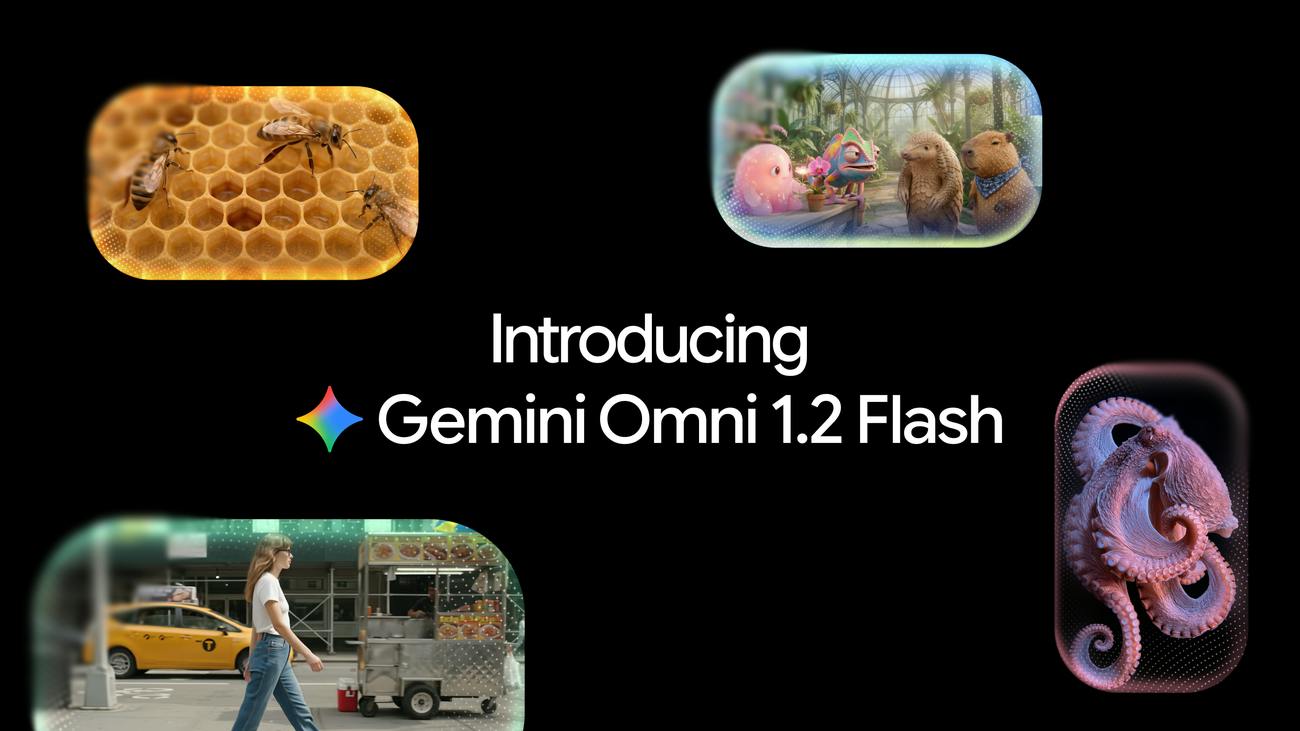
Google DeepMind's video generation and editing model, Gemini Omni 1.2 Flash, is now officially generally available (GA). Compared with the previous generation, it advances on three dimensions simultaneously: duration, cost, and controllability. A single clip extends from 10 to 15 seconds, generation cost at 720p drops to $0.07 per second—about 30% cheaper than Omni 1.1. Taken together, these numbers don't point to "yet another video model" but to a cost inflection point where AI video moves from demo to production tool.
The cost curve: what a 30% drop means
At $0.07 per second, a 15-second 720p video costs just over $1 directly. For marketing assets, e-commerce showcases, and social short-video scenarios that require batch output, this price point has entered the range where you can "casually try a few more takes."
The price cut is presumably driven by the Flash series' consistent inference-efficiency approach rather than pure subsidy. Officially positioned as the lightweight, high-speed tier in the Gemini family, it divides labor with Pro-grade models: Flash handles rapid iteration and draft generation, while high-resolution final cuts go to subsequent stages. For developers, this means the trial-and-error cost of video generation is pushed down to near that of text generation, and workflow design will change accordingly—generate many candidates first, then select and refine, rather than burning money to get it right in one shot.
The division of labor between the Flash series and Pro-grade models is the backdrop for understanding this pricing strategy. In the Gemini model family, Flash is positioned as the lightweight, high-speed tier, using techniques such as model distillation and inference optimization to substantially compress per-inference cost while maintaining usable quality; Pro-grade models pursue higher generation quality and detail. This "fast and slow dual-tier" product structure is not unique to video—it has precedents in text and image modalities. For video generation, the significance of the Flash tier is maximizing output per unit of compute, making batch draft generation economically viable, while final-cut quality can be filled in through subsequent upscaling or switching to a higher-tier model.
Multi-turn editing: modify without regenerating
The most engineering-valuable part of this update is support for multi-turn editing without regenerating the entire video. With past video models, changing a line of dialogue or a camera angle often required rerunning the whole segment—costly and disruptive to continuity. Omni 1.2 Flash instead makes incremental modifications on existing results, bringing video editing closer to "editing" than "gacha pulls" for the first time.
Supporting stability improvements include character and style consistency, more accurate lip sync, and smoother camera movement. These three map exactly to the most criticized visual issues in AI video: identity flicker, style drift, mismatched lip sync, and shaky camera. Multi-turn editing plus consistency improvements together form the precondition for usability—otherwise every edit introduces new inconsistencies and the editing feature is essentially useless.
Multi-turn editing technically relies on making local modifications to the latent representation of an already-generated video rather than resampling from noise. Traditional text-to-video treats every prompt change as a completely new generation, making character identity, lighting, and background hard to align across frames; incremental editing preserves the structural information of the original video and only makes targeted adjustments to target regions or attributes. This places higher demands on model controllability: precise spatiotemporal localization and seamless blending between modified and unmodified regions. Improvements in character consistency and lip sync are precisely the preconditions for this editing paradigm to hold.
From draft to 4K: a tiered-resolution workflow
The model supports generating drafts at 360p or 720p first, then upscaling to 1080p or 4K. This brings the image-domain idea of "low-resolution drafts, high-resolution finals" to video, essentially spending compute on shots you're sure to keep.
For team collaboration, this tiering has another meaning: the draft stage can align on creative direction at extremely low cost, and only after confirmation do you spend more on the final cut. Compared with generating high resolution in one shot and starting over when unsatisfied, the overall budget is easier to control.
Video super-resolution is the key step in upscaling low-resolution drafts to 1080p or 4K. Unlike image super-resolution, video super-resolution must also ensure temporal consistency across frames; otherwise upscaling tends to produce artifacts such as flicker and edge jitter. A common approach combines diffusion model priors with optical flow or temporal attention mechanisms to enhance detail while constraining coherence between adjacent frames. This is exactly where the cost advantage of the tiered workflow comes from: the draft stage completes creative screening at 360p/720p, and only shots confirmed to be kept enter the high-resolution upscaling stage, concentrating expensive compute on final cuts.
Access channels and applicability assessment
Omni 1.2 Flash is now available in the Gemini API, Google Cloud, and Google's own creation tools such as Flow and Vids. For developers, the API and Cloud mean it can be embedded in their own products; for content teams, Flow and Vids provide out-of-the-box entry points. The parallel multi-channel rollout shows Google is betting on both B2B integration and C-end creation paths.
What needs to be viewed soberly: 15 seconds is still short-clip territory, with an obvious distance from long-form narrative; $0.07 per second is the 720p price, and costs rise at higher resolutions. But in scenarios dominated by short clips—advertising assets, product demos, social media content—the combination of cost and editing capability already meets practical deployment conditions. The real signal from Omni 1.2 Flash is this: the center of gravity in AI video competition is shifting from "can it generate" to "is it cheap to generate, and is it smooth to edit."
Frequently Asked Questions
What is Omni 1.2 Flash? Google DeepMind's video generation and editing model, the latest lightweight version of the Gemini Omni series, now officially available.
What is the generation cost? $0.07 per second at 720p, about 30% lower than Omni 1.1.
How long a video does it support? Up to 15 seconds per clip, versus 10 seconds for the previous generation.
Can resolution be increased afterward? Yes—generate a draft at 360p or 720p first, then upscale to 1080p or 4K.
Where can I use it? The Gemini API, Google Cloud, and the Flow and Vids creation tools.
One-line Summary
Google Gemini Omni 1.2 Flash is now available, 30% cheaper with multi-turn editing, pushing AI video toward a production tool.
Paragraph Summary
Google DeepMind has officially released Gemini Omni 1.2 Flash, upgrading duration, cost, and controllability in sync: single clips extend from 10 to 15 seconds, 720p generation cost drops to $0.07 per second—about 30% lower than the previous generation. Most engineering-valuable is multi-turn editing without full regeneration, plus improved character and style consistency, lip sync, and camera smoothness. The model also supports generating 360p/720p drafts and upscaling to 1080p or 4K, forming a tiered workflow of low-cost drafts and high-cost finals. It is now integrated into the Gemini API, Google Cloud, and tools such as Flow and Vids. The article argues this marks a shift in AI video competition from "can it generate" toward cost and editing experience, though the 15-second duration and 720p price point still limit its main scenarios to advertising assets, product demos, and social short video.
Related articles
 Tech Frontiers
No AI Ghostwriting: Writer's Quarter Reinvents Novel Writing with a Visual Workbench
The Writer's Quarter is an AI-free novel writing and planning tool that unifies character building, story planning, and manuscript writing in one visual workbench. This article analyzes its positioning, target users, and differentiated value amid the rise of AI writing tools.
 Tech Frontiers
Fleeep: A Unified Inspiration Collection Notes App for Creatives
Fleeep is a notes app for creatives that unifies screenshots, bookmarks, saved posts, and inspiration into one calm, cross-device, offline-capable space. This article analyzes its positioning, differentiation, and target users.
 Tech Frontiers
Rex Beta: The All-in-One Terminal Multiplexer from the Creator of Ghostty
Rex (Beta) is a terminal multiplexer by Mitchell Hashimoto, creator of Ghostty and Echo, featuring native macOS/iOS apps, web access, and multiplayer collaboration—earning 71 votes on Product Hunt. This article analyzes its positioning and Beta-stage signals.