Google Opens Up Gemini and Search: AI Agents Reshape the App Ecosystem
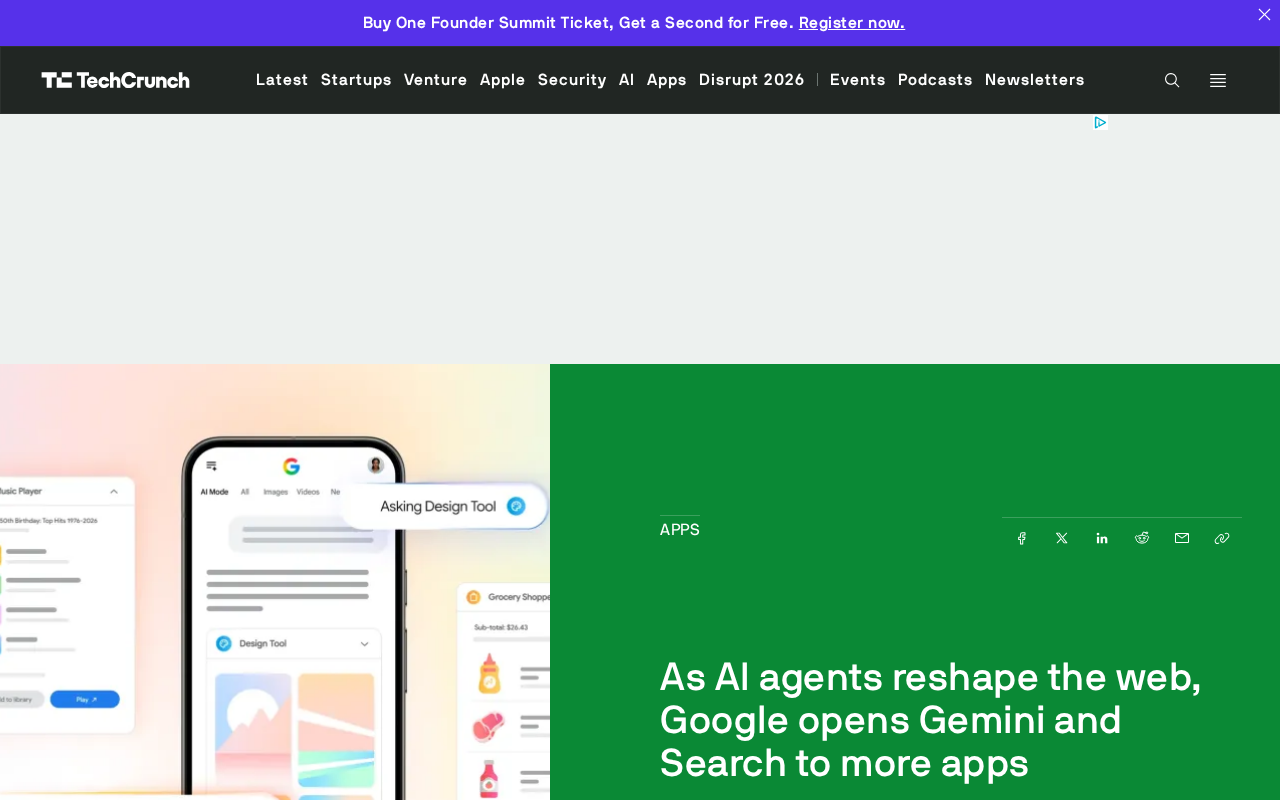
Google opens Gemini and Search to third-party services, making AI agents the new distribution entry point.
Google plans to launch a developer platform allowing businesses to integrate services into Gemini and Search, signaling that AI agents are becoming new service distribution entry points. User interaction is shifting from downloading apps to expressing needs in natural language, with agents calling backend services. This weakens standalone app entry value, elevates service quality and agent-callable capability, and introduces new competition around platform rules and ranking, while challenges remain in reliability, privacy, integration costs, and fairness.
Google is driving an ecosystem shift centered on AI agents. According to foreign media reports, Google will launch a new developer platform that allows businesses to integrate their services into Google's AI experiences, especially Gemini and Search. Behind this move is the fact that AI agents are reshaping how users discover and use applications.
From Apps to Agents: The Migration of Interaction Entry Points
Traditionally, users download apps through app stores and then complete tasks within the apps. The rise of AI agents allows users to express their needs directly in natural language, with agents calling backend services to complete tasks. By opening Gemini and Search to more applications, Google is essentially turning the search box and AI assistant into new service distribution entry points.
For businesses, this means they no longer rely solely on standalone apps to acquire users; instead, they can reach consumers directly through Google's AI interfaces. The report notes that this may change how consumers discover and use applications—from "finding an app" to "stating a need."
An AI agent is a software system capable of perceiving its environment, planning autonomously, and invoking tools or services to accomplish user goals. Unlike traditional chatbots, agents do more than generate text: they can break down tasks, select external APIs, execute multi-step operations, and return results. Key technologies include function calling, planning and memory mechanisms, and the emerging inter-agent communication protocols. By opening Gemini and Search to third-party services, Google is essentially providing agents with a callable "tool library" so that agents can directly complete tasks such as booking tickets, shopping, and querying within a conversation, rather than merely returning links.
The Role of the Developer Platform
The new developer platform is the key vehicle for this strategy. It allows businesses to integrate their services into Google's AI experiences in some form, possibly through APIs, plugins, or agent protocols. Although specific technical details have not been fully disclosed, the direction is clear: Google wants to make Gemini an extensible AI hub, with Search serving as the discovery layer.
This approach aligns with industry trends. AI agents need to call external services to complete complex tasks, and platforms aggregate service supply by opening interfaces. With the massive user bases of Search and Gemini, Google is well positioned to occupy a favorable position in the agent ecosystem.
Plugins and agent protocols are two common forms of integration. Plugins typically declare service capabilities through standardized description files, allowing large models to call them automatically when needed; agent protocols (such as MCP) define communication specifications between agents and external services, enabling interoperability among agents and services from different sources. Google may require developers to provide structured service descriptions, authentication methods, and invocation interfaces, with the platform routing based on user intent. For developers, this means maintaining an additional AI-facing interface layer and ensuring that services can reliably complete transactions without human interface intervention.
Potential Impact on the App Ecosystem
If this platform is successfully implemented, the logic of app distribution may undergo profound changes. The entry-point value of standalone apps may be weakened, while the quality of services themselves and their ability to be invoked by agents will become more important. Developers need to consider how to make their services "discovered" and "invoked" in AI conversations.
At the same time, this introduces new dimensions of competition: whoever's services are more easily integrated by AI agents may gain more exposure. As the platform operator, Google's rules and ranking mechanisms will directly affect developers' interests.
"Agent-callable capability" refers to whether a service can expose its functions, parameters, and permissions in a machine-readable way and support agents in automatically completing end-to-end processes. This includes clear API documentation, structured data, authentication mechanisms such as OAuth, and interpretable returns for errors and exceptions. In AI chat interfaces, the way services are discovered shifts from app store rankings to agent intent matching and platform ranking. Developers need to optimize service descriptions and response quality to increase the probability of being selected by agents, which is akin to an extension of traditional search engine optimization (SEO) toward "agent optimization."
Challenges and Uncertainties
Although the direction is clear, the plan still faces challenges. The reliability of AI agents, privacy and security, and the cost and complexity of developer integration are all issues that need to be addressed. In addition, how Google balances the position of its own services versus third-party applications in AI experiences will also affect the fairness of the ecosystem.
At present, the news is still at an early stage, and specific platform capabilities, integration methods, and timelines remain unclear. But what is certain is that AI agents are becoming a new battleground for tech giants, and Google's opening move is an important signal of this trend.
One-line Summary
Google will open Gemini and Search to third-party services, driving AI agents to become new distribution entry points.
Paragraph Summary
Google plans to launch a developer platform that allows businesses to integrate their services into Gemini and Search, marking AI agents as new service distribution entry points. The article notes that user interaction is shifting from "downloading an app and operating within it" to "expressing needs in natural language, with agents calling backend services," making the search box and AI assistant new traffic entry points. The developer platform is the vehicle for this strategy, potentially integrating services through APIs, plugins, or agent protocols, making Gemini an extensible AI hub. This change will weaken the entry-point value of standalone apps, make service quality and agent-callable capability more important, and introduce new competitive dimensions around platform rules and ranking mechanisms. The plan still faces challenges regarding reliability, privacy, integration costs, and ecosystem fairness.
Related articles
Gemini 4 Carbon Hands-On: The Strongest AI Model? Compared with Claude Opus 5.5
Google's Gemini 4 Carbon tops the Artificial Analysis leaderboard with 71% on CW Bench and leads Vending Bench. Hands-on comparison with Claude Opus 5.5: stunning front-end design but slightly behind in web development, with a clear price advantage.

Gemini 4 Carbon Tops Global Rankings as AI Productivity and Open-Source Ecosystems Surge
Google DeepMind's Gemini 4 Carbon tops global benchmarks, built for complex agents and system security. ByteDance launches Doubao Work integrated with Feishu, Anthropic's AI autonomously breaches 5 system-level attack chains, and ModelBest and Fudan open-source on-device multimodal and image generation models.

Overseas Creator Breaks Down N8n AI Agent Business Playbook: From Tooling to Monetization
An overseas creator breaks down the N8n AI agent business playbook: comparing Zapier, Make, and N8n, detailing four monetizable automation categories—lead capture, WhatsApp follow-up, booking, and content pipelines—plus agency pricing and a sales playbook.